El Aguila Wreck
16.3275°N 86.5790°W · wreck
El Aguila Wreck
A 75-meter cargo vessel deliberately sunk off Roatán’s west coast in 1997, now one of the Bay Islands’ most visited wrecks and broken into three sections by Hurricane Mitch.
Overview
The El Aguila (Spanish for “The Eagle”) is a 75-meter (230-foot) cargo vessel that was deliberately scuttled near Sandy Bay, on the northwest coast of Roatán, in 1997 to serve as an artificial reef and dive attraction. The vessel originally sank off Utila while carrying concrete from Puerto Cortes to Haiti, was salvaged, and eventually purchased and purposefully sunk by Anthony’s Key Resort as a replacement for deteriorating wooden-hulled wrecks. Hurricane Mitch in 1998 broke the wreck into three distinct pieces, tilting the structure at a 45-degree angle. The wreck rests on sand at approximately 33 meters (110 feet), with the mast extending upward to around 15 meters (50 feet). After nearly three decades submerged, El Aguila is heavily encrusted with corals and sponges. It is consistently rated among the top wreck dives in Honduras.
Site Information
- Location: Southwest coast of Roatán, Bay Islands, Honduras
- Entry Type: Boat dive
- Site Type: Wreck dive
- Difficulty Level: Advanced
- Maximum Depth: 33 meters
- Typical Visibility: 25–35 meters (80–115 feet)
- Current: Light to moderate on the south wall
- Best Time: Year-round; best visibility December to April
Marine Life
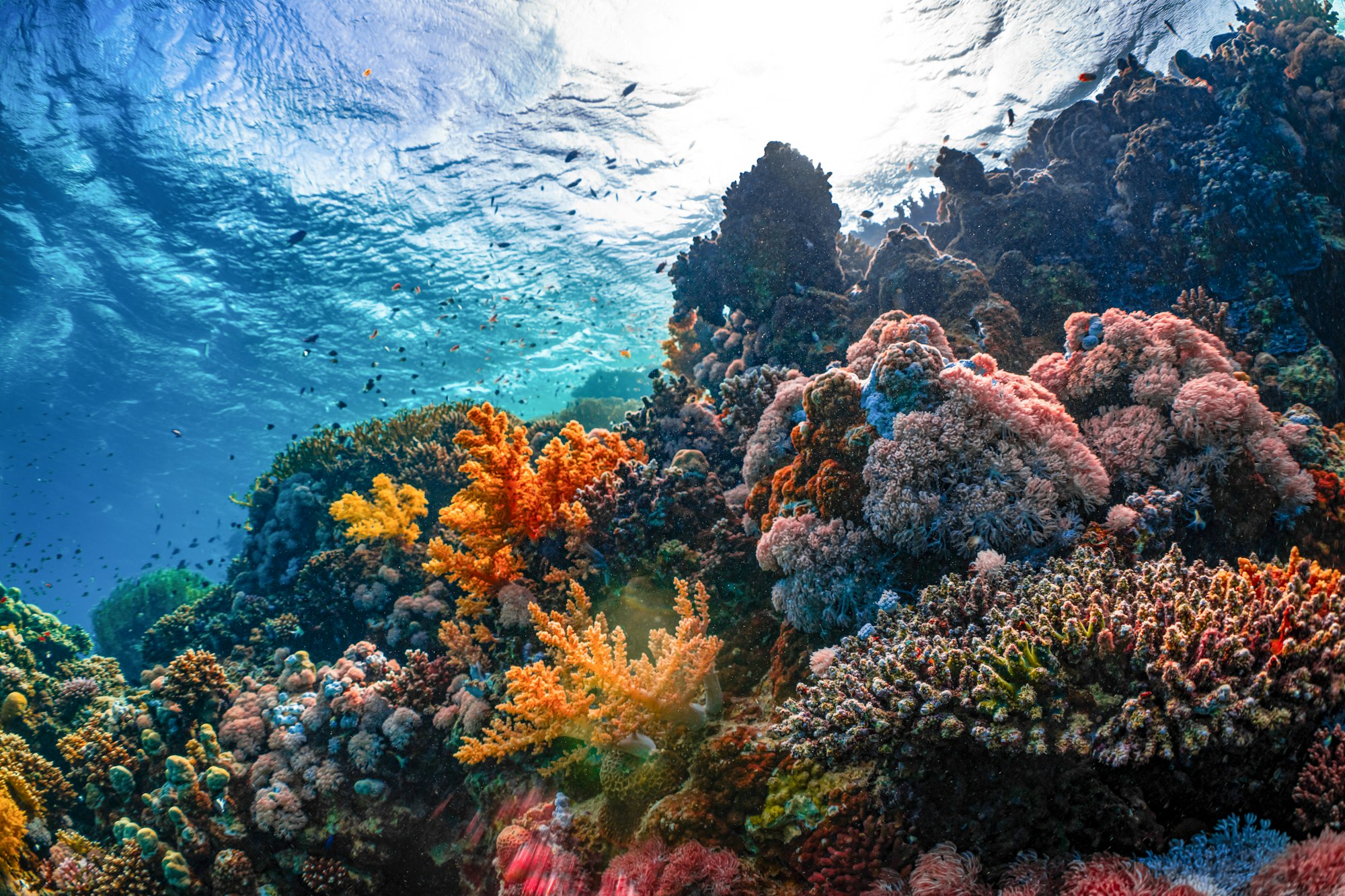
Groupers, snappers, barracuda, and creole wrasse are consistently reported at El Aguila by multiple dive operators. Garden eels inhabit the sandy areas surrounding the wreck sections. Green moray eels occupy crevices in the hull. Schools of yellowtail snappers and chubs circulate above the structure. Blennies and damselfish work the encrusted surfaces. Rays are reported in the area. The mast and upper hull are covered in substantial coral and sponge growth after nearly three decades of colonization. The portholes at the bow shelter arrow crabs and bearded fire worms.
Note: Some sources reference large moray eel concentrations as a notable feature of this wreck. However, the specific claim that El Aguila hosts “one of the largest concentrations of moray eels of any wreck in the Bay Islands” could not be confirmed across three independent sources and has been removed pending additional verification.
Dive Profile
The three-section layout means a structured dive plan. The wreck rests at approximately 33 meters on sandy bottom, with the mast rising to around 15 meters. Begin at the shallower upper structure and work progressively deeper across the three sections. The stern is tilted at 45 degrees. Penetration of accessible areas is possible in the shallower sections with proper equipment. Make a conservative ascent over the wreck and complete the safety stop at 5–8 meters. Nitrox is strongly recommended to maximize bottom time at depth.
Entry and Exit
Served by West End, West Bay, and French Harbour operators. Permanent mooring on the wreck. Entry via giant stride or back roll from the dive boat.
Tips
- Plan a dive centered on the shallower bow section first, then visit the deeper sections as a secondary objective
- Nitrox 32% is strongly recommended for this dive
- Penetration into accessible interior spaces requires a torch and proper wreck training
- The moray eel population is extraordinary — move slowly around the wreck exterior and photograph every opening
- Combine El Aguila with a wall dive at nearby Mary’s Place for the definitive Roatán dive day
Safety
The broken, multi-level nature of El Aguila requires careful dive planning. The deepest sections at 33 meters limit recreational air bottom time. Do not penetrate the stern section without advanced wreck training. The hull has deteriorated sections with sharp edges. Hurricane damage has created unpredictable interior structures — proceed cautiously. Always carry and deploy an SMB. Dive with a buddy.
Photography
El Aguila is one of the Caribbean’s best wreck photography subjects. The dense encrustation of orange sponges on the hull creates vivid color contrast with the blue water. Moray eel portraits — a head emerging from a sponge-encrusted porthole — are the signature shot. The broken hull sections viewed from the sandy seabed with divers above provide dramatic wide-angle compositions. A strobe is essential at depth.
Sources: Splash Inn Dive Resort – El Aguila Shipwreck, Anthony’s Key Resort – El Aguila, DreamWrecks – El Aguila Roatan, Reef Gliders – El Aguila Wreck, Greatest Dive Sites – El Aguila. Last updated 2026-06-27.
Sea-surface temperature and wave height from Open-Meteo Marine (ERA5 reanalysis, monthly averages).
523 verified species observations (255 species) logged within ~11 km of this site between 1911 and 2023, from the Ocean Biodiversity Information System.
- Pterois · lionfish
- Gambusia nicaraguensis
- Palatogobius grandoculus
- Poecilia orri
- Lipogramma evides · banded basslet
- Gnatholepis thompsoni · goldspot goby
- Epigonidae
- Gobiomorus dormitor
- Phaeoptyx
- Gerres cinereus
- Lutjanus apodus
- Malacoctenus erdmani · imitator blenny
Scientific survey records skew toward sampled taxa (molluscs, corals) and do not reflect what you are guaranteed to see on a dive.
Source: OBIS (obis.org), aggregated Darwin Core occurrence records.
Conditions change with the tide and the season. If you have dived this site, share what it was actually like — date, visibility, current, and what you saw. Real, recent reports from divers are exactly what this guide is built to collect.
Send a conditions report ›