Boonsung Wreck
8.7708°N 98.1864°E · wreck
The Boonsung Wreck lies off the coast near Khao Lak, Phang Nga Province, Thailand — outside the Similan Islands National Park proper, but a common day-trip and liveaboard add-on dive. It is one of the most fish-dense wreck dives in Thailand, locally nicknamed “Fish Soup” for the density of marine life it has accumulated.
Overview
The wreck is a former tin-mining dredger. Sources agree it dates from Thailand’s mid-20th-century tin mining boom and was in service from around the 1950s. Its sinking date is not firmly established: operator sources variously give 1984, 1985, or “between 1983 and 1985, exact date not known” — this write-up treats the sinking as occurring in the early-to-mid 1980s rather than picking a single year. Sources also disagree on how the vessel was lost: several dive shop accounts repeat an anecdote that a flooded or malfunctioning toilet/bilge system caused it to swamp during rough seas, while at least one source instead describes it as deliberately scuttled — reportedly by the Thai Navy, out of concern that the intact structure sat too close to the surface for safe navigation. No verified account resolves this discrepancy, and neither version should be presented as established fact.
Dimensions are also reported inconsistently: two independent sources (a Khao Lak dive-shop summary and IDC Phuket) both give approximately 40 meters long, 12 meters wide, and 6 meters high, which this write-up uses as the best-supported figures; other sources describe it as smaller (roughly 5 meters in height) or larger (around 60 meters long). The wreck sits on a flat sandy bottom at 18–20 meters, with its shallowest structure around 11–12 meters. The 2004 Indian Ocean tsunami broke the previously intact structure apart; sources differ on the resulting piece count (accounts range from four to six large sections), but agree the tsunami is what fragmented it into the scattered field divers see today.
Whale shark sightings are reported here by multiple independent sources (khaolakscubaadventures.com and a separate operator/blog consensus), most commonly in the February–April window when fish schools are densest — this write-up uses that seasonal window rather than the original October–January estimate, which was not supported by the sources consulted.
Site Information
- Location: Off the Khao Lak coast (Bangsak/Thap Lamu Pier area), Phang Nga Province, Thailand — outside National Park boundaries
- Entry Type: day trip
- Site Type: Wreck dive
- Difficulty Level: Beginner
- Maximum Depth: 20 meters
- Typical Visibility: Reported highly variable — from near-zero to 20+ meters depending on conditions
- Current: Light to moderate; can be stronger on the open-water surface crossing
- Best Time: October to May; whale shark sightings most reported February–April
Marine Life
The wreck’s defining feature is fish density: schools of trevally, barracuda, snapper, and fusiliers are consistently reported by multiple sources. Also reported: large porcupinefish and pufferfish, lionfish, scorpionfish, several moray eel species (honeycomb, giant, white-eyed), sweetlips, cuttlefish, and nudibranchs. Leopard sharks are reported by at least one operator source. Whale sharks are reported by multiple independent sources as a seasonal (February–April) highlight, though sightings are opportunistic rather than guaranteed on any given dive.
Dive Profile
The wreck’s shallow depth (18–20 meters, with structure starting around 11–12 meters) keeps the entire site within open-water certification limits. Divers typically descend a mooring line to the wreck’s upper structure, then work laterally across the scattered debris field. Two mooring lines are used to manage variable-visibility descents. Visibility inside dense fish schools can drop to a few meters purely from the volume of fish present.
Entry and Exit
Day-trip boat from Khao Lak, or as a stop on longer liveaboard routes. Boat entry by giant stride or back roll; ascent on the mooring line.
Tips and Recommendations
- Early-morning dives on day trips tend to find the fish schools thickest, before boat traffic and midday visitor numbers build
- Whale sharks visit unpredictably; if one appears, stay neutral and observe from a distance — do not pursue or touch, per Thailand’s marine wildlife etiquette rules
- Carry a torch for the interior of collapsed machinery sections where moray eels and lionfish shelter
- Because visibility here is reported as more variable than at the Similan Islands sites, confirm conditions with your guide before descending
Safety Considerations
The wreck’s shallow depth and open, collapsed structure mean there are no significant penetration hazards for recreational divers — this is not a site requiring wreck-penetration training. The primary risks are the open-water boat crossing and variable visibility. This is an offshore site; always dive with a buddy and follow your guide’s briefing. If a whale shark appears, maintain the required minimum distance and do not touch or attempt to ride it.
Photography
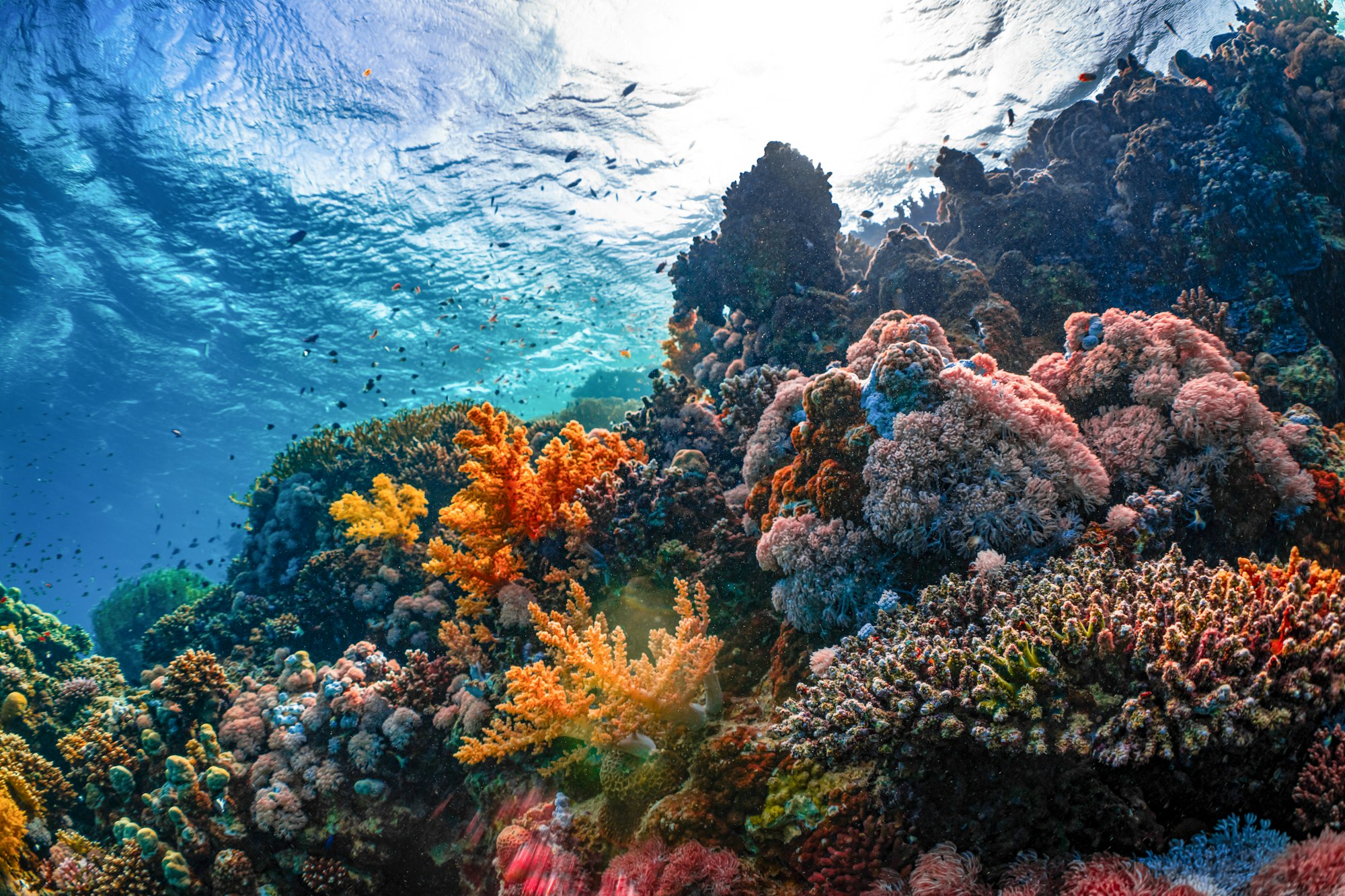
Wide-angle photography of the fish schools, shot upward toward the surface light, is the signature opportunity here. A strobe helps for close-ups of the encrusted wreck structure. Macro shooters can look for nudibranchs and small reef fish on the debris field.
Sources: Khao Lak Scuba Adventures, IDC Phuket, Khao Lak Explorer, Not Troubles Just Bubbles, Wetzone Divers. Last updated 2026-07-05.
Sea-surface temperature and wave height from Open-Meteo Marine (ERA5 reanalysis, monthly averages).
20 verified species observations (16 species) logged within ~11 km of this site between 1987 and 2019, from the Ocean Biodiversity Information System.
- Acrochordus granulatus
- Decapterus macrosoma
- Calotes versicolor
- Decapterus russelli
- Goniobranchus annulatus
- Hypselodoris pulchella
- Goniobranchus geminus
- Pteraeolidia semperi · ムカデミノウミウシ
- Clithon corona
- Clithon diadema
- Hypselodoris rudmani
- Oliva scripta
Scientific survey records skew toward sampled taxa (molluscs, corals) and do not reflect what you are guaranteed to see on a dive.
Source: OBIS (obis.org), aggregated Darwin Core occurrence records.
Conditions change with the tide and the season. If you have dived this site, share what it was actually like — date, visibility, current, and what you saw. Real, recent reports from divers are exactly what this guide is built to collect.
Send a conditions report ›