Hilma Hooker
12.1038°N 68.2901°W · wreck
Hilma Hooker
Bonaire’s most famous wreck — a 236-foot cargo freighter seized with 25,000 pounds of marijuana, now lying on her starboard side in 30 meters and home to large tarpon, barracuda, and dense coral encrustation.
Overview
The Hilma Hooker is Bonaire’s most iconic dive and one of the Caribbean’s premier wreck sites. Originally named Midsland, this 71.8-meter (236-foot) general cargo freighter was built in 1951 by Van der Giessen de Noord shipyard in the Netherlands. The vessel changed hands and names six times over three decades — Midsland, Mistral, William Express, Anna C., Doric Express, and finally Hilma Hooker — before arriving at Kralendijk harbor in mid-1984 with engine failure. When Bonaire customs boarded the vessel and the captain could not produce registration papers, authorities discovered a false bulkhead concealing 25,000 pounds (approximately 11 tonnes) of marijuana. The crew were arrested and the ship impounded, but no owners came forward to claim it. As the neglected hull deteriorated and took on water at the Town Pier, authorities towed it to an anchorage off the south coast on September 7, 1984. Five days later, on September 12, 1984, at 9:08 AM, water entered through lower portholes, the ship rolled onto her starboard side, and slipped beneath the surface in approximately two minutes. After more than 40 years underwater, the wreck is heavily encrusted with corals and sponges and supports a thriving ecosystem anchored by large tarpon and barracuda schools.
Site Information
- Location: South Bonaire, between Angel City and Salt Pier
- Entry Type: Shore entry
- Site Type: Wreck dive
- Difficulty Level: Intermediate
- Maximum Depth: 30 meters
- Typical Visibility: 15–30 meters
- Current: Can be moderate to strong
- Best Time: Early morning (before 8:00 AM) for best visibility and fewer divers
Marine Life
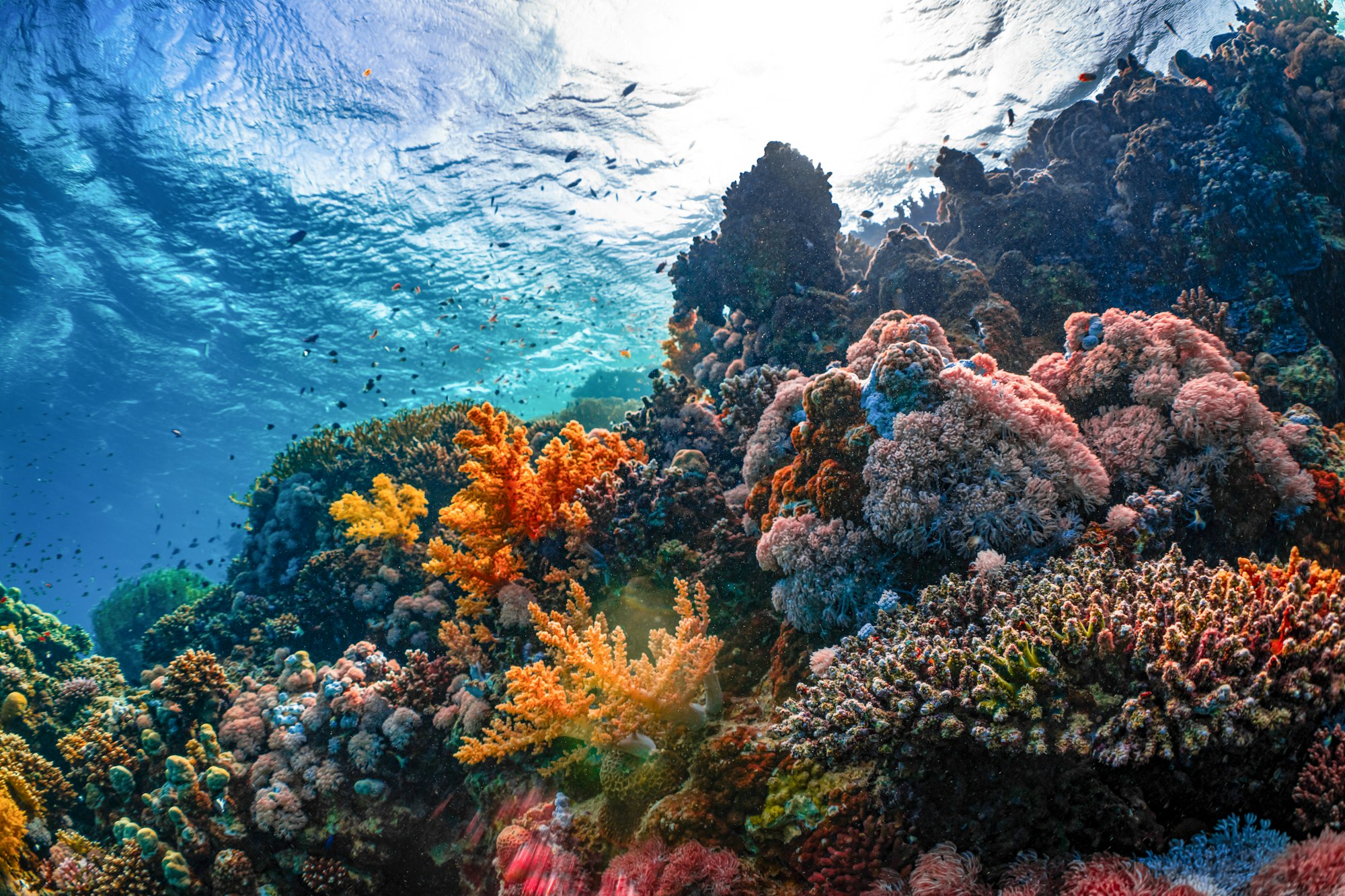
Tarpon are the Hilma Hooker’s signature species — large individuals patrol the hull sides and disappear into the shadows of the wreck interior. Schools of barracuda and horse-eye jacks circle above the structure. Large resident groupers hold territory around the hull openings. Green and spotted moray eels inhabit crevices throughout the wreck. The coral-encrusted hull provides habitat for parrotfish, angelfish, snappers, wrasses, damselfish, and squirrelfish. Spiny lobsters shelter beneath overhangs. Eagle rays and sea turtles are regular visitors. Scorpionfish and frogfish camouflage themselves on the encrusted surfaces. The surrounding sand flats host garden eels, and macro photographers find seahorses, cleaner shrimp, and gobies on and around the structure. Night dives reveal a different cast of nocturnal species.
Dive Profile
The wreck lies on her starboard side on a sand channel within a double reef system, parallel to the shoreline. Three yellow buoys mark the site: the southern buoy at the bow, the center buoy amidships at the reef edge, and the northern buoy at the stern. The port rail sits at approximately 18 meters (60 feet), accessible to Intermediate divers with good buoyancy control. The sand bottom beneath the keel reaches 28–30 meters (95–100 feet). The mainmast extends across the sand channel toward the outer reef. At 236 feet long, the wreck rewards multiple dives to explore fully from bow to stern. Cargo holds are open with hatch covers resting on the sand below. Nitrox is recommended to maximize bottom time at the deeper sections.
Entry and Exit
Shore entry over ironshore — a wetsuit or dive skin is recommended for the entry to protect against scrapes. The site is marked with a painted rock onshore. Snorkel on the surface to the furthest buoy to conserve air before descending to the wreck. The swim from shore is short — the wreck lies close to the reef line. Boat access is available but this is primarily dived as a shore dive, consistent with Bonaire’s shore-diving culture.
Tips
- Arrive early (by 7:30–8:00 AM) to beat cruise ship dive groups that typically arrive around 9–10 AM and stir up sediment
- Snorkel out to the buoys on the surface to save air for the wreck
- Plan at least two dives to properly explore the full 236-foot length
- Bring a dive light to illuminate the hull interior and bring out the colors of sponge and coral encrustation
- Nitrox 32% is strongly recommended given the 30-meter working depth
- The top of the wreck at 18 meters offers excellent exploration for divers not comfortable at depth
Safety
The Hilma Hooker spans a wide depth range — from 18 meters at the port rail to 30 meters at the sand bottom. Divers exploring the deeper sections should monitor bottom time carefully and plan gas consumption for the return swim. Penetration into the hull interior is possible through cargo holds and superstructure openings but should only be attempted with proper wreck training, a dive light, and awareness of entanglement hazards — the bridge and superstructure have sprung and cracked plates, and interior structures are deteriorated and unpredictable. Current can be moderate to strong. Always dive with a buddy and carry an SMB.
Photography
The Hilma Hooker is one of the Caribbean’s most photogenic wrecks. The dense encrustation of sponges and corals on the hull creates vivid color and texture. Tarpon silhouetted against the blue water alongside the hull are the signature shot. Wide-angle compositions of the full hull profile with divers for scale are dramatic from the sand channel. The open cargo holds frame interesting light patterns. A strobe is essential at depth to restore the reds and oranges of the sponge growth. Macro subjects — frogfish, seahorses, cleaning stations — reward patient photographers on the encrusted surfaces.
Sources: InfoBonaire Dive Site Map, STINAPA Bonaire Marine Park, Tourism Corporation Bonaire, Scuba Diving Magazine – Bonaire Guide, Buddy Dive Resort Bonaire. Last updated 2026-05-24.
Sea-surface temperature and wave height from Open-Meteo Marine (ERA5 reanalysis, monthly averages).
1969 verified species observations (196 species) logged within ~11 km of this site between 1930 and 2019, from the Ocean Biodiversity Information System.
- Eretmochelys imbricata · Hawksbill sea turtle
- Chelonia mydas · Green sea turtle
- Caretta caretta · Loggerhead sea turtle
- Pterois · lionfish
- Scarus vetula
- Scarus taeniopterus
- Acanthurus coeruleus
- Cephalopholis cruentata
- Lutjanus apodus
- Hemanthias leptus
- Chaetodon capistratus
- Gobiidae
Scientific survey records skew toward sampled taxa (molluscs, corals) and do not reflect what you are guaranteed to see on a dive.
Source: OBIS (obis.org), aggregated Darwin Core occurrence records.
Conditions change with the tide and the season. If you have dived this site, share what it was actually like — date, visibility, current, and what you saw. Real, recent reports from divers are exactly what this guide is built to collect.
Send a conditions report ›