Windjammer
12.2203°N 68.3753°W · wreck
Windjammer
Iron-hulled sailing ship Mairi Bhan, lost in a 1912 storm off the BOPEC terminal — lies on her starboard side at roughly 55–60 meters. A technical-depth wreck, not a recreational dive.
Overview
The “Windjammer” is the wreck of the Mairi Bhan (sometimes written Mairi Bahn), a four-masted iron-hulled sailing ship built in 1874 by Barclay, Curle & Co. in Glasgow. Carrying a cargo of asphalt or tar barrels, she was driven onto Bonaire’s northwest coast by a severe storm and sank in 1912 in front of what is now the BOPEC oil terminal. She rests on her starboard side at approximately 55–60 meters (180–200 feet), with both masts still standing and reaching upward toward the surface. This is not a recreational dive — it sits well beyond no-decompression limits on air or standard nitrox, and access is restricted by the active oil terminal above.
Site Information
- Location: Northwest Bonaire, in front of the BOPEC oil terminal
- Entry Type: Boat dive
- Site Type: Wreck dive
- Difficulty Level: Technical
- Maximum Depth: 55 meters
- Typical Visibility: 20–30 meters
- Current: Often strong, variable
- Best Time: Determined entirely by sea state and permit availability — not a casual dive
Marine Life
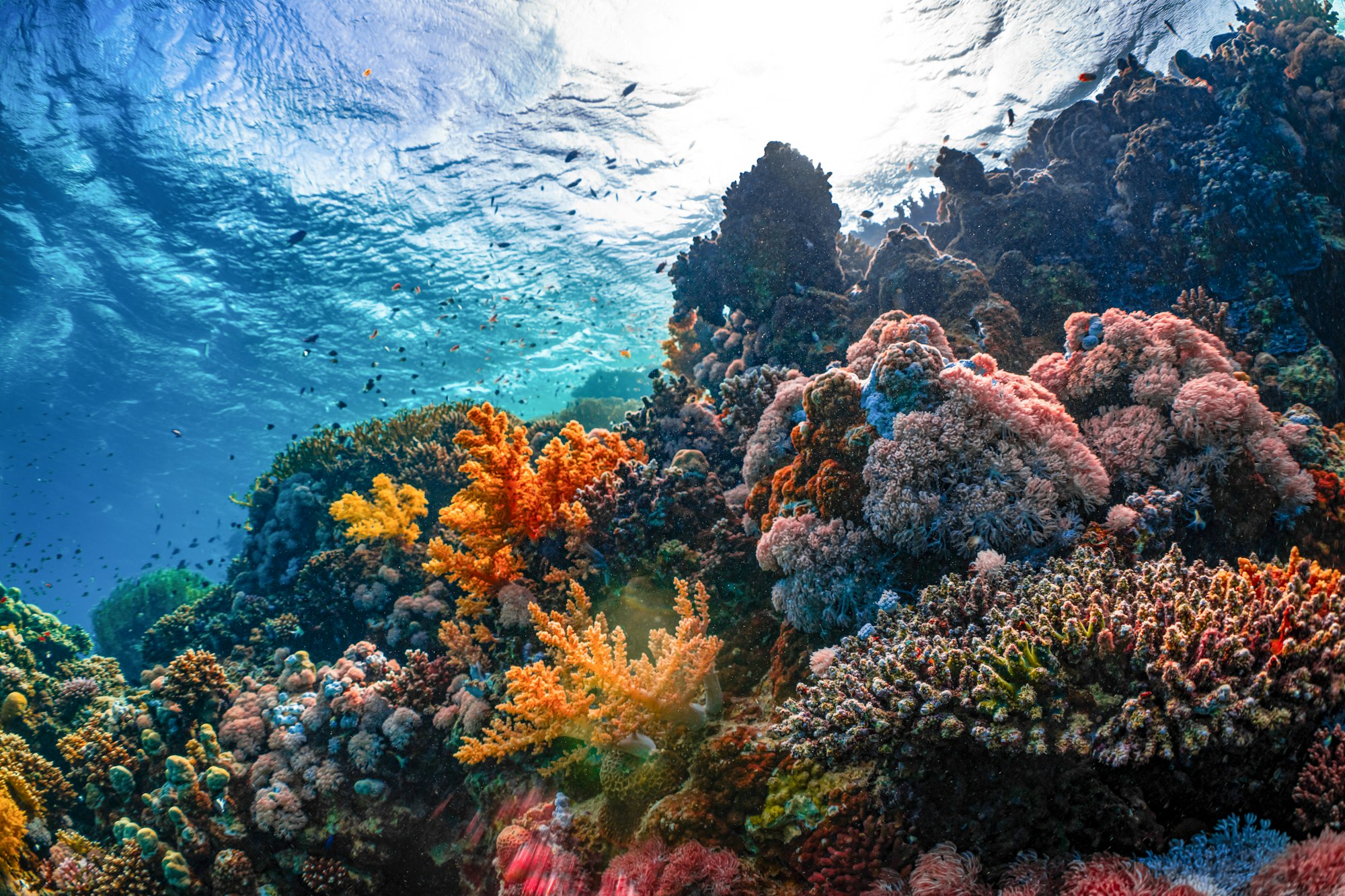
The hull and standing masts have accumulated decades of sponge and coral growth. Reports include large groupers and snappers around the structure, schools of jacks in the water column, and pelagic visitors drawn to the offshore depth and current. Macro detail is secondary here — this is a wide-angle wreck-profile dive.
Dive Profile
Both masts remain upright with the wreck on her starboard side. Most descriptions place the top of the masts around 35–40 meters and the main deck and hull in the 50–60 meter range. The seabed continues deeper. The combination of strong current, depth, and the ship’s exposed orientation places this firmly in technical-diving territory: a multi-gas profile with substantial decompression obligation is the norm.
Entry and Exit
Access requires a BOPEC permit and an accredited technical operator with boat support — the wreck sits directly off an operational oil-handling terminal. Shore access is not feasible. Plan around terminal operations and sea state.
Tips
- This is a technical dive: full trimix certification, redundant gas, decompression planning, surface support, and a guide familiar with the site are all expected
- Do not attempt on standard recreational training
- Confirm BOPEC permit status before traveling — access has been periodically restricted
- The wreck is heavily exposed to current; surface conditions can deteriorate quickly
Safety
Depth, current, decompression obligation, and proximity to an active industrial terminal each contribute risk. Penetration of the hull is not advised without specific wreck-penetration training and dedicated equipment — the iron structure has been submerged for over a century. Always carry redundant gas and SMBs.
Photography
The standing masts photograph dramatically against open water for divers who can capture them, particularly with another diver for scale. Strobes are essential at depth; ambient light at 55+ meters is minimal even in clear water.
Nearby Sites
The Windjammer site sits offshore from the BOPEC area on Bonaire’s northwest coast. Karpata, La Dania’s Leap, and Carel’s Vision are the nearest recreational-depth sites along the same coastline, but none are functional alternatives — they are wholly different dives.
Sources: DreamWrecks – Windjammer / Mairi Bhan, Blue-Oceans – Mairi Bhan Shipwreck, Divers-Guide – Windjammer, NUMA – Bonaire Windjammer. Last updated 2026-05-16.
Sea-surface temperature and wave height from Open-Meteo Marine (ERA5 reanalysis, monthly averages).
1983 verified species observations (161 species) logged within ~11 km of this site between 1930 and 2025, from the Ocean Biodiversity Information System.
- Eretmochelys imbricata · Hawksbill sea turtle
- Caretta caretta · Loggerhead sea turtle
- Scarus taeniopterus
- Pterois · lionfish
- Scarus vetula
- Microspathodon chrysurus
- Sparisoma viride
- Sparisoma aurofrenatum
- Chelonia mydas · Green sea turtle
- Cephalopholis cruentata
- Lutjanus apodus
- Acanthurus coeruleus
Scientific survey records skew toward sampled taxa (molluscs, corals) and do not reflect what you are guaranteed to see on a dive.
Source: OBIS (obis.org), aggregated Darwin Core occurrence records.
Conditions change with the tide and the season. If you have dived this site, share what it was actually like — date, visibility, current, and what you saw. Real, recent reports from divers are exactly what this guide is built to collect.
Send a conditions report ›