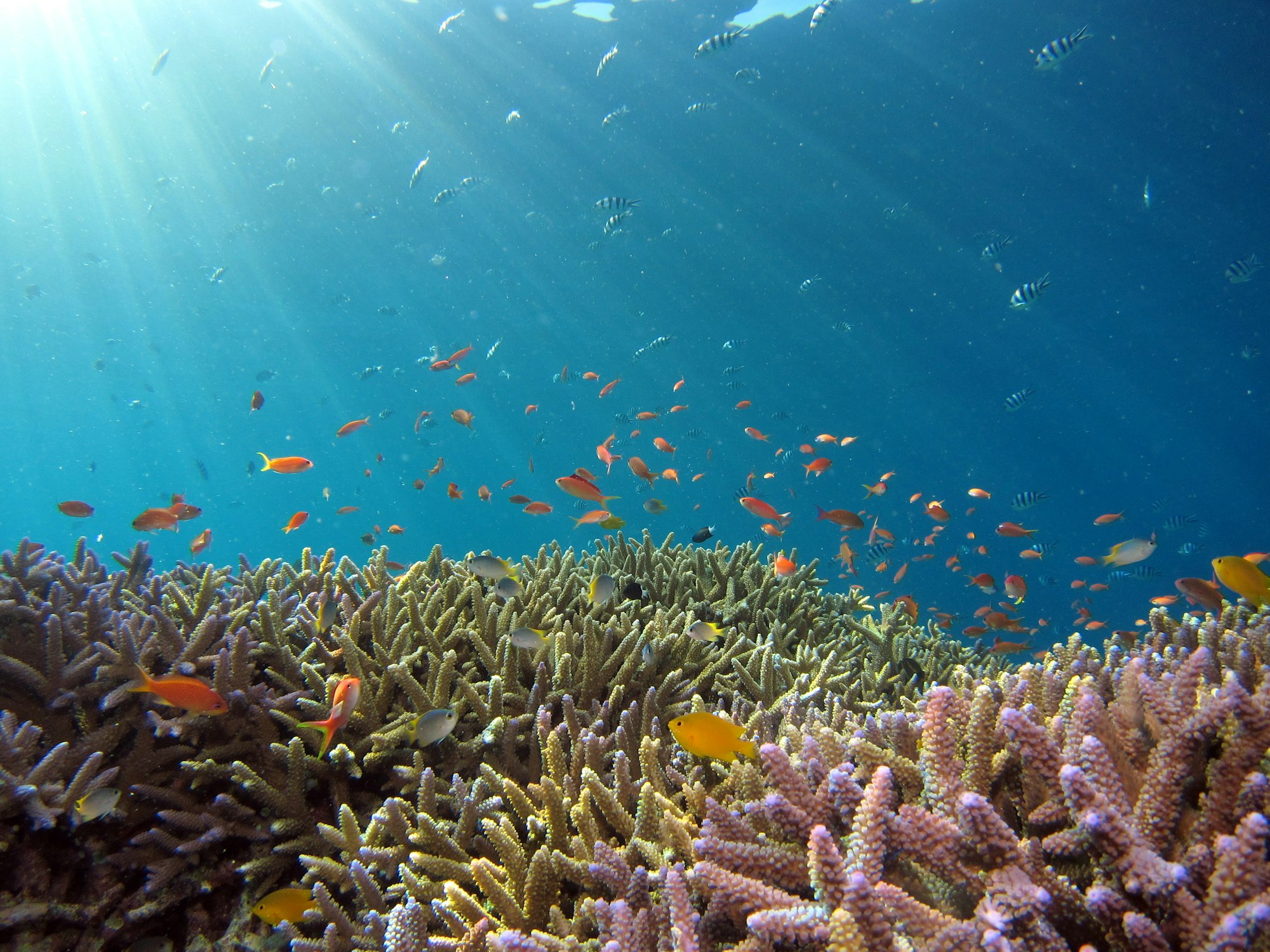
Faille St Etienne
17.6181°S 149.6203°W · wall
Faille St Etienne is a deep fissure dive site in the Tahiti lagoon near the St Etienne passage, French Polynesia. “Faille” means crack or fissure, and this site is defined by a dramatic vertical split in the reef that descends to 40 metres.
Overview
The fissure at St Etienne is one of the more dramatic geological features in Tahiti’s dive sites. The crack runs roughly north–south through the outer reef slope, creating a narrow passage that divers can swim through or along as it descends steeply. The walls of the faille are covered in encrusting corals, sponges, and black corals that thrive in the lower light of the deeper section. At 40 metres the fissure opens onto the outer slope, where the oceanic influence brings larger pelagics. Visibility can reach 30–40 metres on clear days, and water temperature drops slightly to around 25–26°C at depth.
What to Expect
The upper part of the fissure (10–20 m) has good coral coverage with glassfish swarms that part to allow passage. Deeper, the walls narrow and are draped in black coral (Antipatharia spp.) and large sea fans. Whitetip reef sharks and grey reef sharks are confirmed at this site; resting sharks on ledges are a typical encounter. At the base where the faille meets the open slope, grey reef sharks patrol. The dive rewards experienced divers with a sense of journeying through a geological fault while surrounded by dense marine life. Note: “nurse sharks” and “silvertip sharks” cited in earlier descriptions were removed — no site-specific confirmation found for these species here.
Conditions
- Best season: April–November
- Visibility: 25–40 m typical
- Current: Variable; can be strong at the fissure entrance
- Water temperature: 26–28°C upper, 25–26°C at 40 m
- Entry: Boat dive
Tips
A maximum depth of 40 m means this site is suitable for Advanced Open Water divers and above. Monitor bottom time carefully and begin ascent from depth with a 3-minute safety stop at 5 m. A torch is essential for illuminating the fissure walls below 20 m.
Sources: Dive and Sea Tahiti – Dive Sites, Eleuthera Tahiti Diving Center – Spots, Scubago – La Faille St Etienne. Last updated 2026-05-30.
Sea-surface temperature and wave height from Open-Meteo Marine (ERA5 reanalysis, monthly averages).
1984 verified species observations (322 species) logged within ~11 km of this site between 1899 and 2025, from the Ocean Biodiversity Information System.
- Megaptera novaeangliae · Humpback whale
- Naso unicornis
- Parupeneus multifasciatus
- Scarus psittacus
- Acanthurus xanthopterus
- Balistapus undulatus
- Centropyge flavissima
- Parupeneus barberinus
- Scarus oviceps
- Ostracion cubicum
- Chlorurus sordidus
- Lutjanus fulvus
Scientific survey records skew toward sampled taxa (molluscs, corals) and do not reflect what you are guaranteed to see on a dive.
Source: OBIS (obis.org), aggregated Darwin Core occurrence records.
Conditions change with the tide and the season. If you have dived this site, share what it was actually like — date, visibility, current, and what you saw. Real, recent reports from divers are exactly what this guide is built to collect.
Send a conditions report ›