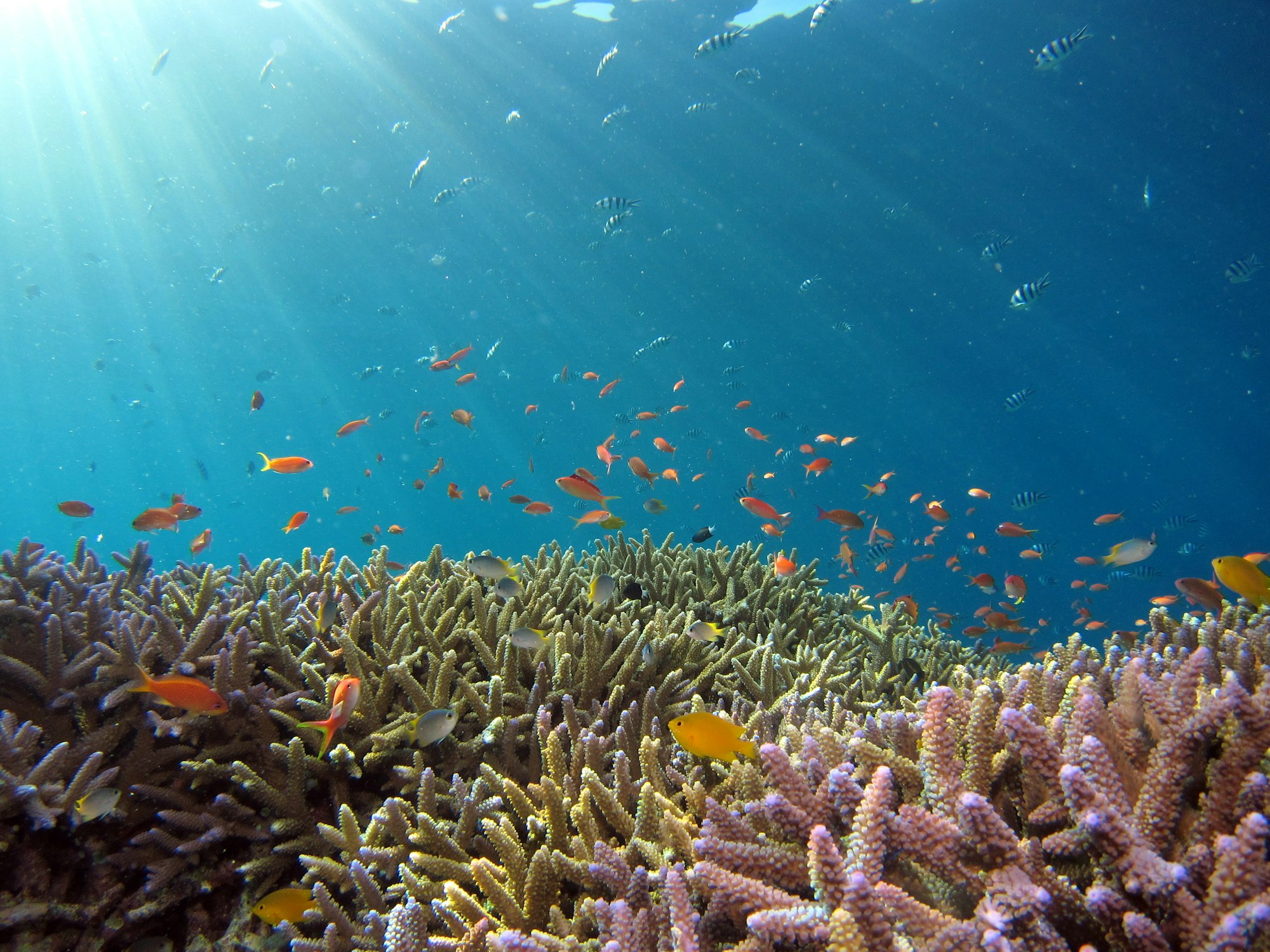
Batu Tiga Dive Site
8.5996°S 119.5729°E · pinnacle
Batu Tiga — “Three Rocks” in Indonesian — is a trio of current-swept pinnacles in Komodo National Park where strong tidal flows attract sharks, large pelagics, and dense aggregations of reef fish to a dramatic underwater rockscape.
Overview
Three distinct pinnacles break the surface at Batu Tiga, and each submerged structure supports its own community of marine life while sharing the strong currents that sweep between them. The rocky formations descend to sandy channels at 25–30 meters, with the exposed faces draped in hard and soft corals shaped and polished by years of current exposure. The site is firmly in the advanced category: currents can run to 3 knots between the rocks and the tidal reversal creates unpredictable flow directions that require active management. On the right current, the action is comparable to Crystal Rock — circling sharks, swirling fish schools, and the excitement of a genuine current-driven pinnacle environment.
Site Information
- Location: Komodo National Park, East Nusa Tenggara, Indonesia
- Entry Type: Boat dive
- Site Type: Pinnacle/seamount
- Difficulty Level: Advanced
- Maximum Depth: 35 meters
- Typical Visibility: 15–30 meters
- Current: Strong to very strong between the rocks; must be timed with tidal flow
- Best Time: April to November; morning dives on incoming current
Marine Life
Grey reef sharks and whitetip reef sharks patrol the channels between the pinnacles, occasionally resting on the sandy bottom. Schools of bigeye trevally form baitballs around the pinnacle summits on strong current days, with giant trevally slashing through from below. Napoleon wrasse cruise the deeper sections. Barracuda hang in loose schools in mid-water. The pinnacle faces hold sweetlips in clusters beneath overhangs and schooling snapper around coral-covered ledges. Sea turtles are common, and the occasional eagle ray passes through the channels.
Dive Profile
The guide will select the approach pinnacle based on current direction. Descend quickly and position on the up-current face, working down to the sand at 25–30 meters before ascending the most fish-dense face. The channels between rocks are exciting but expose divers to the strongest flow — enter them briefly with a clear exit plan. End the dive at the shallowest pinnacle top before deploying an SMB for a blue-water safety stop.
Entry and Exit
Liveaboard or day boat from Labuan Bajo. The skipper positions upstream of the target pinnacle. Rapid descent is important to avoid being swept past the site. Blue-water safety stop with SMB is standard — the boat follows divers’ positions.
Tips and Recommendations
- Brief carefully on which side of the rocks to approach given the day’s current direction
- A reef hook can be useful to pause and observe the fish action on strong-current days
- Watch for down-currents in the channels between pinnacles — fin horizontally to escape them
- This site pairs well with Crystal Rock or Castle Rock on the same liveaboard day
- Bring a wide-angle lens — the open-water fish schools are the main photographic subject
Safety Considerations
The gaps between the three pinnacles can concentrate current into dangerous channelled flow. Do not enter the channels without clear visibility of the exit and a guide’s direction. Down-currents can develop rapidly on the downstream faces. Always carry an SMB and brief on abort procedures before entering. Suitable for experienced drift divers only.
Photography
Three-dimensional pinnacle diving with fish schools in the water column above creates ideal wide-angle subjects. A 10–17mm fisheye or 14–24mm zoom captures the pinnacle faces with fish activity. Shark shots work well in the sandy channels where grey reef sharks rest or circle. Deploy strobes to bring back colour at depth.
Sources: Blue Marlin Dive – Komodo Dive Sites, Dragon Dive Komodo – Komodo Dive Sites, Divezone – Komodo. Last updated 2026-06-10.
Sea-surface temperature and wave height from Open-Meteo Marine (ERA5 reanalysis, monthly averages).
716 verified species observations (305 species) logged within ~11 km of this site between 1970 and 2023, from the Ocean Biodiversity Information System.
- Pseudochromis
- Gymnothorax
- Fowleria vaiulae · Dwarf Cardinalfish
- Pseudochromis flavopunctatus
- Parapercis cylindrica
- Fusigobius humeralis
- Mobula alfredi · Reef manta ray
- Nectamia fusca · Dusky Cardinal
- Ostorhinchus cyanosoma · English: Yellowstriped Cardinalfish (1)
- Pseudochromis perspicillatus
- Pygoplites diacanthus
- Fusigobius melacron
Scientific survey records skew toward sampled taxa (molluscs, corals) and do not reflect what you are guaranteed to see on a dive.
Source: OBIS (obis.org), aggregated Darwin Core occurrence records.
Conditions change with the tide and the season. If you have dived this site, share what it was actually like — date, visibility, current, and what you saw. Real, recent reports from divers are exactly what this guide is built to collect.
Send a conditions report ›