Fish Bank
3.5149°N 72.9188°E · reef
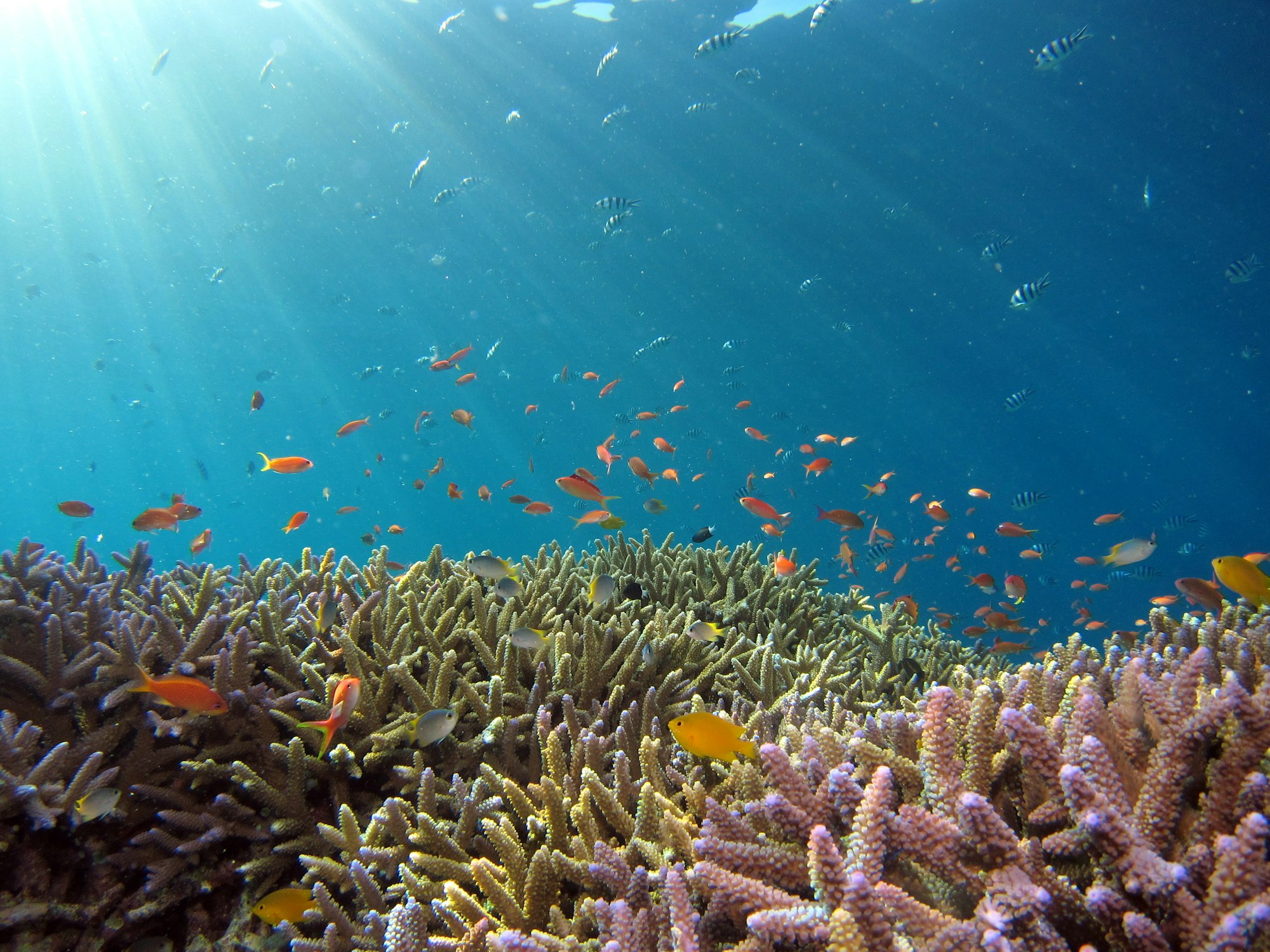
Fish Bank is a submerged reef structure in the central-southern Maldives — a productive elevated bank rising from the atoll floor that aggregates fish life in spectacular numbers, earning its descriptive name from the dense fish populations that define the site.
Overview
Fish Bank is a broad, relatively flat reef plateau rising to around 15 meters below the surface, with its flanks sloping down to 25 meters before dropping away. The elevated topography acts as an obstacle to tidal currents, creating upwelling and turbulence zones that trap plankton and small baitfish above the bank. This feeding concentration supports extraordinary aggregations of larger reef and pelagic fish: schools of hundreds of snappers, fusiliers, and bigeye hang in dense columns above the bank, attracting grey reef sharks and whitetip sharks that circle persistently. On favourable current days, hammerhead sharks and eagle rays are drawn in from the open atoll. The bank’s flat-top reef has hard coral coverage that supports the foundational invertebrate community, but the overwhelming feature of Fish Bank is the sheer density of schooling fish that give the site its name. Whale sharks have been reported passing through during the northeast monsoon season.
Site Information
- Location: Central-Southern Maldives
- Entry Type: Boat dive
- Site Type: Reef
- Difficulty Level: Intermediate
- Maximum Depth: 25 meters
- Typical Visibility: 15-30 meters
- Current: Moderate to strong; current direction determines fish aggregation position
Marine Life
Dense schools of snappers, fusiliers, bigeye, grey reef sharks, whitetip reef sharks, eagle rays, occasional hammerheads, whale sharks (seasonal), Napoleon wrasse, and strong tidal currents driving the fish concentration.
Tips for Divers
Position on the up-current edge of the bank on entry — this is where the fish schools are thickest, pushed against the current running over the bank. Descend to the bank plateau and watch the predator-prey dynamics play out overhead. Grey reef sharks are most active when tidal flow is strongest. This site is best appreciated with an understanding of current dynamics; dive it during a running tidal phase rather than at slack for the most impressive fish aggregations.
Sea-surface temperature and wave height from Open-Meteo Marine (ERA5 reanalysis, monthly averages).
128 verified species observations (23 species) logged within ~11 km of this site between 1991 and 2022, from the Ocean Biodiversity Information System.
- Rhincodon typus · Whale Shark
- Carcharhinus melanopterus
- Phyllidiella rosans · ロザンイボウミウシ
- Phyllidia varicosa
- Berthellina citrina
- Phyllidia alyta
- Chelidonura varians
- Hypselodoris whitei
- Goniobranchus gleniei
- Caloria indica
- Tambja olivaria
- Verconia varians
Scientific survey records skew toward sampled taxa (molluscs, corals) and do not reflect what you are guaranteed to see on a dive.
Source: OBIS (obis.org), aggregated Darwin Core occurrence records.
Conditions change with the tide and the season. If you have dived this site, share what it was actually like — date, visibility, current, and what you saw. Real, recent reports from divers are exactly what this guide is built to collect.
Send a conditions report ›