Big Brother Island
26.3130°N 34.8443°E · wall
The larger of Egypt's two offshore Brothers islets, Big Brother is a liveaboard-only pinnacle ringed by sheer walls, home to the wrecks Numidia and Aida and to oceanic whitetip, thresher and hammerhead sharks — advanced divers only.
Overview
Big Brother is the larger of the two islets known collectively as the Brothers, or El Akhawein, sitting alone in open water well off Egypt’s mainland coast. It is little more than a sliver of rock crowned by a stone lighthouse built under British administration in the 1880s and still maintained by the Egyptian authorities. Below the waterline the island is the tip of a seamount: walls drop away almost vertically on every side, plunging far past sport-diving depth into blue water. There is no shore, no jetty for divers and no day-boat access — the site is reached by liveaboard only, and boats operate inside a marine protectorate with park fees, briefings and access rules that change from season to season.
Why divers come
Two things draw people this far offshore. The first is sharks: an isolated pinnacle in deep water acts as a magnet for pelagics, and the Brothers have a long reputation for oceanic whitetips, threshers, hammerheads, grey reef and silvertip sharks. The second is that Big Brother is one of very few places where a serious historic wreck lies draped down a reef wall, dived in clear blue water rather than silt.
The wrecks (Numidia & Aida)
The Numidia was a British cargo steamer owned by the Anchor Line of Glasgow, lost on the island’s northern point in July 1901, only months after entering service. She lies bow-up on the slope: the shallowest structure sits at roughly 8–10 m, the mid-sections and superstructure fall through the 30–50 m band, and the stern continues well past 80 m. Sources differ on exact figures, but all agree the deeper half is beyond recreational limits.
The Aida rests on the western side. Built in France before the First World War as an Egyptian lighthouse tender and later used as a transport, she was driven onto the rocks in heavy weather in September 1957 while landing personnel and supplies for the island’s garrison; most of those aboard were rescued. Her broken bow section lies from about 25–30 m and the stern trails down to around 60 m and deeper.
The dive
Dives are almost always drifts, dropped by tender and picked up in open water. The typical plan is a descent onto the top of the Numidia’s slope, a controlled traverse down the wreck to a planned maximum, then a slow ascent along the wall with a long safety stop in blue water. The Aida is dived the same way, entered at the wall and swum along the hull. Reef hooks, SMBs and a computer with conservative settings are standard.
Marine life
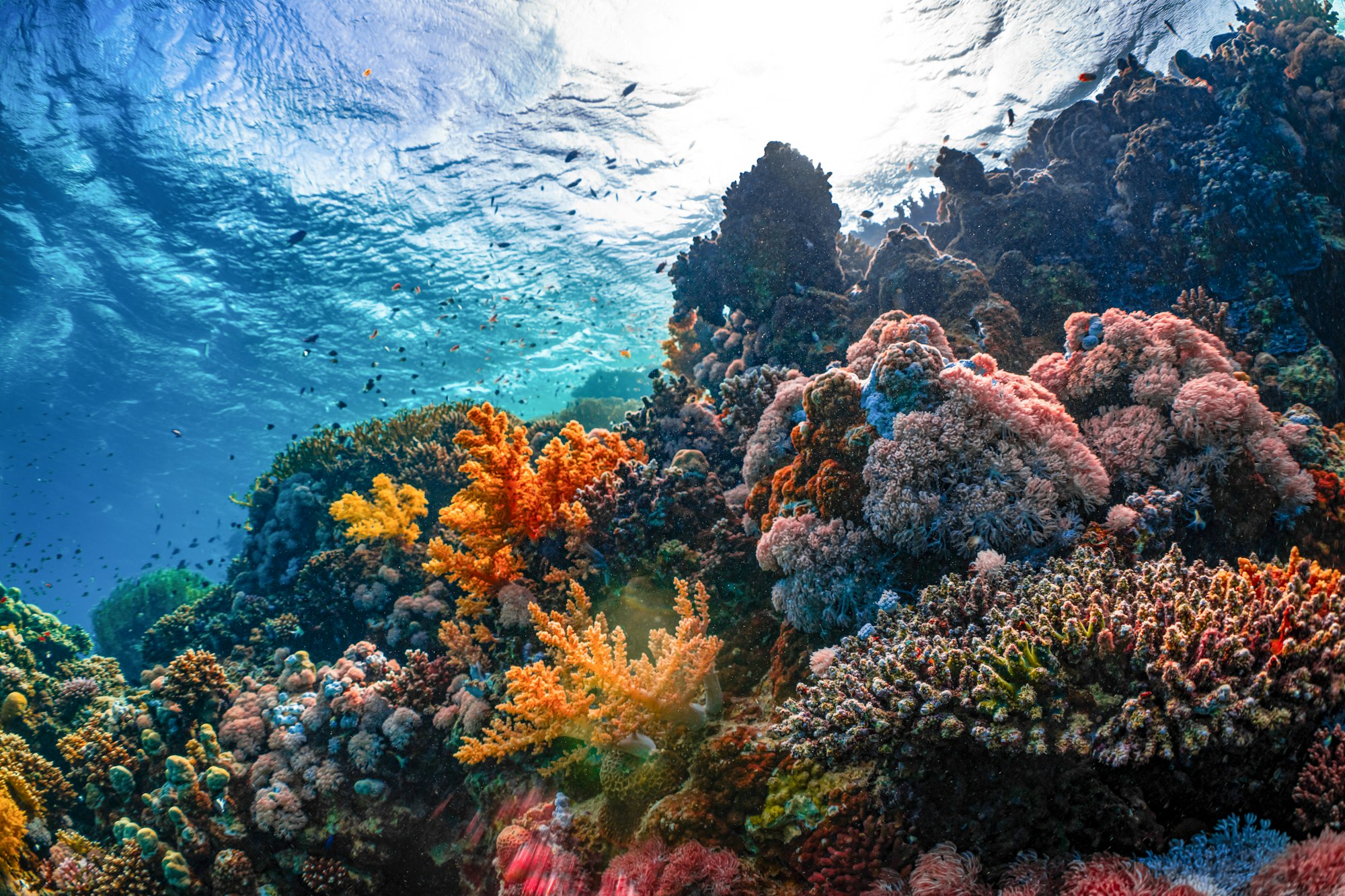
The walls themselves are exceptional — hard coral in the shallows, soft corals and large gorgonians deeper, dense clouds of anthias and fusiliers, giant trevally, tuna and Napoleon wrasse. Shark sightings vary: hammerheads and threshers are more often reported around the plateaus in cooler months, while oceanic whitetips are most associated with late-year trips. Nothing here is guaranteed.
Conditions & who should dive it
This is an advanced, exposed, open-ocean site. Currents can be strong and unpredictable, sometimes switching direction or pulling down along the wall, and surface conditions can make pickups awkward. On the wreck sections there is no shallow reef refuge — the bottom is simply blue water. Operators commonly ask for around 50 logged dives, plus current and deep experience. The deeper parts of both wrecks are past recreational limits and should not be chased; plan a hard maximum before entry and stick to it. Oceanic whitetips here are bold and persistent and have been involved in incidents that led to temporary closures of the site — follow the crew’s shark protocol, stay in a group, and treat close approaches as normal behaviour rather than aggression.
When to go
Liveaboards run the route through much of the year, with the warmer, calmer months generally favoured for crossings and cooler months more associated with pelagic activity. Access has been suspended in the past for safety and conservation reasons, so confirm current status with the operator before booking.
Getting there
By liveaboard from Hurghada, Marsa Alam or Port Ghalib, usually as part of a Brothers–Daedalus–Elphinstone itinerary. Crossings are long and can be cancelled in bad weather.
A note on protection
The Brothers lie within Egypt’s offshore marine park. Night diving is not permitted, boat time at the island is restricted, waste discharge nearby is banned and crews must meet environmental training requirements. Park fees are typically collected on board in cash and are rarely included in the trip price.
Sea-surface temperature and wave height from Open-Meteo Marine (ERA5 reanalysis, monthly averages).
14 verified species observations (6 species) logged within ~11 km of this site between 2006 and 2010, from the Ocean Biodiversity Information System.
- Rhincodon typus · Whale Shark
- Pseudorca crassidens · False killer whale
- Acropora humilis
- Acropora hyacinthus
- Acropora paniculata
- Acropora nasuta
Scientific survey records skew toward sampled taxa (molluscs, corals) and do not reflect what you are guaranteed to see on a dive.
Source: OBIS (obis.org), aggregated Darwin Core occurrence records.
Conditions change with the tide and the season. If you have dived this site, share what it was actually like — date, visibility, current, and what you saw. Real, recent reports from divers are exactly what this guide is built to collect.
Send a conditions report ›