Blue Belt
20.2267°N 37.3152°E · wreck
Blue Belt is a wreck dive site near Port Sudan, Sudan — also known as the “Toyota Wreck” for its cargo of 190 Toyota vehicles. The Blue Belt was a Saudi Arabian general cargo vessel of 2,399 GRT and 103 metres in length, built by Howaldtswerke in Hamburg in 1950. On 2 December 1977 she struck a reef approximately 75 km north of Port Sudan while sailing from Jeddah to Port Sudan, sinking in poor winter weather. The Blue Belt was not a Sudanese vessel — she was Saudi-registered and her cargo of Toyota cars, trucks, pick-ups, and 4x4 vehicles can still be seen scattered around the wreck, now coral-encrusted after nearly five decades on the seabed.
Overview
The Blue Belt lies upside down on a sloping seabed, stretching from approximately 21 metres at the shallowest to around 90 metres at the deepest — the bulk of recreational diving takes place in the 21–40 metre range. The wreck is heavily encrusted with hard and soft corals, and scattered coral-encrusted Toyota vehicles lie outside the hull. A resident school of barracuda spirals continuously around the wreck, creating one of Sudan’s most dramatic diving experiences. Visibility is excellent at 25–40 metres.
Site Information
- Location: Red Sea, Sudan (~75 km north of Port Sudan)
- Entry Type: Boat dive
- Site Type: Wreck dive
- Difficulty Level: Intermediate
- Maximum Depth: 90 meters
- Typical Visibility: 25–40 meters (82–130 feet)
- Current: Light to moderate
- Best Time: November to April
Marine Life
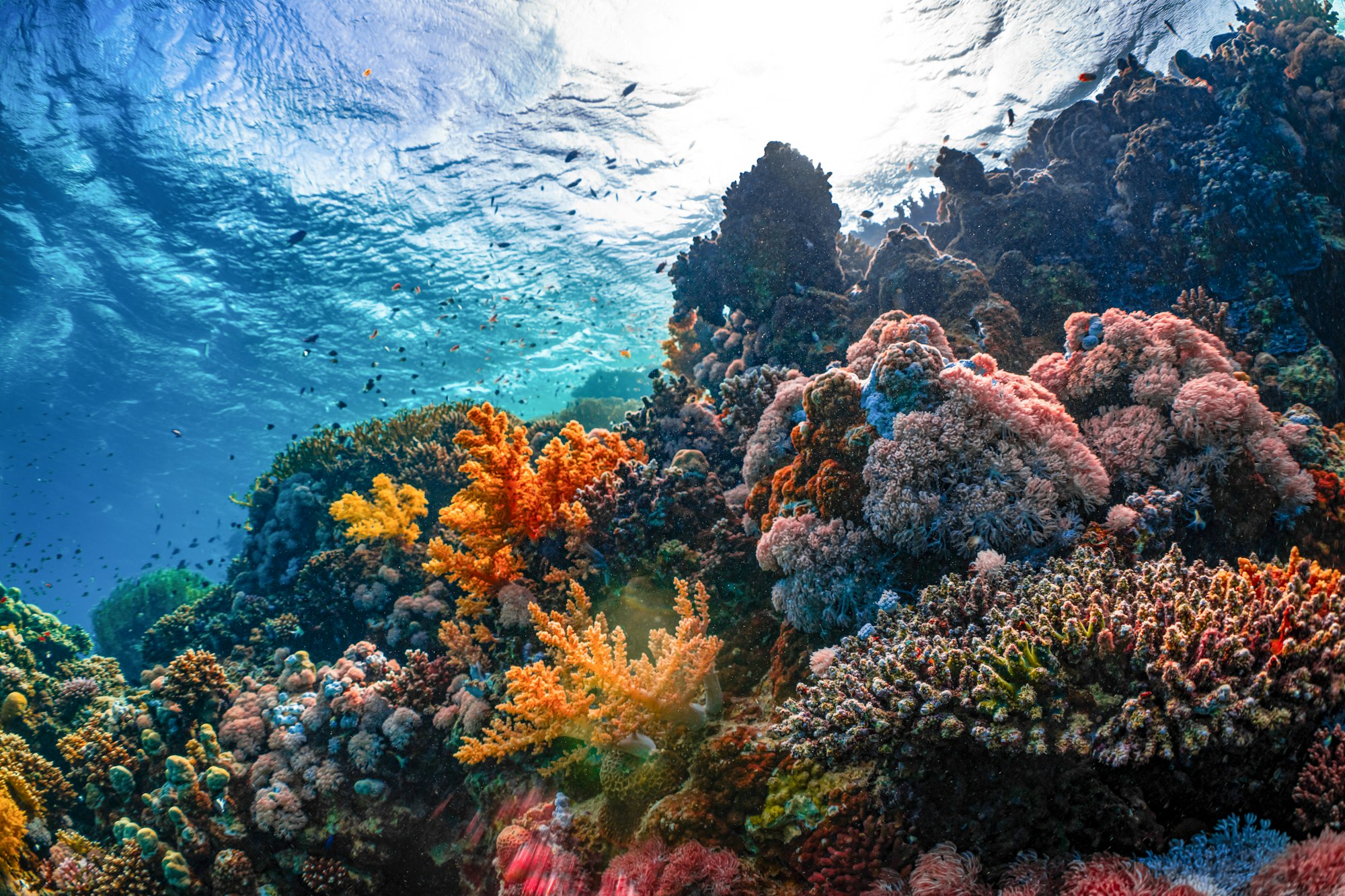
The resident barracuda school is the headline attraction — often 300–500 individuals forming a continuously rotating tornado above the wreck. Lionfish inhabit the holds and sheltered spaces. Moray eels occupy the interior corridors. humphead wrasse and large grouper are regularly sighted. The exterior coral encrustation hosts anthias, butterflyfish, and chromis in large numbers. Eagle rays have been sighted in the blue water surrounding the wreck.
Dive Profile
Descend to 21–30 metres where the upturned hull and scattered Toyota vehicles are the main features. The coral-encrusted cars and trucks are immediately recognisable — headlights, tyres, and steering wheels are still visible after nearly five decades underwater. Mid-dive, position yourself below the barracuda school and watch them spiral overhead. The shallower sections of the hull around 12–18 metres provide the most photogenic views of the barracuda against blue water. Safety stop at 5 metres before surfacing. The deeper sections of the wreck (beyond 40 m) are for experienced technical divers only.
Entry and Exit
Remote site accessible by liveaboard from Port Sudan. Zodiac or tender boat transfers to the dive site. Blue water entry with descent to the wreck. Open water SMB deployment for pick-up is standard.
Tips and Recommendations
- Approach the barracuda school slowly from below for the best circling effect
- Dawn and dusk dives see the most active fish feeding behaviour
- Wide-angle fisheye lenses are essential for the barracuda school shots
- Bring a torch for wreck interior inspection
- This is a liveaboard-only destination — plan Sudan itineraries carefully
Safety Considerations
Sudan diving requires full liveaboard logistics and experienced guides. The wreck interior should only be entered with wreck penetration certification. Lionfish are present throughout the structure. Strong currents are possible in the open water around the site. Carry all appropriate signalling devices.
Photography
Blue Belt offers some of the Red Sea’s most dramatic wildlife photography. The barracuda tornado against the blue water background is an iconic subject. Wide-angle shots from beneath the school looking up toward the surface create stunning compositions. Wreck interior photography with torch-illuminated soft coral details provides atmospheric close-up work.
Sources: Cassiopeia Safari - Blue Belt/Toyota Wreck, Adrex - Toyota Wreck Sudan, Good Dive - Blue Belt. Last updated 2026-05-25.
Sea-surface temperature and wave height from Open-Meteo Marine (ERA5 reanalysis, monthly averages).
3 verified species observations (3 species) logged within ~11 km of this site between 2009 and 2009, from the Ocean Biodiversity Information System.
- Enneapterygius abeli
- Enneapterygius obscurus
- Enneapterygius altipinnis
Scientific survey records skew toward sampled taxa (molluscs, corals) and do not reflect what you are guaranteed to see on a dive.
Source: OBIS (obis.org), aggregated Darwin Core occurrence records.
Conditions change with the tide and the season. If you have dived this site, share what it was actually like — date, visibility, current, and what you saw. Real, recent reports from divers are exactly what this guide is built to collect.
Send a conditions report ›