Chrisoula K
27.5805°N 33.9288°E · wreck
A 98-metre Greek-registered freighter lying on Abu Nuhas reef's north face, famous for holds still stacked with Italian floor tiles. Shallow bow to a stern near 26 m, with silty overhead penetration for trained divers.
Overview
On the exposed northern face of Sha’ab Abu Nuhas, in the Strait of Gubal, lies the cargo vessel that virtually every dive guide in the Red Sea calls the Chrisoula K — and that every diver calls the Tile Wreck. The nickname is unambiguous even when the name is not: her holds are still filled with crated Italian floor tiles, stacked in rows, a freight manifest frozen mid-delivery. She sits on a sand slope with her bow in only a few metres of water and her stern, rudder and four-bladed propeller reaching roughly 26 metres, making her one of the most usefully profiled wrecks on a reef that has claimed at least four ships.
Why divers come
Few wrecks offer this much for a single tank. The tiles are the signature — genuinely strange to see, and photographically unlike anything else in Egypt. Beyond them, the wreck is remarkably legible: derricks, funnel, intact rudder and propeller, and an engine room that several sources describe as being in unusually good condition. Because the hull spans from near-surface to the high twenties, buddy teams can work the stern first and drift the shallows for an extended, comfortable ascent along the wreckage.
The dive
Boats typically drop divers near the stern, the deepest point. Working forward, the cargo holds open up along the hull, several of them with large access points on both port and starboard sides. The tile crates sit in the forward and midship holds; the engine room can be entered by trained divers and is a highlight for those qualified to do it. Moving shallower, the structure becomes progressively more broken — collapsed beams and fallen plating — before the bow section rises into the surge zone, where sunlight, hard coral growth and swirling glassfish make an excellent safety stop.
The wreck’s history (and the identity dispute)
The vessel generally identified as the Chrisoula K was built in Germany in 1954, launched as the Dora Oldendorff, later renamed Anna B, and acquired her final name under Greek ownership in 1979. Sources agree she struck Abu Nuhas on 30–31 August 1981, running at speed while the master was off watch, carrying Italian tiles from Italy to Jeddah. The crew survived; the ship was a total loss.
The identification, however, is genuinely contested and divers should know it. Peter Collings has argued at length that the Tile Wreck is in fact the Marcus, which grounded on the same reef in May 1978 with a near-identical tile cargo — citing engine differences from the Chrisoula K’s specification and the testimony of a seaman who claims to have served on both vessels. Collings reports the Chrisoula K’s main body was located in 2000 in deep water some distance off the reef.
Others push back hard. Researchers including Ned Middleton point to the Lloyd’s casualty report naming the Chrisoula K and her tile cargo, and critics of the Marcus theory note that no Marcus appears in Egyptian wreck records and that the vessel proposed as her former identity remained in service for decades afterwards. A separate, older confusion also persists between this wreck and the nearby Kimon M — the “Lentil Wreck” — which sank in December 1978. The honest position is that the matter is unresolved. Divers will hear the name Chrisoula K on every briefing; they should treat it as the working name, not a settled fact.
Marine life
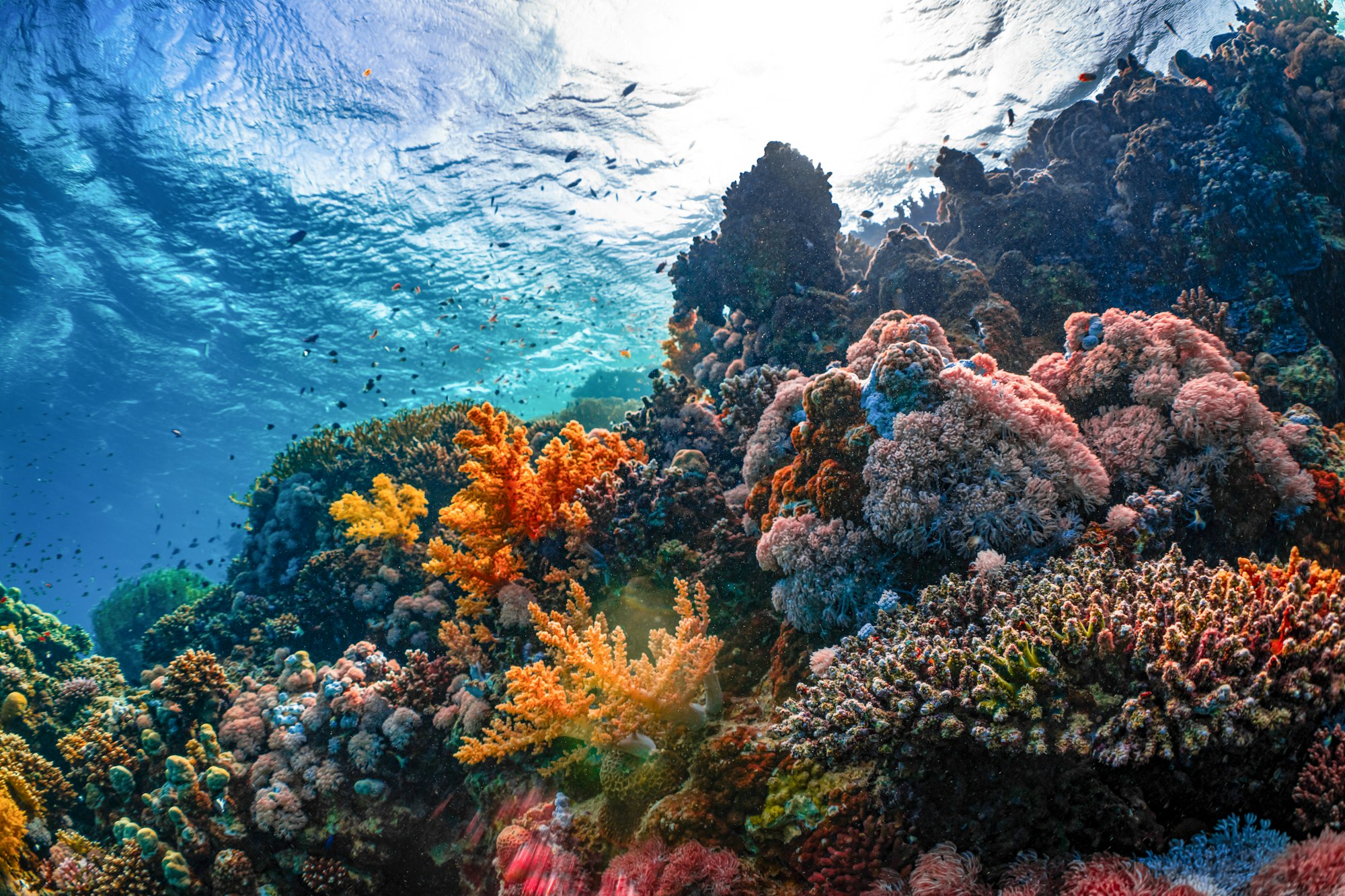
The wreck functions as a reef. Dense clouds of glassfish fill the holds and shadowed structure, with lionfish hanging above them and batfish patrolling the open deck. Titan triggerfish, fusiliers, masked butterflyfish and boxfish are routine; table corals, red sponges and anemonefish colonise the shallower plating. Spanish dancers are occasionally found on night dives.
Conditions & who should dive it
Abu Nuhas is an exposed north-facing reef where currents out of the Gulf of Suez converge — surface conditions can be choppy and surge is common over the shallow bow. Visibility is usually excellent, often 20–30 metres. The open-water route along the hull suits a competent intermediate diver. The holds and engine room are a genuine overhead environment: they demand wreck training, a primary and backup torch, a guide who knows the exits, and disciplined finning. Silt is thick, tile cargo shifts, and collapsed beams and cabling create real entanglement hazards. Divers without penetration training should stay outside the hull — there is more than enough to see.
When to go
Diveable year-round, with water around 22–28°C. Summer brings the warmest water and best conditions; winter can be windy, and this exposed reef is among the first sites cancelled in rough weather.
Getting there
Most divers reach the site by liveaboard on a northern wrecks-and-reefs itinerary, which allows early and late dives before the day boats arrive. Day trips run from El Gouna (closest), Hurghada (roughly 2–2.5 hours) and Sharm el-Sheikh (considerably longer).
A note on protection
Abu Nuhas sits in a busy shipping lane and takes heavy dive traffic. The tile cargo is part of the wreck’s identity — souvenirs are not acceptable, and removing anything is prohibited. Careful buoyancy matters doubly here: the shallow bow carries live coral, and silt disturbed inside the holds degrades the dive for everyone behind you.
Sea-surface temperature and wave height from Open-Meteo Marine (ERA5 reanalysis, monthly averages).
26 verified species observations (12 species) logged within ~11 km of this site between 1990 and 2012, from the Ocean Biodiversity Information System.
- Tursiops aduncus · Indian ocean bottlenose dolphin
- Tursiops · Bottlenose dolphins
- Stenella attenuata · Pantropical spotted dolphin
- Grampus griseus · Risso's dolphin
- Conus striatus
- Conomurex
- Muricella sayad
- Pseudoparacis erythraeensis
- Verrucella gubalensis
- Acanthogorgia gubalensis
- Astrogorgia milka
- Animalia
Scientific survey records skew toward sampled taxa (molluscs, corals) and do not reflect what you are guaranteed to see on a dive.
Source: OBIS (obis.org), aggregated Darwin Core occurrence records.
Conditions change with the tide and the season. If you have dived this site, share what it was actually like — date, visibility, current, and what you saw. Real, recent reports from divers are exactly what this guide is built to collect.
Send a conditions report ›