Dunraven
27.7033°N 34.1217°E · wreck
The Dunraven is one of the Red Sea’s most popular historic wreck dives, resting on the south face of Sha’ab Mahmoud (also called Beacon Rock) near Sharm el-Sheikh in the Straits of Gubal. The iron-hulled British steamship ran aground on the reef in early 1876 while returning from Bombay, caught fire while stranded, and finally sank on 22 April 1876. Today the wreck lies upside down, creating an atmospheric underwater cavern with good natural light filtering through.
Overview
The Dunraven was an 85-metre British steamship of approximately 1,800 tonnes, built by C. Mitchell and Co. in Newcastle upon Tyne and launched on 14 December 1872. She was engaged in trade between Britain and India when she ran aground on Sha’ab Mahmoud on a return voyage from Bombay, carrying spices, cotton, and muslin. The crew remained on board for weeks attempting to refloat her before the ship caught fire and sank on 22 April 1876. No lives were lost in the sinking. The wreck was rediscovered in 1977. The hull sits inverted on the sandy bottom at 18 metres, with the keel visible at around 6 metres below the surface. The overturned hull creates an overhang that is swim-through accessible on the stern section, where filtered sunlight creates dramatic lighting effects. Visibility at the site typically reaches 20–30 metres. Water temperatures average 22°C in winter and 28°C in summer.
Site Information
- Location: Red Sea, Egypt (Sha’ab Mahmoud / Beacon Rock, Straits of Gubal)
- Entry Type: Boat dive
- Site Type: Wreck dive
- Difficulty Level: Intermediate
- Maximum Depth: 18 meters
- Typical Visibility: 20-30 meters (65-100 feet)
- Current: Moderate to strong
- Best Time: September to May
Marine Life
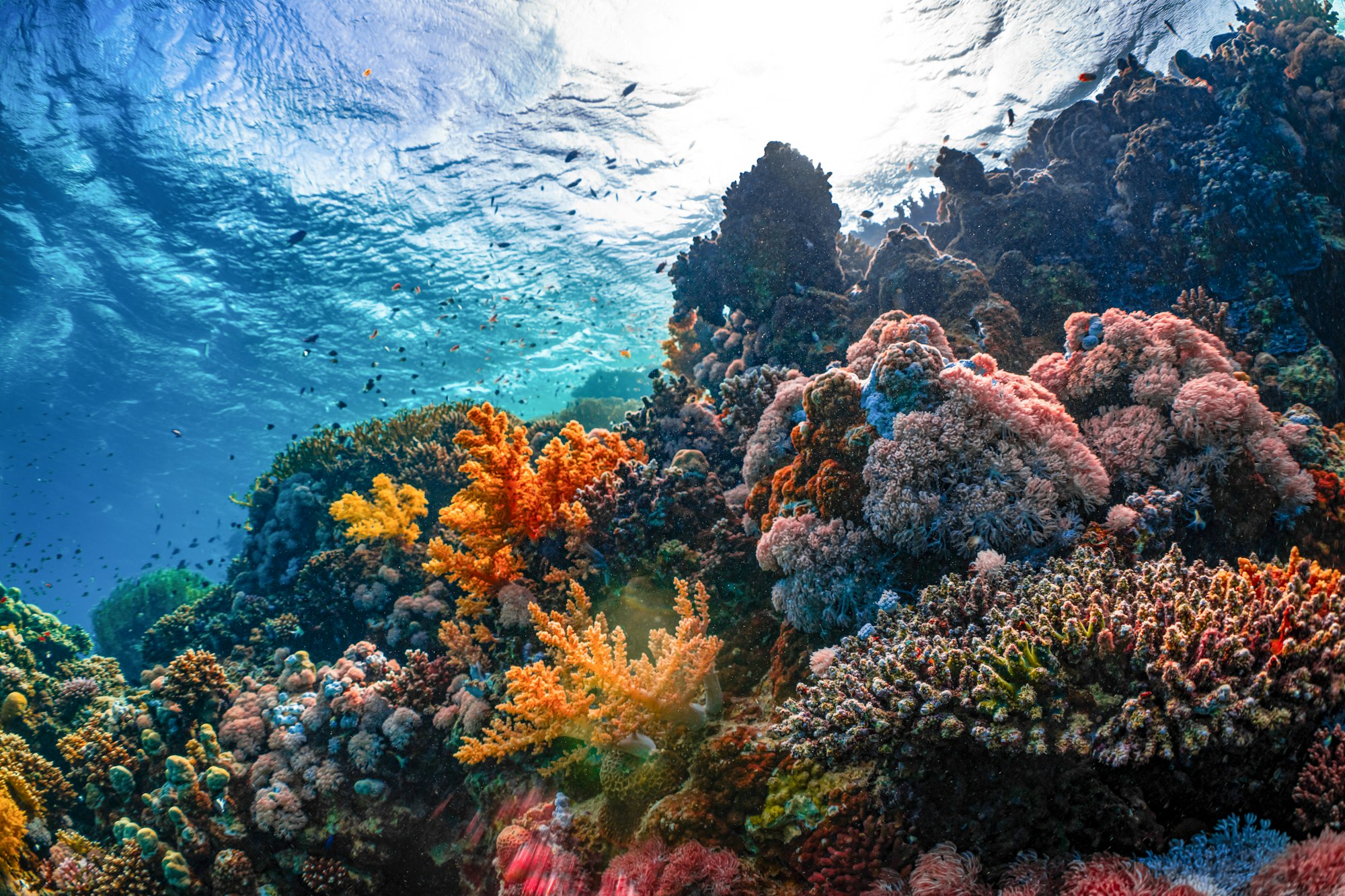
The Dunraven’s encrusted hull hosts an extraordinary diversity of marine life. Glasseye and glassy sweepers school in the thousands beneath the overturned hull’s overhang. Large groupers and squirrelfish occupy the deeper stern sections. Lionfish are ubiquitous throughout the wreck. Soft corals, sea fans, and fire corals have colonised the entire exterior. Sea turtles are regularly seen resting on the sandy bottom alongside the hull. Moray eels peer from portholes and gaps in the plating. Barracuda often cruise the surrounding reef, and reef sharks occasionally circle the wreck site.
Dive Profile
Most operators approach the wreck from the stern, descending to the keel at around 6 meters before dropping down the side to the bow section at 18 meters. The classic route follows the port (left) side to the bow, then turns back along the starboard side past the engine room — still recognisable — to the stern overhang. The stern swim-through at 15 meters is the highlight: a natural cavern formed by the inverted hull that can be safely entered without penetration training, though a torch greatly enhances the experience. Reserve 50 bar for the return journey and safety stop.
Entry and Exit
Boats moor on a fixed mooring buoy on the reef. Entry is via giant stride; descend the mooring line to the wreck. Return to the mooring line for ascent and a 3-minute safety stop at 5 meters. The site can experience moderate current flowing along the reef face — if conditions are running, drift to a point where you can still ascend the line.
Tips and Recommendations
- Bring a dive torch — the stern swim-through and interior overhangs require light to fully appreciate
- Maintain careful buoyancy throughout to avoid stirring up silt inside the hull cavern
- The stern swim-through is beginner-accessible but can be disorienting on the first pass — follow your guide
- Best light inside the cavern is around midday when sun is overhead
- Combine with a dive on the nearby Thistlegorm wreck for a full Red Sea wreck day
Safety Considerations
The stern swim-through is a confined space; divers with poor buoyancy should practice before attempting it. Lionfish are numerous throughout the wreck and hide in dark recesses — watch where you put your hands. Moderate currents are possible across the Straits of Gubal. Always carry an SMB for open-water safety stops. Fire coral is present on much of the exterior encrustation.
Photography
The Dunraven is among the most photogenic wrecks in the Red Sea. The stern swim-through with sunlight beams streaming through gaps in the hull is an iconic Red Sea image. A wide-angle lens captures the sweep of the inverted hull; a torch or video light will bring out the colours of the soft corals and sweeper schools in the cavern interior. Macro photographers will find nudibranchs, flatworms, and commensal shrimp throughout the encrusted plates.
Sources: SS Dunraven Wikipedia, Divers Alert Network - Discovery of the Dunraven, Egypt Liveaboard - Dunraven. Last updated 2026-05-25.
Sea-surface temperature and wave height from Open-Meteo Marine (ERA5 reanalysis, monthly averages).
52 verified species observations (31 species) logged within ~11 km of this site between 1995 and 2018, from the Ocean Biodiversity Information System.
- Tursiops · Bottlenose dolphins
- Stenella attenuata · Pantropical spotted dolphin
- Grampus griseus · Risso's dolphin
- Tursiops aduncus · Indian ocean bottlenose dolphin
- Tursiops truncatus · Common bottlenose dolphin
- Rhincodon typus · Whale Shark
- Pseudorca crassidens · False killer whale
- Stenella longirostris · Spinner dolphin
- Nerita sanguinolenta
- Haliotis pustulata
- Vexillum blandulum
- Clanculus pharaonius
Scientific survey records skew toward sampled taxa (molluscs, corals) and do not reflect what you are guaranteed to see on a dive.
Source: OBIS (obis.org), aggregated Darwin Core occurrence records.
Conditions change with the tide and the season. If you have dived this site, share what it was actually like — date, visibility, current, and what you saw. Real, recent reports from divers are exactly what this guide is built to collect.
Send a conditions report ›