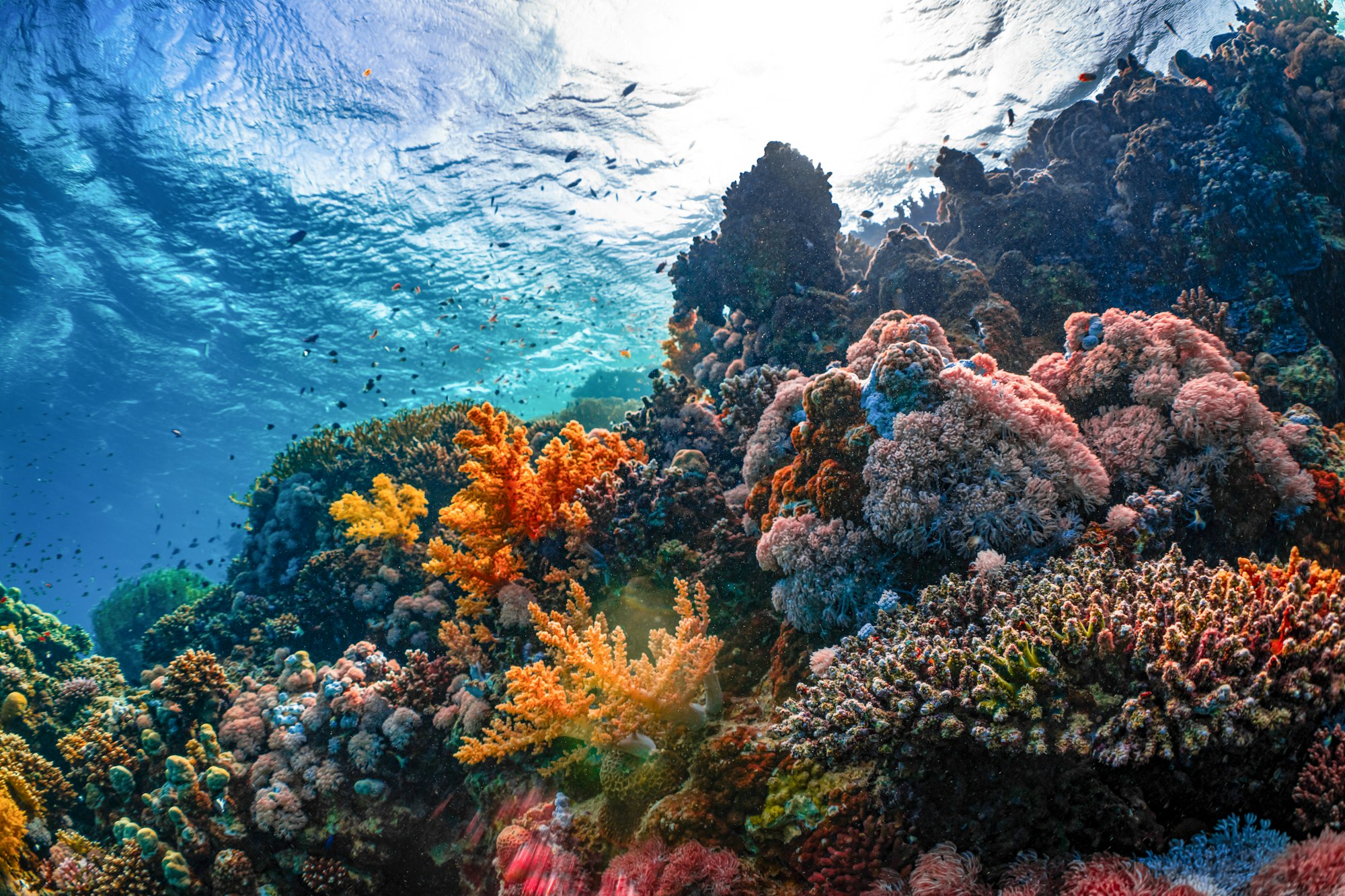
Elphinstone Reef
25.3093°N 34.8607°E · wall
A narrow offshore reef north of Marsa Alam whose north and south plateaus fall into open blue water, drawing oceanic whitetip sharks in autumn along soft-coral walls — an exposed, current-swept advanced dive.
Overview
Elphinstone Reef — also known locally as Sha’ab Abu Hamra — is a narrow, cigar-shaped reef lying alone in open water off Egypt’s southern coast, north of Marsa Alam town and a few nautical miles offshore of the Marsa Abu Dabbab stretch. Published descriptions put its length at roughly 300–400 m, running north to south, with the crest breaking the surface at its midpoint. From that thin spine the reef falls away on both long flanks in near-vertical walls that continue past 100 m into genuinely deep water. Plateaus extend from each tip: the northern one steps down through roughly 20 m to around 40 m before dropping off, while the southern plateau tapers into an arrowhead at a comparable depth. Everything a recreational diver does here happens on those two shoulders and the walls between them.
Why divers come
Elphinstone’s reputation rests on sharks in blue water. It is one of a handful of Egyptian sites — alongside the Brothers and Daedalus — where oceanic whitetips are encountered with some regularity, and where they behave in a way that makes them unmistakable: cruising slowly and shallow near the southern plateau, often shadowed by pilot fish. Hammerheads are the other draw, more often reported off the northern tip and considerably less reliable. Between the shark passes, the walls themselves justify the trip: dense Dendronephthya soft corals, large gorgonians and whip corals, with the reef’s exposed position keeping fish life abundant.
The dive
Most dives start on one plateau and drift along a wall. Boats typically drop divers in the current rather than at a fixed point, and operators commonly call for a negative entry and a brisk descent so the group is not swept off the reef before reaching the drop-off. The northern plateau is the usual hammerhead station; the southern plateau is where whitetips tend to appear, frequently in the top 15 m and often best seen during the safety stop rather than at depth. Beneath the southern tip lies the site’s most talked-about feature, a deep archway sometimes called the Sarcophagus. Reported figures vary between about 52 and 65 m, with roughly 55 m the commonly quoted depth; SSI describes the passage as swimmable at 45–60 m. It is unambiguously a technical-depth feature requiring extended-range training and decompression capability, and it is not a recreational objective. Recreational divers should treat 40 m as the working ceiling and let the archway remain a story told on the boat.
Marine life
Beyond the headline sharks, grey reef and silky sharks are reported, with tiger sharks noted as occasional. Dogtooth tuna, trevally, barracuda, snapper, Napoleon wrasse and moray eels are routine; turtles and dolphins turn up unpredictably, and whale sharks only rarely.
Conditions & who should dive it
This is an exposed, open-ocean pinnacle with no shelter. Currents are strong — commonly cited at two knots or more, usually running north to south but capable of reversing — and they are genuinely unpredictable, with divers and operators frequently reporting turbulence and downward flow along the walls. Surface conditions can be rough enough to cancel the day. Visibility averages around 20 m and is often better. Operators generally ask for Advanced Open Water certification plus meaningful logged experience, commonly around 50 dives including deep and drift work.
The sharks require their own discipline. Oceanic whitetips are large, bold and persistent; they approach closely and make repeated passes, and this is normal rather than predatory. Documented bite incidents involving the species have occurred in the Egyptian Red Sea, which is precisely why standard guidance is followed strictly: stay together as a group, hold a vertical posture in the water column, keep the shark in sight, do not dangle limbs or trail equipment, never chase, touch or bait, and ascend and exit as a unit under the guide’s direction. Encounters here overwhelmingly pass without incident when that briefing is respected.
When to go
Oceanic whitetip sightings peak in autumn, roughly October to December, with September through November most often named as the sweet spot. Water temperatures range from around 22 °C in late winter to roughly 29 °C in late summer, so a suitable exposure suit matters for repetitive deep dives.
Getting there
Elphinstone is reached by day boat from Marsa Alam and Port Ghalib — a short run in good weather, longer from northern ports — or as a scheduled stop on southern Red Sea and offshore-marine-park liveaboard itineraries. Early departures are favoured for calmer seas and quieter water.
A note on protection
Egypt’s Red Sea reefs are managed by the Egyptian Environmental Affairs Agency, with ranger patrols, mooring buoys in place of anchoring, and restrictions on disturbing or removing marine life. References differ on Elphinstone’s exact administrative status relative to the fee-collecting offshore protectorates, so divers should follow their operator’s current guidance on permits and site rules. Regardless of designation, the conservation stakes are high: oceanic whitetips have declined severely worldwide and the Red Sea is among their remaining strongholds. No feeding, no baiting, no pursuit.
Sea-surface temperature and wave height from Open-Meteo Marine (ERA5 reanalysis, monthly averages).
27 verified species observations (12 species) logged within ~11 km of this site between 1996 and 2025, from the Ocean Biodiversity Information System.
- Tursiops · Bottlenose dolphins
- Stenella longirostris · Spinner dolphin
- Tursiops aduncus · Indian ocean bottlenose dolphin
- Rhincodon typus · Whale Shark
- Conomurex fasciatus
- Nerita sanguinolenta
- Maculastrombus mutabilis
- Dolomena plicata
- Aplysia nigrocincta
- Stomatella auricula
- Rochia virgata
- Tripneustes gratilla
Scientific survey records skew toward sampled taxa (molluscs, corals) and do not reflect what you are guaranteed to see on a dive.
Source: OBIS (obis.org), aggregated Darwin Core occurrence records.
Conditions change with the tide and the season. If you have dived this site, share what it was actually like — date, visibility, current, and what you saw. Real, recent reports from divers are exactly what this guide is built to collect.
Send a conditions report ›