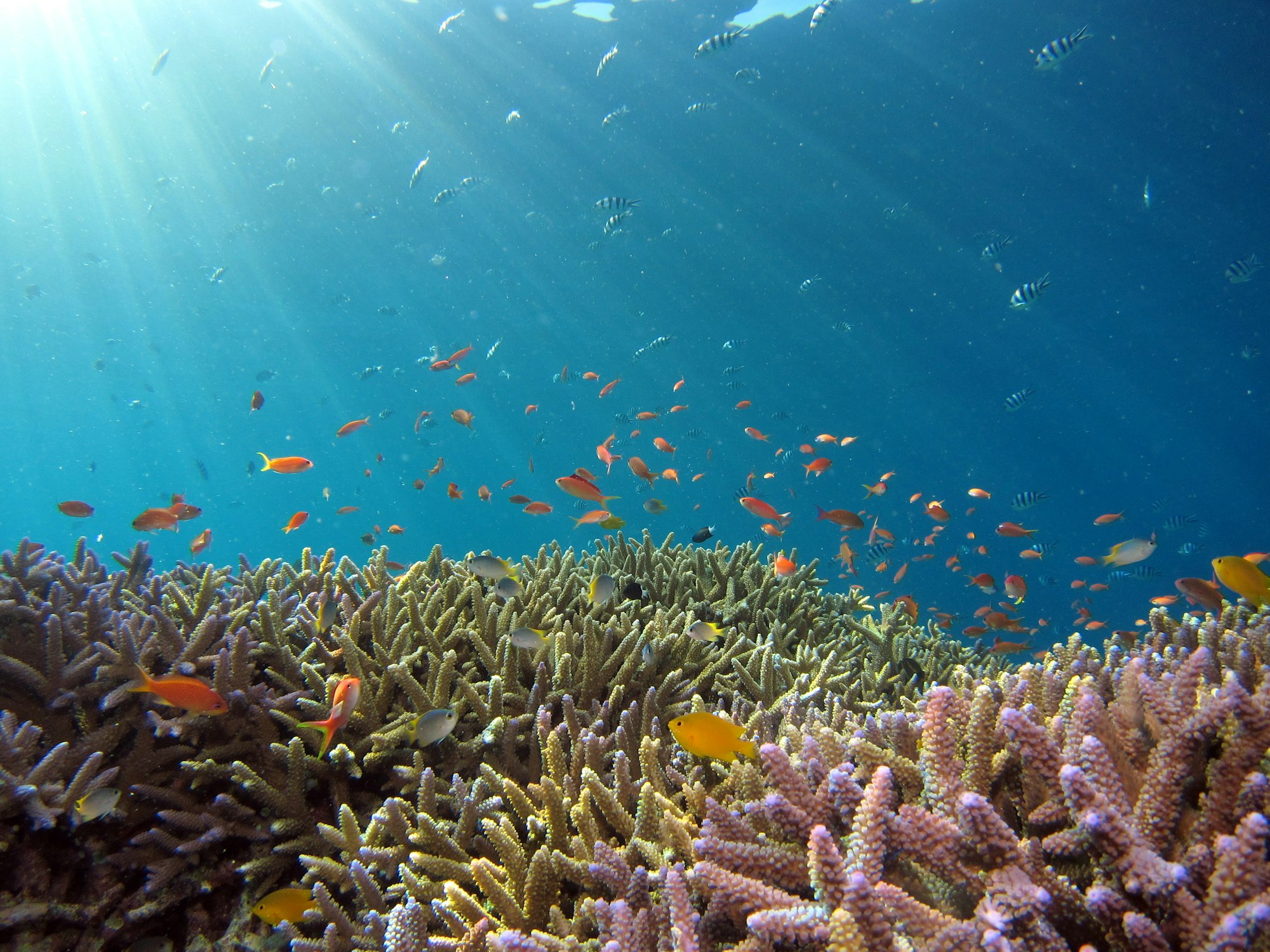
Golden Blocks
28.4391°N 34.4660°E · reef
Golden Blocks is a reef dive site in the northern Egyptian Red Sea near Dahab, named for the large rectangular blocks of yellow-gold coral and rock formations that give the site its distinctive character.
Overview
Located in the Dahab area on the Gulf of Aqaba side of the Sinai Peninsula, Golden Blocks sits in the upper part of the Gulf where vertical light and exceptional water clarity create the intense blue and gold colour contrasts that give the site its name. The “blocks” are large sandy and coral-covered rocky outcrops arranged on a gently sloping reef, lying at depths of 5–20 meters. The site is generally dived as a boat dive and sees less traffic than Dahab’s more famous shore entries, giving it a quieter character. The coral blocks are interspersed with sandy corridors, creating a navigable maze-like structure ideal for exploratory diving.
Site Information
- Location: Gulf of Aqaba, Dahab area, northern Sinai, Egypt
- Entry Type: Boat dive
- Site Type: Reef
- Difficulty Level: Intermediate
- Maximum Depth: 20 meters
- Typical Visibility: 20–35 meters
- Current: Generally mild in the Gulf of Aqaba
- Best Time: October to May
Marine Life
The sandy corridors between the blocks are hunting grounds for humphead wrasse, and juvenile fish of many species shelter in the gaps. Triggerfish — both Picasso and titan — are territorial around nesting areas on the sand. Bluespotted ribbontail rays rest in the open sandy patches. The blocks themselves host numerous small critters including nudibranchs, shrimps, and juvenile moray eels. Reef sharks pass through on occasion, and barracuda hang in small groups above the deeper blocks. Turtles visit regularly to feed on algae growing on the block surfaces.
Dive Profile
Enter from the boat and descend to the deepest blocks at 18–20 meters. Navigate through the sandy corridors between the blocks, gradually ascending as you work northward. The majority of bottom time is well spent in the 8–15 meter range where coral encrustation on the blocks is most developed. Finish the dive in the shallower block zone at 5–8 meters for the safety stop.
Entry and Exit
Day-boat access from Dahab operators. Entry by giant stride. The site’s approximate coordinates are noted — confirm the exact mooring position with the local dive guide, as boat captains navigate by landmarks. Exit back to the boat by SMB.
Tips and Recommendations
- Bring a torch to look under the blocks and in the sandy corridors for resting rays and hidden critters
- The sandy sections are worth inspecting slowly for garden eels and sand-dwelling gobies
- Titan triggerfish nest on the sand between blocks — give them a wide berth March–May
- The site offers good alternative diving when Dahab’s famous shore entries are crowded
- Dahab’s clear Gulf of Aqaba water makes this site excellent for natural-light photography
Safety Considerations
Titan triggerfish can be aggressive during nesting season (March–May). If one charges, swim upward rather than away horizontally. Currents in the Gulf of Aqaba are generally mild but can increase with wind. Be aware of boat traffic in the Dahab bay when surfacing, and always deploy an SMB.
Photography
The blocky formations create geometric, graphically interesting compositions when combined with wide-angle lenses. The intense blue Gulf of Aqaba water makes a striking backdrop. Macro subjects on the block surfaces and in the sand corridors are rewarding for patient photographers.
Sources: Divezone - Red Sea, Dive the World - Egypt Red Sea, Red Sea Scuba Diving, PADI - Diving in Egypt. Last updated 2026-04-04.
Sea-surface temperature and wave height from Open-Meteo Marine (ERA5 reanalysis, monthly averages).
357 verified species observations (274 species) logged within ~11 km of this site between 1968 and 2024, from the Ocean Biodiversity Information System.
- Pleurosicya micheli · Michel's Ghost Goby
- Aseraggodes macronasus
- Siganus · Black Spinefoot
- Priolepis cincta · Banded Reef Goby
- Haliophis guttatus
- Pleurosicya prognatha · Beaky Acropora Goby
- Gobiodon irregularis
- Arnoglossus macrolophus
- Astronesthes martensii
- Grampus griseus · Risso's dolphin
- Gobiodon ater
- Gobiodon fuscoruber
Scientific survey records skew toward sampled taxa (molluscs, corals) and do not reflect what you are guaranteed to see on a dive.
Source: OBIS (obis.org), aggregated Darwin Core occurrence records.
Conditions change with the tide and the season. If you have dived this site, share what it was actually like — date, visibility, current, and what you saw. Real, recent reports from divers are exactly what this guide is built to collect.
Send a conditions report ›