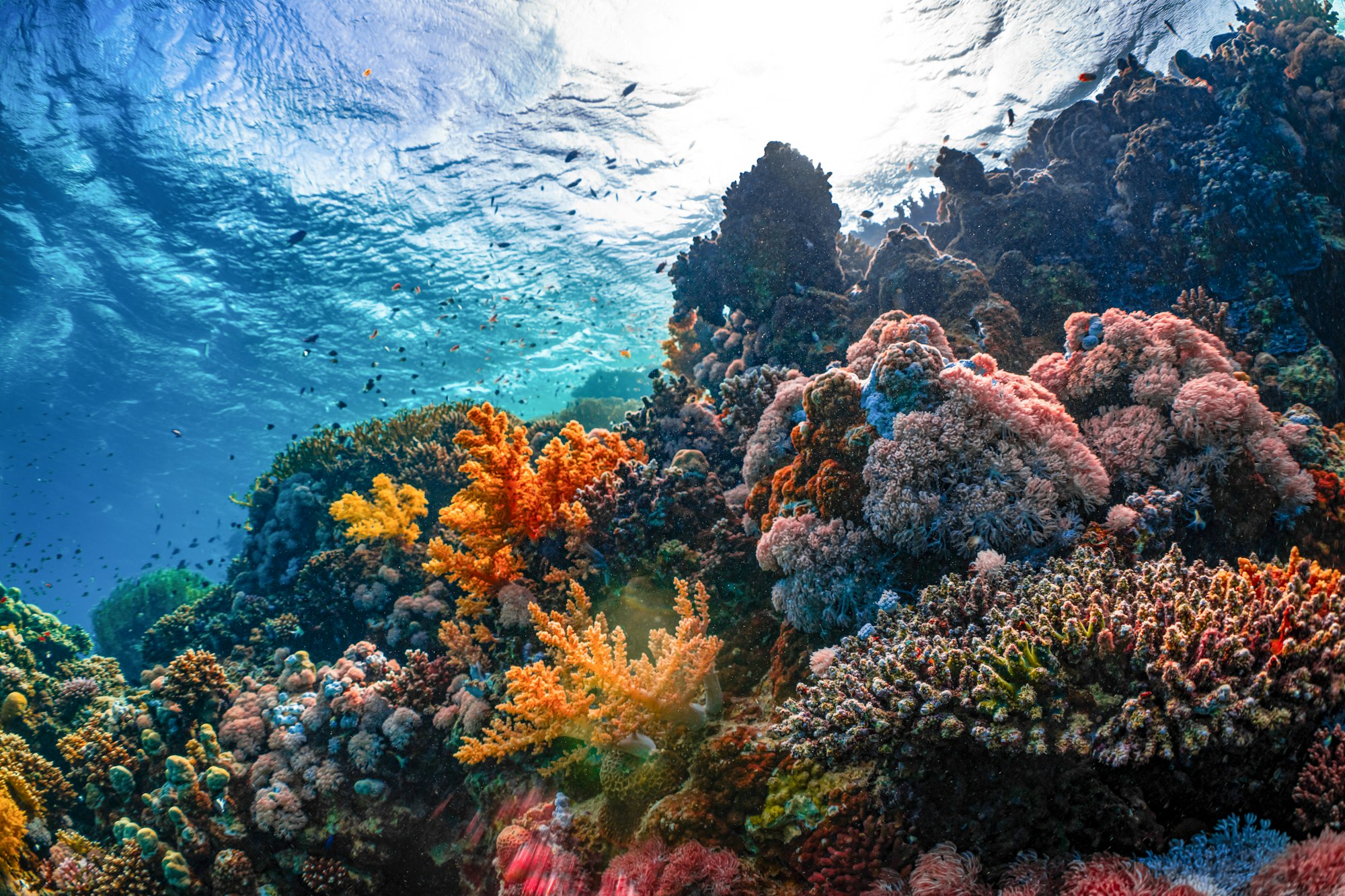
Gordon reef
27.9849°N 34.4536°E · wall
The southernmost of the four Straits of Tiran reefs, marked by the rusting hulk of the cargo ship Loullia and dived for its broad sandy plateau, garden eels and occasional resting whitetip reef sharks; generally the gentlest Tiran reef but still current-exposed.
Overview
Gordon Reef is the southernmost of the four coral towers — Jackson, Woodhouse, Thomas and Gordon — that rise from the deep water of the Straits of Tiran, where the Gulf of Aqaba narrows to a few kilometres of navigable channel. Named, like its neighbours, after nineteenth-century British cartographers, the reefs split the strait into two shipping passages still used by commercial traffic today. Gordon is the nearest of the four to Sharm el-Sheikh and the first reached on a northbound day boat, which is why it appears on almost every Tiran itinerary. Its reef top sits barely below the surface, and it is instantly identifiable from a distance by the broken hull of a freighter stranded on its northern edge.
Why divers come
The draw is a rare combination: a genuinely large, gently shelving sandy plateau on a site that is otherwise a wall dive, plus a piece of maritime history you can see from the boat deck. On 29 September 1981 the cargo vessel Loullia, sailing in ballast from Aqaba toward Suez, was pushed off course in a storm and grounded on the reef’s northern edge. Refloating attempts failed, the crew abandoned her on 2 October, and she was written off as a total loss. She has sat there ever since, bows to the east, corroding and breaking into sections. Divers do not penetrate or dive beneath the hull — it is structurally unsound — but drums and cabling from her cargo lie scattered on the reef around the 15-metre mark, now crusted in coral and sheltering reef fish.
The dive
Boats typically moor on the sheltered side and dives are run either as a mooring dive or as a drift, depending on the day’s flow. The plateau fans out to the south-west at roughly 10 to 25 metres, ending in a drop-off into blue water. In its middle is a rounded sandy depression widely called the “Amphitheatre” or “Shark Pool” — the feature many operators loosely refer to as a shark observatory, though the site formally carrying that name lies in Ras Mohammed National Park, not here. Large gorgonian fans stand around its rim at roughly 22–25 metres. A shallower sandy stretch on the way back to the mooring holds a colony of garden eels, best approached slowly and from a distance. Debris from the wreck and from decades of boat traffic — drums, cable, discarded gear — is a visible and unglamorous part of the seascape.
Marine life
The Amphitheatre is the reason for the site’s reputation: whitetip reef sharks are sometimes found resting on the sand there, and eagle rays pass along the plateau edge. Both are occasional, not dependable — divers who treat a shark sighting as a bonus rather than an expectation come away happier. Schooling barracuda, tuna and trevally patrol the drop-off, and bannerfish, groupers, snappers, surgeonfish, unicornfish, turtles, giant morays and Napoleon wrasse are regulars on the reef proper. Summer months bring the best odds of pelagic action in the strait generally; hammerheads are a Tiran possibility rather than a Gordon speciality.
Conditions & who should dive it
Gordon is usually described as the gentlest of the four Tiran reefs, and it is — but that is a relative statement. Current pushes through the strait unpredictably, is often strongest on the southern plateau and along the ascending edge, and can turn a relaxed plateau swim into a drift with little warning. This is an active shipping lane; stay with the guide, carry an SMB and deploy it before surfacing. Visibility is commonly in the 20–25 metre range. Sensible prerequisites are solid buoyancy, current experience and an advanced-level certification.
When to go
Diveable year-round. Water runs roughly 22°C in late winter to around 28°C at the height of summer, with summer bringing warmer water, calmer surface conditions and the better pelagic window; winter is cooler, sometimes windier, and quieter.
Getting there
Day boats from Sharm el-Sheikh, roughly an hour to ninety minutes depending on departure marina. Gordon is normally the first or last stop on a Tiran day, often paired with Thomas, Woodhouse or Jackson.
A note on protection
The Tiran reefs fall within Egypt’s protected-area system administered alongside Ras Mohammed National Park, and a per-person park fee applies to boat trips. Rates change and differ by nationality and activity — confirm the current figure with your operator, and carry cash, as fees are usually collected on the boat or at the gate.
- Loullia — The Red Sea Wreck Project
- Straits of Tiran Diving, Sinai Peninsula, Red Sea — Dive The World
- Gordon Reef, Tiran — Circle Divers Sharm El Sheikh
- Gordon Reef, Straits of Tiran — Pro-Taucher
- Gordon Reef — Seawolf Diving Safari
- National park fees for divers in Sharm el Sheikh — Reef Oasis Dive Club
Sea-surface temperature and wave height from Open-Meteo Marine (ERA5 reanalysis, monthly averages).
171 verified species observations (78 species) logged within ~11 km of this site between 1968 and 2023, from the Ocean Biodiversity Information System.
- Grampus griseus · Risso's dolphin
- Stenella attenuata · Pantropical spotted dolphin
- Tursiops truncatus · Common bottlenose dolphin
- Stenella longirostris · Spinner dolphin
- Tursiops · Bottlenose dolphins
- Rhincodon typus · Whale Shark
- Tursiops aduncus · Indian ocean bottlenose dolphin
- Stenella · Spinner dolphins
- Bathygobius fuscus
- Istigobius decoratus
- Meiacanthus nigrolineatus
- Trimma mendelssohni
Scientific survey records skew toward sampled taxa (molluscs, corals) and do not reflect what you are guaranteed to see on a dive.
Source: OBIS (obis.org), aggregated Darwin Core occurrence records.
Conditions change with the tide and the season. If you have dived this site, share what it was actually like — date, visibility, current, and what you saw. Real, recent reports from divers are exactly what this guide is built to collect.
Send a conditions report ›