Hey Daroma
28.0567°N 34.4483°E · wreck
Hey Daroma is a wreck dive in the northern Egyptian Red Sea near Sharm el-Sheikh, the remains of a vessel that foundered in the waters of the Tiran/Sharm corridor and now lies on the reef slope at accessible depths.
Overview
The northern Red Sea near Sharm el-Sheikh is a historically active shipping lane, and the reefs and shallows have claimed several vessels over the centuries. Hey Daroma is one of these casualties — a wreck that settled on the reef slope at depths of 5–20 meters, accessible to intermediate divers on day trips from Sharm el-Sheikh. The vessel has been encrusted with coral growth over the years, and the structure now functions as an artificial reef that supports a distinct community of wreck-dwelling species. The wreck is positioned so that both the shallow upper sections and the deeper hull base can be explored in a single dive, offering a varied profile.
Site Information
- Location: Northern Egyptian Red Sea, Sharm el-Sheikh area
- Entry Type: Boat dive
- Site Type: Wreck dive
- Difficulty Level: Intermediate
- Maximum Depth: 20 meters
- Typical Visibility: 20–30 meters
- Current: Moderate; subject to tidal influence in the Tiran corridor
- Best Time: October to May
Marine Life
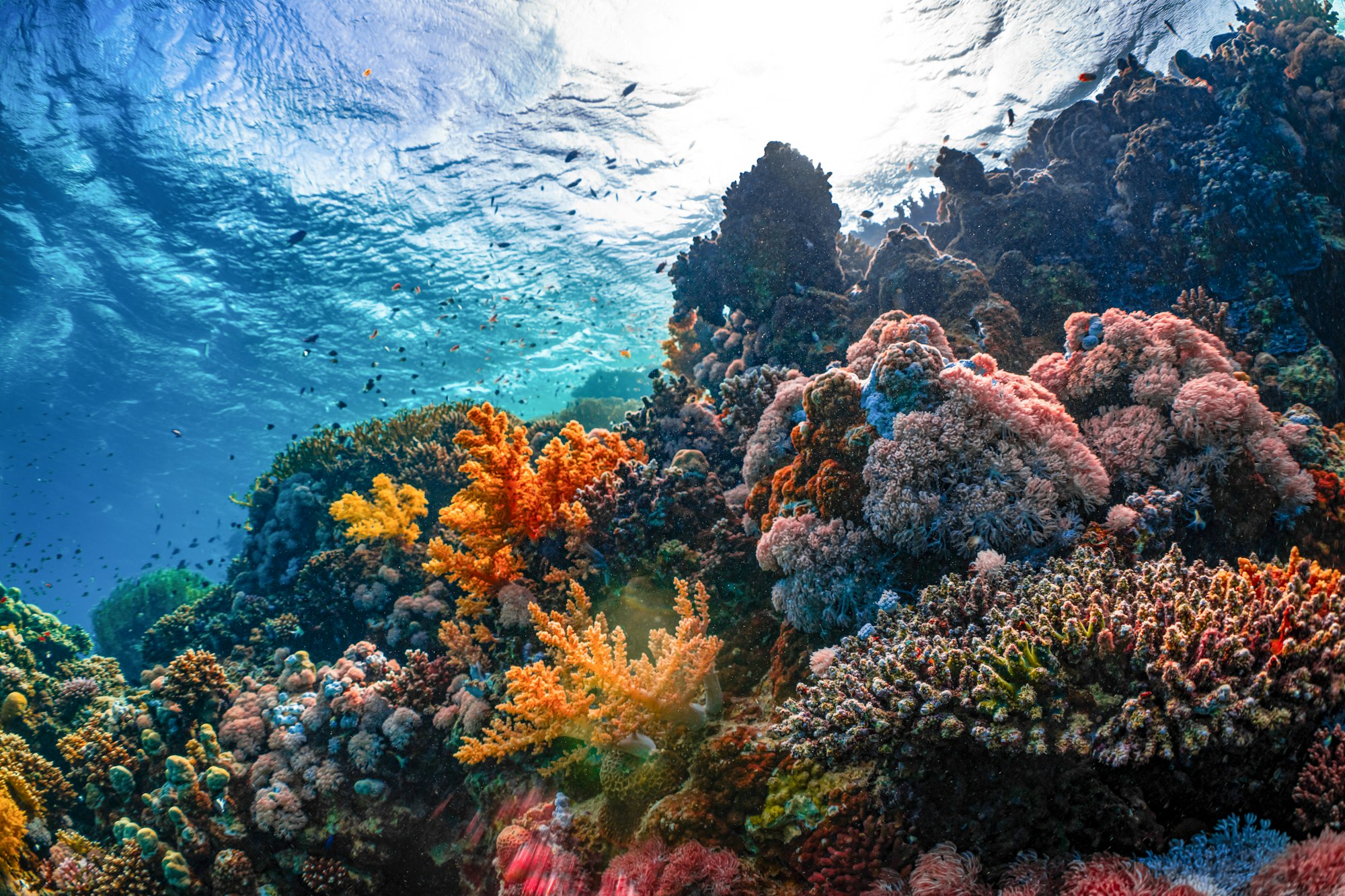
Schools of glassy sweepers and cardinalfish fill the wreck’s interior spaces and overhangs, creating a shimmering silver curtain effect typical of Red Sea wreck diving. Lionfish are consistently present, hovering motionless in the shade of the hull. Large groupers claim the deeper sections. Moray eels are resident throughout the structure, and triggerfish patrol the exterior hull surfaces. The surrounding reef slope hosts the standard Sharm-area community of reef fish, including humphead wrasse and hawksbill turtles grazing the coral nearby.
Dive Profile
Descend to the deepest part of the wreck at 18–20 meters to examine the hull base and any swim-throughs. Work upward along the hull, exploring overhangs and recesses as depth decreases. The shallowest part of the wreck at 5–8 meters is well lit and provides good photographic conditions for natural-light shots. Complete the safety stop hovering near the shallowest hull section.
Entry and Exit
Day-boat access from Sharm el-Sheikh or Naama Bay operators. Entry by giant stride or back roll. The boat typically anchors or moors near the wreck. Deploy an SMB before ascending and surface on the lee side of the reef to minimise exposure to Tiran corridor tidal currents.
Tips and Recommendations
- A dive torch is essential for illuminating the wreck interiors and bringing out coral colours
- Maintain strict buoyancy control inside the wreck to prevent silt disturbance
- The combination of wreck exterior and surrounding reef allows a varied dive experience
- Northern Red Sea visibility in the Sharm area is typically among the best in Egypt — bring a wide-angle lens
- Combine with a Tiran reef dive for a balanced day trip from Sharm el-Sheikh
Safety Considerations
Entanglement risks on a degraded wreck include loose metal, netting, and cables. Never force through constricted spaces. Strong tidal flow in the Sharm–Tiran corridor can affect ascents; deploy an SMB well before surfacing. Avoid penetrating deep into the wreck without proper training and equipment.
Photography
The glassy sweeper clouds inside the wreck are excellent wide-angle subjects, especially when backlit by natural light entering from the wreck openings. The exterior hull with coral encrustation provides colourful close-focus wide-angle opportunities. A powerful torch is needed for interior detail shots.
Sources: Divezone - Red Sea, Dive the World - Egypt Red Sea, Red Sea Scuba Diving, PADI - Diving in Egypt. Last updated 2026-04-04.
Sea-surface temperature and wave height from Open-Meteo Marine (ERA5 reanalysis, monthly averages).
137 verified species observations (61 species) logged within ~11 km of this site between 1968 and 2022, from the Ocean Biodiversity Information System.
- Grampus griseus · Risso's dolphin
- Stenella attenuata · Pantropical spotted dolphin
- Tursiops truncatus · Common bottlenose dolphin
- Stenella longirostris · Spinner dolphin
- Tursiops · Bottlenose dolphins
- Tursiops aduncus · Indian ocean bottlenose dolphin
- Bathygobius fuscus
- Istigobius decoratus
- Meiacanthus nigrolineatus
- Stenella · Spinner dolphins
- Trimma avidori
- Trimma mendelssohni
Scientific survey records skew toward sampled taxa (molluscs, corals) and do not reflect what you are guaranteed to see on a dive.
Source: OBIS (obis.org), aggregated Darwin Core occurrence records.
Conditions change with the tide and the season. If you have dived this site, share what it was actually like — date, visibility, current, and what you saw. Real, recent reports from divers are exactly what this guide is built to collect.
Send a conditions report ›