Jackson reef
28.0060°N 34.4726°E · wall
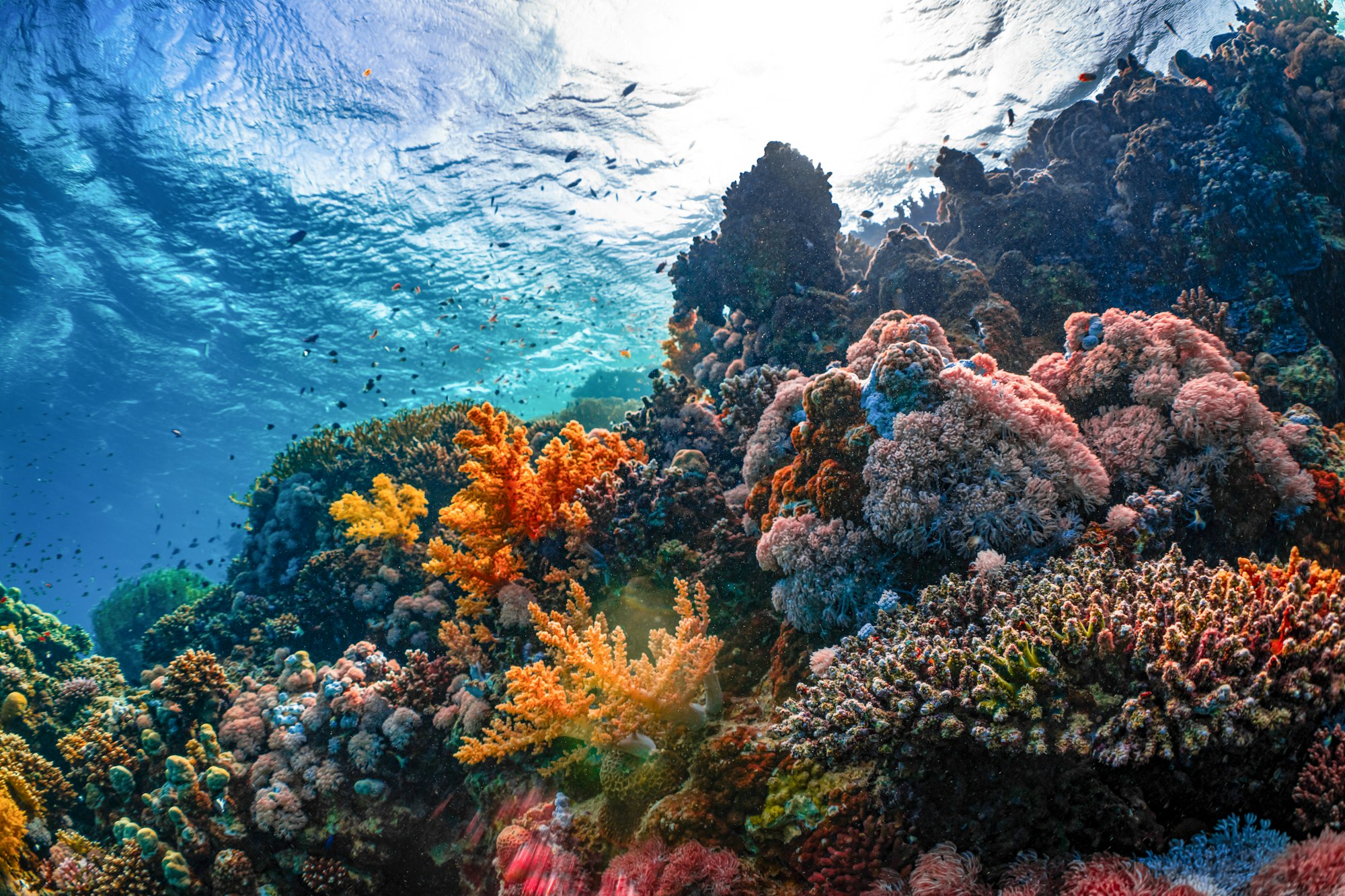
The northernmost of the four Straits of Tiran reefs, Jackson pairs a coral-plastered wall and current-swept plateau with the rusting remains of the freighter Lara on its reef top, plus seasonal hammerheads in the blue — advanced diving.
Overview
Jackson Reef is the northernmost of the four coral massifs strung across the Straits of Tiran, at the mouth of the Gulf of Aqaba between the Sinai coast and Tiran Island. With Gordon, Thomas and Woodhouse to its south, it completes a quartet named after the 19th-century British surveyors who charted these waters. The reefs split the strait into two navigable channels — Enterprise Passage to the west for southbound traffic, Grafton Passage to the east for northbound — and it is precisely this constricted, comparatively shallow topography that accelerates tidal flow and makes Tiran diving what it is.
Why divers come
Two things draw boats north. The first is the reef itself: a steeply falling wall and shallow plateau upholstered in soft coral, fed by nutrient-rich water pushing through the strait. The second is the blue. Jackson’s exposed northern aspect drops away into open water where pelagics patrol, and in the warmer months scalloped hammerheads are reported schooling offshore — a genuine possibility rather than a promise. Overhead, the rusting remains of the Lara are unmistakable on the reef top.
The dive
Most day boats moor on the sheltered southern side and run the dive as a drift with the reef on the shoulder. Shallow sandy cuts and a coral garden give way to a wall that plunges past recreational limits toward a sandy floor where garden eels stand in the current; typical profiles keep divers in the top 30 metres. The northern side, where the Lara lies, is only worked when the sea is calm — usually summer — and divers there watch the blue while staying tight to the reef.
The Lara was a Cypriot freighter that grounded on Jackson in the early 1980s. Reported dates differ substantially between operators (1980, 1981 and 1982 all appear, with later salvage variously placed in 1996), so treat any single year with caution. What is consistent: sections of twisted metal remain visible above and just below the waterline on the reef top, while the bulk of the hull lies deep on the northern slope, beyond recreational depth and firmly technical territory.
Marine life
The reef supports dense anthias and fusilier clouds, Napoleon wrasse, giant moray, blue-spotted stingray and hawksbill turtles over the coral. In the current-washed corners, grey reef and whitetip reef sharks, giant trevally, tuna and barracuda work the drop-off. Scalloped hammerheads are the headline act but are seasonal, weather-dependent and encountered out in open water — never assume them.
Conditions & who should dive it
This is an advanced site, and honestly so. Currents through the strait are strong and can shift direction and strength unpredictably, particularly around the exposed corners and the saddle between Jackson and Woodhouse. The real hazard is being carried off the reef into open water, which is why a surface marker buoy is standard kit here, why competent drift technique matters, and why staying with the guide is not a formality. Compounding this, the strait is an active commercial shipping lane with vessel traffic in both passages — surfacing away from the boat is a serious situation, not an inconvenience. Divers should be comfortable with blue-water disorientation, buoyancy in moving water and prompt deployment of an SMB.
When to go
Diving runs year-round with generally excellent visibility. Summer through early autumn brings the calmest seas, the best access to the northern side and the wreck, and the window in which hammerheads are most often reported — commonly cited as roughly July to September, with some operators extending it later. Winter is cooler and windier, and northern-side plans are more frequently abandoned.
Getting there
Jackson is a day-boat site from Sharm el-Sheikh, typically as the northernmost stop on a Tiran itinerary combining two or three of the four reefs. Red Sea liveaboards on northern routes also call here.
A note on protection
The Tiran reefs fall within Egypt’s protected-area network administered alongside Ras Mohammed National Park. Dive centres in Sharm collect a per-person conservation fee on boat trips — commonly quoted at around €7 and settled at the centre — though amounts and exactly which trips they cover have changed over time. Confirm current charges when booking, and dive the reef accordingly: no contact, no collection, nothing left behind.
Sea-surface temperature and wave height from Open-Meteo Marine (ERA5 reanalysis, monthly averages).
166 verified species observations (74 species) logged within ~11 km of this site between 1968 and 2023, from the Ocean Biodiversity Information System.
- Grampus griseus · Risso's dolphin
- Stenella attenuata · Pantropical spotted dolphin
- Tursiops truncatus · Common bottlenose dolphin
- Stenella longirostris · Spinner dolphin
- Tursiops · Bottlenose dolphins
- Tursiops aduncus · Indian ocean bottlenose dolphin
- Bathygobius fuscus
- Istigobius decoratus
- Stenella · Spinner dolphins
- Rhincodon typus · Whale Shark
- Meiacanthus nigrolineatus
- Trimma avidori
Scientific survey records skew toward sampled taxa (molluscs, corals) and do not reflect what you are guaranteed to see on a dive.
Source: OBIS (obis.org), aggregated Darwin Core occurrence records.
Conditions change with the tide and the season. If you have dived this site, share what it was actually like — date, visibility, current, and what you saw. Real, recent reports from divers are exactly what this guide is built to collect.
Send a conditions report ›