Louilla
27.9896°N 34.4535°E · wreck
The Louilla is a wreck stranded on the northern edge of Gordon Reef in the Straits of Tiran — an immediately recognisable sight that sticks more than 10 metres above the water surface and is visible from passing boats. She is a Panamanian-registered freighter of 2,271 GRT, originally built in Sweden in 1952 as the Antonia, later renamed Zschoau and then Loullia. She measured 107.55 metres in length. On 29 September 1981, while sailing in ballast from Aqaba to Suez, she ran aground on the northern edge of Gordon Reef. Salvage attempts failed and she was abandoned on 2 October 1981, declared a total constructive loss.
Overview
The Louilla’s hulk remains partly above the surface, gradually deteriorating over the decades — another vessel has ploughed into her at some point, breaking the wreck in half, and each year she shifts further toward the depths. The accessible diving portions lie at 10–20 metres on the reef slope alongside the grounded hull. The site is typically combined with Gordon Reef wall diving on the same day trip from Sharm el-Sheikh; the wreck provides a distinctive landmark and an interesting complement to the dramatic reef wall.
Site Information
- Location: Strait of Tiran, northern Red Sea, Egypt
- Entry Type: Boat dive
- Site Type: Wreck dive
- Difficulty Level: Intermediate
- Maximum Depth: 20 meters
- Typical Visibility: 20-35 meters (65-115 feet)
- Current: Moderate to strong; tidal flow through the strait
- Best Time: September to May
Marine Life
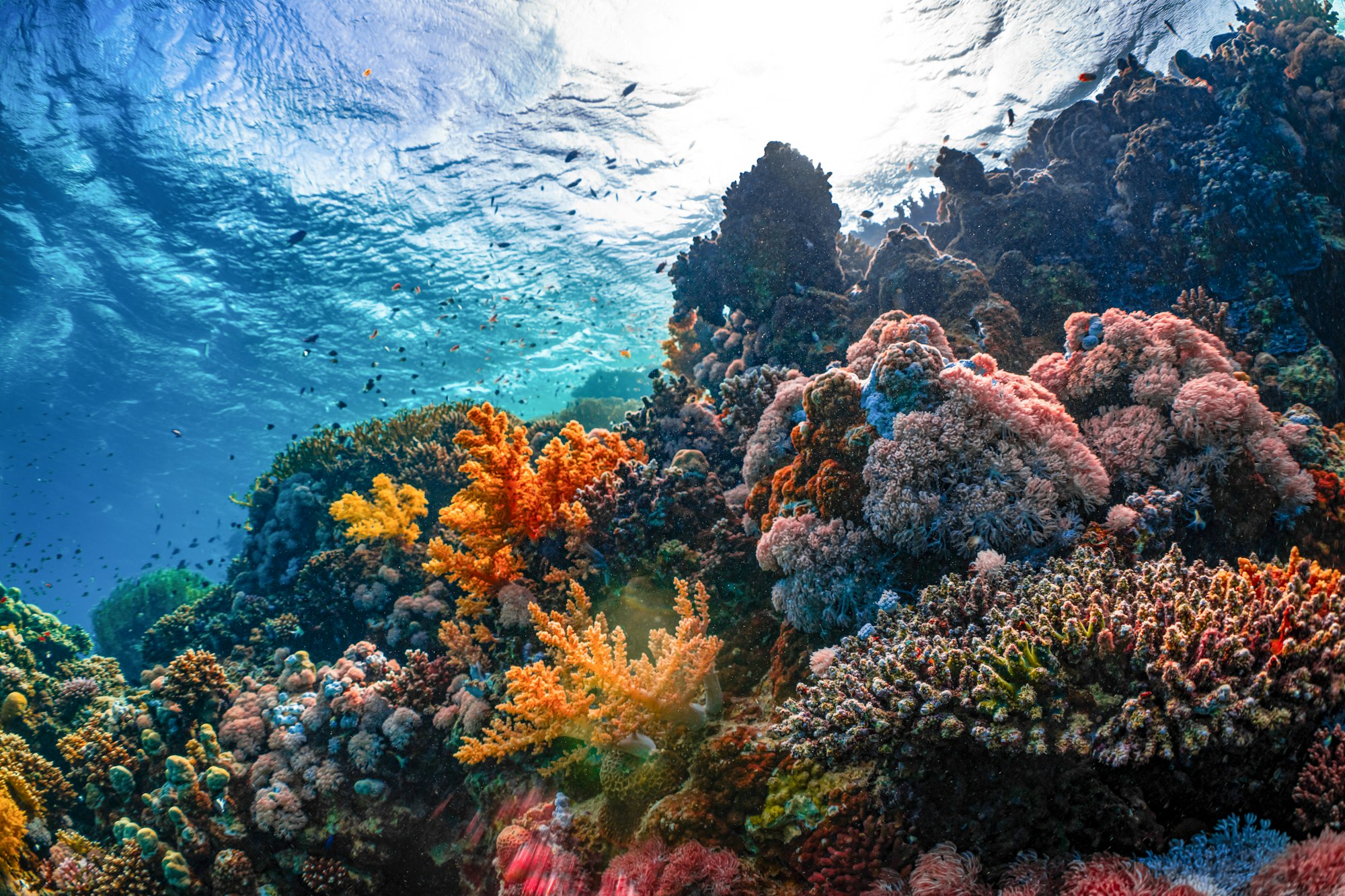
The Louilla wreck hosts a community of encrusting organisms and resident fish that has established over decades. Schools of glassy sweepers fill interior spaces, and groupers occupy the shaded hold sections. Lionfish are abundant along shaded hull sections, and moray eels are common in every suitable crevice. The coral growth on the exterior supports sea fans, soft corals in orange and red, and a range of associated small invertebrates. In the open water surrounding the wreck, the Tiran area’s characteristic mix of humphead wrasse, barracuda schools, and grey reef sharks may be encountered.
Dive Profile
Descend to the wreck and begin by circumnavigating the exterior to understand the structure before exploring in detail. Work the exterior features at 10-20 meters, examining the hull plating, deck structures, and any accessible cargo hold or engine room sections. Allow time to explore the adjacent reef if air permits. Ascend with 50 bar minimum reserve and complete a safety stop before deploying SMB for boat pickup.
Entry and Exit
Day boats and liveaboards from Sharm el-Sheikh access the Tiran area regularly. Entry via giant stride or back roll. Given the tidal currents in the strait, the boat operates a drift pickup rather than fixed anchorage at times. Follow the dive guide’s briefing on current management and exit procedures.
Tips and Recommendations
- Carry a torch — the interior sections and underside of the hull require artificial light
- Check current conditions before the dive; a falling tide can produce strong flow in the strait
- The wreck can be combined with reef diving on the adjacent Tiran reefs for a full day of diving variety
- Ask the operator whether the wreck is accessible for interior exploration on the current visit
Safety Considerations
Tidal currents in the Strait of Tiran can be significant and change in direction and strength with the tidal cycle. Divers must be capable of managing moderate drift conditions and surfacing in open water with an SMB. Wreck penetration requires appropriate training and equipment. Fire coral is present on reef and wreck surfaces; full exposure protection is recommended.
Photography
Wreck photography at this site benefits from both the structural subjects of the hull and the open-water pelagic encounters possible in the surrounding Tiran waters. Wide-angle shots of the coral-encrusted hull work best in mid-morning light. Schools of glassy sweepers in the interior create atmospheric scenes with a torch fill light.
Sources: The Scuba News - The Loullia, Peter & Karen Pecksen - Louilla on Gordon Reef, Emperor Divers - Wrecks of the Red Sea. Last updated 2026-05-25.
Sea-surface temperature and wave height from Open-Meteo Marine (ERA5 reanalysis, monthly averages).
170 verified species observations (78 species) logged within ~11 km of this site between 1968 and 2023, from the Ocean Biodiversity Information System.
- Grampus griseus · Risso's dolphin
- Stenella attenuata · Pantropical spotted dolphin
- Tursiops truncatus · Common bottlenose dolphin
- Stenella longirostris · Spinner dolphin
- Tursiops · Bottlenose dolphins
- Rhincodon typus · Whale Shark
- Tursiops aduncus · Indian ocean bottlenose dolphin
- Stenella · Spinner dolphins
- Bathygobius fuscus
- Istigobius decoratus
- Meiacanthus nigrolineatus
- Trimma mendelssohni
Scientific survey records skew toward sampled taxa (molluscs, corals) and do not reflect what you are guaranteed to see on a dive.
Source: OBIS (obis.org), aggregated Darwin Core occurrence records.
Conditions change with the tide and the season. If you have dived this site, share what it was actually like — date, visibility, current, and what you saw. Real, recent reports from divers are exactly what this guide is built to collect.
Send a conditions report ›