Shark Reef
27.7257°N 34.2590°E · wall
Shark Reef
A sheer 800-metre wall at the tip of Ras Mohammed where grey reef sharks patrol the deep edge and massing schools of barracuda, trevally, and snappers create one of the Red Sea’s most spectacular fish concentrations.
Overview
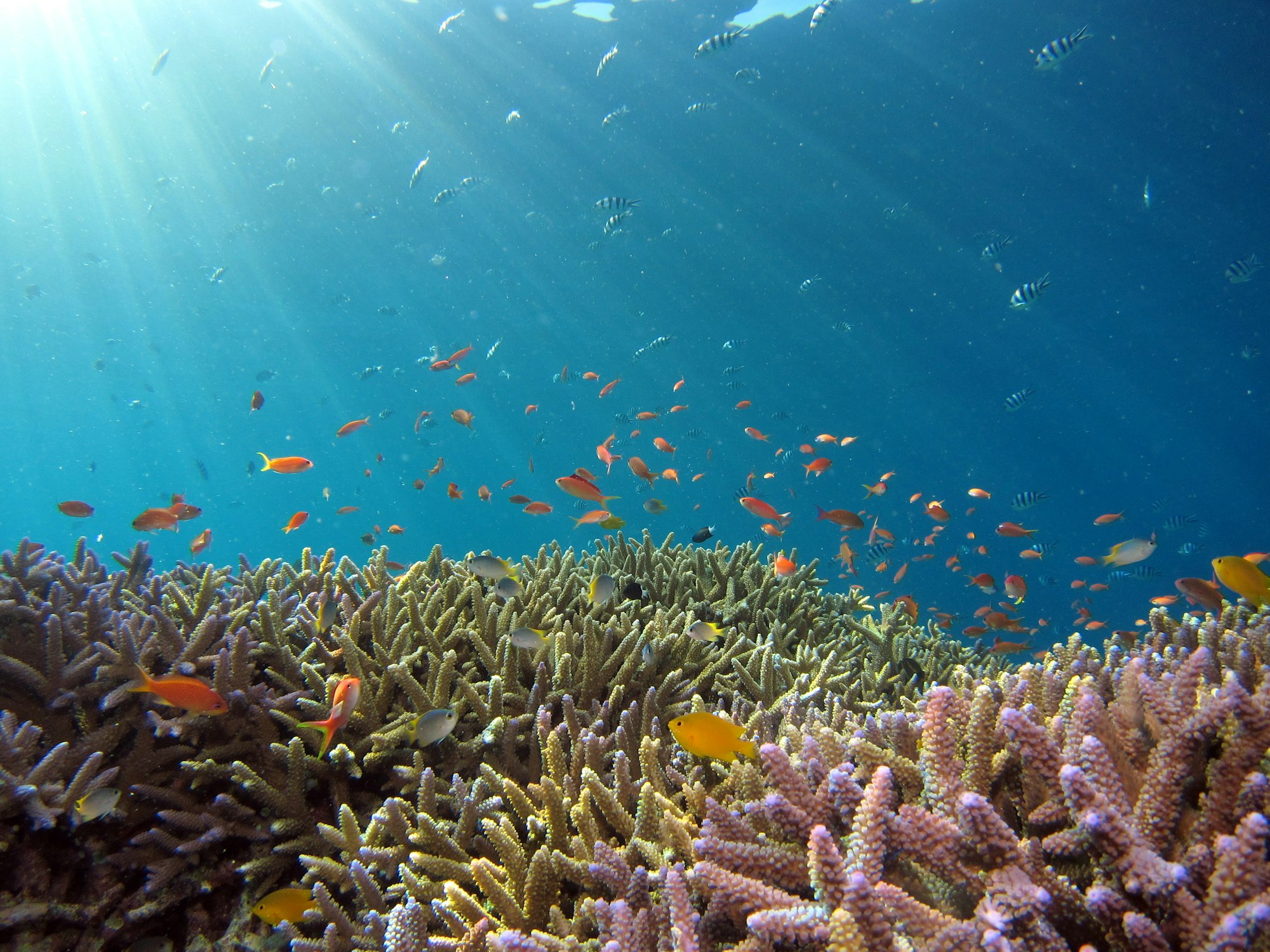
Shark Reef is the first reef encountered when drifting from Ras Mohammed National Park’s famous eastern face, typically dived as a continuous drift with the adjacent Yolanda Reef to the south. Located at the very southern tip of the Sinai Peninsula, where the Gulf of Suez meets the Gulf of Aqaba, Shark Reef owes its biodiversity to the powerful tidal currents that funnel nutrients up the walls. The eastern face is a near-vertical wall dropping 800 metres to the sea floor — one of the most dramatic submarine topographies in the Red Sea. The wall is mantled with orange and purple anthias, massive soft coral trees, and sea fans. Grey reef sharks — the species that gives the reef its name — are reliably seen cruising the wall edge at 15–25 metres, often using cleaning stations in the reef structure. In summer months (July–September), enormous pelagic aggregations form here, with dense schools of yellowfin tuna, barracuda, jacks, and snappers making this one of the most impressive fish biomass concentrations in the Egyptian Red Sea.
Site Information
- Location: Ras Mohammed National Park, Sinai Peninsula, Egypt
- Entry Type: Boat dive
- Site Type: Wall dive
- Difficulty Level: Advanced
- Maximum Depth: 25 meters
- Typical Visibility: 20–35 meters
- Current: Moderate to very strong; key planning factor
- Best Time: Year-round; summer for pelagic aggregations; winter for calmer conditions
Marine Life
Grey reef sharks are the site’s signature residents, typically seen at 15–25 metres along the wall edge, often at cleaning stations where cleaner wrasse tend to them. In summer, yellowfin tuna in large schools patrol the outer blue. Giant barracuda schools mass at the surface on windless summer mornings. Schooling jacks (bigeye and horse-eye) sweep through constantly. Hawksbill and green turtles rest on the shallow reef platform. Eagle rays glide along the base of the wall. Groupers, including potato groupers of substantial size, occupy ledges. The wall itself is heavily colonised by anthias, butterflyfish, bannerfish, and parrotfish. Seasonal visitors include hammerhead sharks (winter, early morning) and occasional manta rays.
Dive Profile
The dive starts with a descent to 15–20 metres at the reef edge and progresses as a drift south from Shark Reef to Yolanda Reef. The eastern wall is the main feature — stay close enough to appreciate the coral and scan the blue for pelagics. Grey reef sharks are most reliably seen at the mid-wall level (15–25 m). The dive transitions naturally to Yolanda Reef where the porcelain cargo wreck field provides the shallow finale. Current can be fast — plan accordingly and be ready to drift without fighting it. Safety stop over the shallow Yolanda reef platform.
Entry and Exit
Exclusive boat access from Sharm el-Sheikh operators — Ras Mohammed requires a park entry fee. Entry by backroll or giant stride, descending quickly to get below the surface current layer. A national park fee applies. The park requires a registered guide. Boat pickup after SMB deployment once clear of the reef. The dive is nearly always done current-assisted, so never plan against the current direction.
Tips and Recommendations
- Enter the water promptly on the divemaster’s signal — missing the entry point means drifting past the reef on the surface
- Position yourself at 15–20 metres on the eastern wall for the best shark sightings
- Keep one eye in the blue water during the entire drift — large pelagics often appear and disappear quickly
- Summer dives (July–August) offer the most intense fish biomass but heavier boat traffic
- Always carry an SMB — drift conditions can separate divers from the boat in seconds
- Combine with Yolanda Reef on the same dive as nature intended
Safety Considerations
Current is the primary hazard. Ras Mohammed currents are tidal and can shift from mild to strong within a single dive. Divers must be comfortable with drift diving, have solid buoyancy control, and be able to deploy an SMB mid-water. The 800-metre wall drop-off below creates depth disorientation risk — monitor depth gauges throughout. Fire coral is abundant on the reef flat. Never attempt this site without an experienced guide who dived it the same morning to assess current direction. Ras Mohammed National Park requires park entry fees and registered dive guides.
Photography
Shark Reef is one of the Red Sea’s premier wide-angle photography sites. Grey reef shark portraits at cleaning stations reward patient hovering. The massing schools of trevally and barracuda in summer produce abstract schooling shots of extraordinary scale. The sheer wall face with its anthias clouds and soft coral trees is spectacular for reef environmental shots. For sharks, position yourself below them against an upward-light background for clean silhouettes.
Sources: Divezone - Red Sea, Dive the World - Egypt Red Sea, Red Sea Scuba Diving, PADI - Diving in Egypt. Last updated 2026-04-04.
Sea-surface temperature and wave height from Open-Meteo Marine (ERA5 reanalysis, monthly averages).
372 verified species observations (269 species) logged within ~11 km of this site between 1828 and 2018, from the Ocean Biodiversity Information System.
- Rhincodon typus · Whale Shark
- Grampus griseus · Risso's dolphin
- Stenella attenuata · Pantropical spotted dolphin
- Tursiops · Bottlenose dolphins
- Tursiops truncatus · Common bottlenose dolphin
- Vinciguerria mabahiss
- Priolepis cincta · Banded Reef Goby
- Tursiops aduncus · Indian ocean bottlenose dolphin
- Pseudorca crassidens · False killer whale
- Stenella longirostris · Spinner dolphin
- Grammistes sexlineatus
- Ecsenius frontalis
Scientific survey records skew toward sampled taxa (molluscs, corals) and do not reflect what you are guaranteed to see on a dive.
Source: OBIS (obis.org), aggregated Darwin Core occurrence records.
Conditions change with the tide and the season. If you have dived this site, share what it was actually like — date, visibility, current, and what you saw. Real, recent reports from divers are exactly what this guide is built to collect.
Send a conditions report ›