Small Brother Island
26.3008°N 34.8626°E · wall
The smaller of Egypt's two Brothers islands, a liveaboard-only offshore pinnacle ringed by sheer gorgonian-draped walls widely rated among the Red Sea's finest, with north-plateau cleaning stations drawing thresher and grey reef sharks. Advanced divers only.
Overview
Small Brother — Little Brother, the lesser of the two islets Egyptians call El Akhawein, “the two brothers” — is a speck of reef in open ocean roughly 67 km off Al-Qusayr, sitting a short hop southeast of its larger sibling. It is small enough to swim around in a dive: operators describe a teardrop-shaped reef only about a hundred metres long, oriented northwest to southeast, breaking the surface by barely a dozen metres. Everything that matters is below. Sheer walls fall away on nearly every side into water hundreds of metres deep, and the island is reachable only by liveaboard.
Why divers come
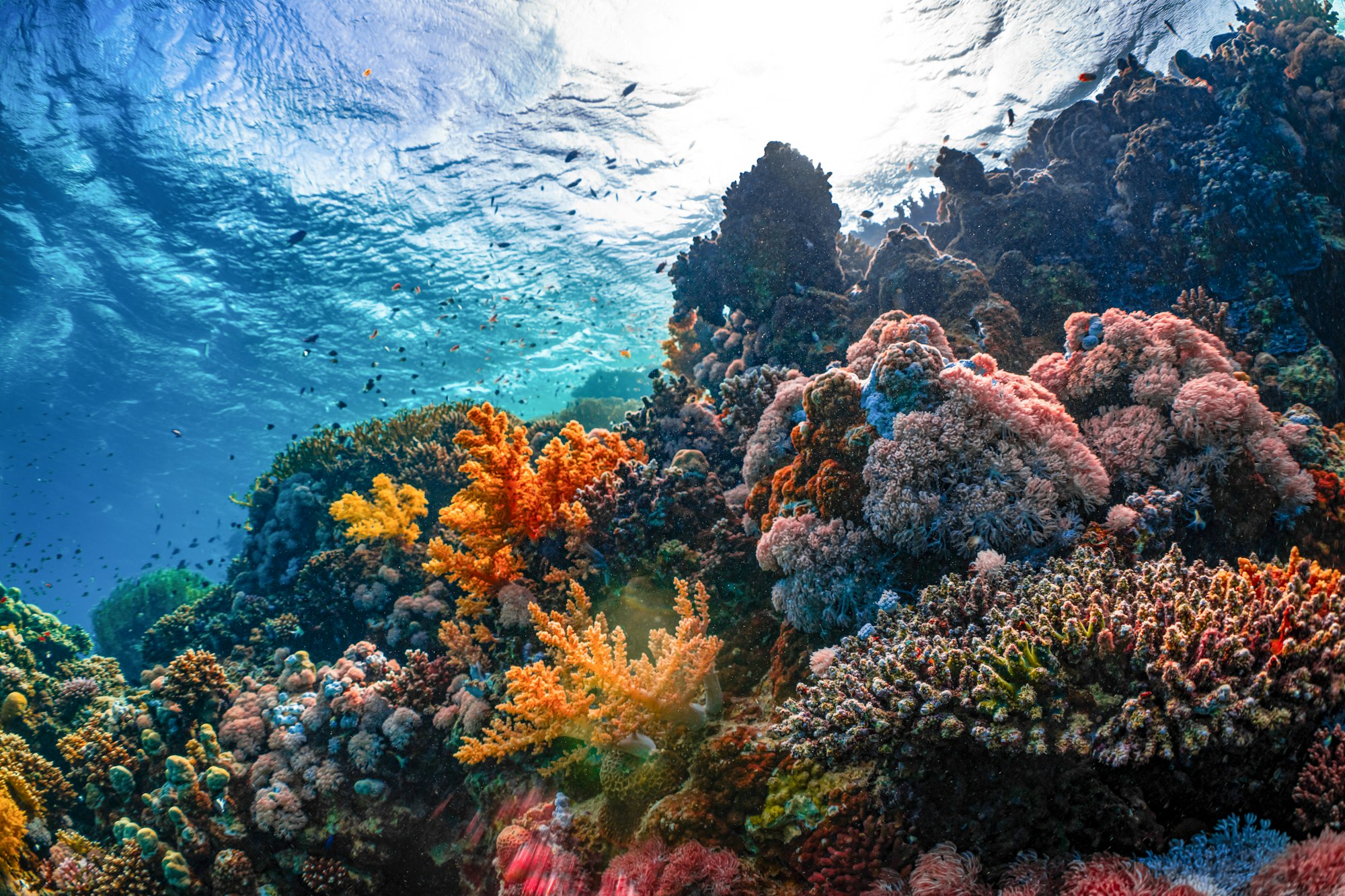
Big Brother has the wrecks — the Numidia and the Aida both lie off its northeastern point. Small Brother has none, and does not need them. Its reputation rests on coral: black coral thickets, dense hard and soft coral cover, and gorgonian sea fans that operators consistently describe as enormous, forming a fan garden that runs from roughly 18 m down past 40 m on the eastern side. It is the wall that repeat visitors talk about, and it is routinely named among the finest in the Red Sea. The second draw is sharks, and the north end is where they concentrate.
The dive
Boats work the site by current, usually dropping at one end and drifting the wall. The reef slopes more gently at the northern point before stepping down to a plateau at around 40 m, and this plateau and the adjacent northeastern wall are where pelagic traffic gathers. Cleaning stations here sit deep — sources place them broadly in the 30–40 m band — which puts them squarely in decompression-planning territory for most divers. The eastern and western walls are the coral showcase, often best in afternoon light on the west. The southern tip has its own plateau, shallower, where barracuda and dogtooth tuna school.
Marine life
Grey reef sharks are the reliable residents, patrolling the north plateau and the fan garden. Hammerheads — scalloped, occasionally great — rise out of the blue for a look and sink away again. Silvertips are reported, more often in late autumn. Thresher sharks visit the cleaning stations, almost always on the first dive of the day, and almost always in the cooler months. They are the reason many divers book the trip, and they are the thing least likely to appear on schedule: treat a thresher as a gift, not an itinerary item. Oceanic whitetips work the walls, particularly in autumn.
Conditions & who should dive it
Currents at Small Brother are frequently described as the strongest anywhere at the Brothers. They shift direction through the day, can change intensity mid-dive, and countercurrents are reported near the southern tip; down-currents are a recognised hazard across the Brothers and demand the skills to recognise and escape one. Much of the wall offers no shallow refuge, so a missed exit means open water with hundreds of metres beneath. An SMB is mandatory, and dives typically begin and end from a Zodiac in seas that can be rough. Oceanic whitetips here are bold and persistent, and will close on divers — brief with the guide before entering. Egyptian regulation requires a minimum of 50 logged dives for the offshore marine parks, and night diving is prohibited. Advanced certification, current experience and honest self-assessment are the real entry requirements.
When to go
Liveaboards run the Brothers roughly May through November, with the fuller season sometimes quoted as May to December. Late spring brings hammerheads; autumn, particularly October and November, offers oceanic whitetips, calmer crossings and visibility that can exceed 30 m. Threshers favour the winter months. Weather can shut the islands down entirely at any point — build slack into the trip.
Getting there
Liveaboard only, no exceptions. Vessels depart from Hurghada, Port Ghalib or Marsa Alam. Since 2018 boats have not been permitted to overnight at the islands and depart in the afternoon, which compresses the diving window and makes early-morning slots valuable.
A note on protection
The Brothers lie within Egypt’s offshore marine protectorate system. Diving requires a licensed operator holding Environmental Affairs Agency permits, and park and port fees are charged separately — usually collected in cash aboard, in euros or dollars. Rules change; confirm current fees, access windows and any closures with your operator before booking.
Sea-surface temperature and wave height from Open-Meteo Marine (ERA5 reanalysis, monthly averages).
14 verified species observations (6 species) logged within ~11 km of this site between 2006 and 2010, from the Ocean Biodiversity Information System.
- Rhincodon typus · Whale Shark
- Pseudorca crassidens · False killer whale
- Acropora humilis
- Acropora hyacinthus
- Acropora paniculata
- Acropora nasuta
Scientific survey records skew toward sampled taxa (molluscs, corals) and do not reflect what you are guaranteed to see on a dive.
Source: OBIS (obis.org), aggregated Darwin Core occurrence records.
Conditions change with the tide and the season. If you have dived this site, share what it was actually like — date, visibility, current, and what you saw. Real, recent reports from divers are exactly what this guide is built to collect.
Send a conditions report ›