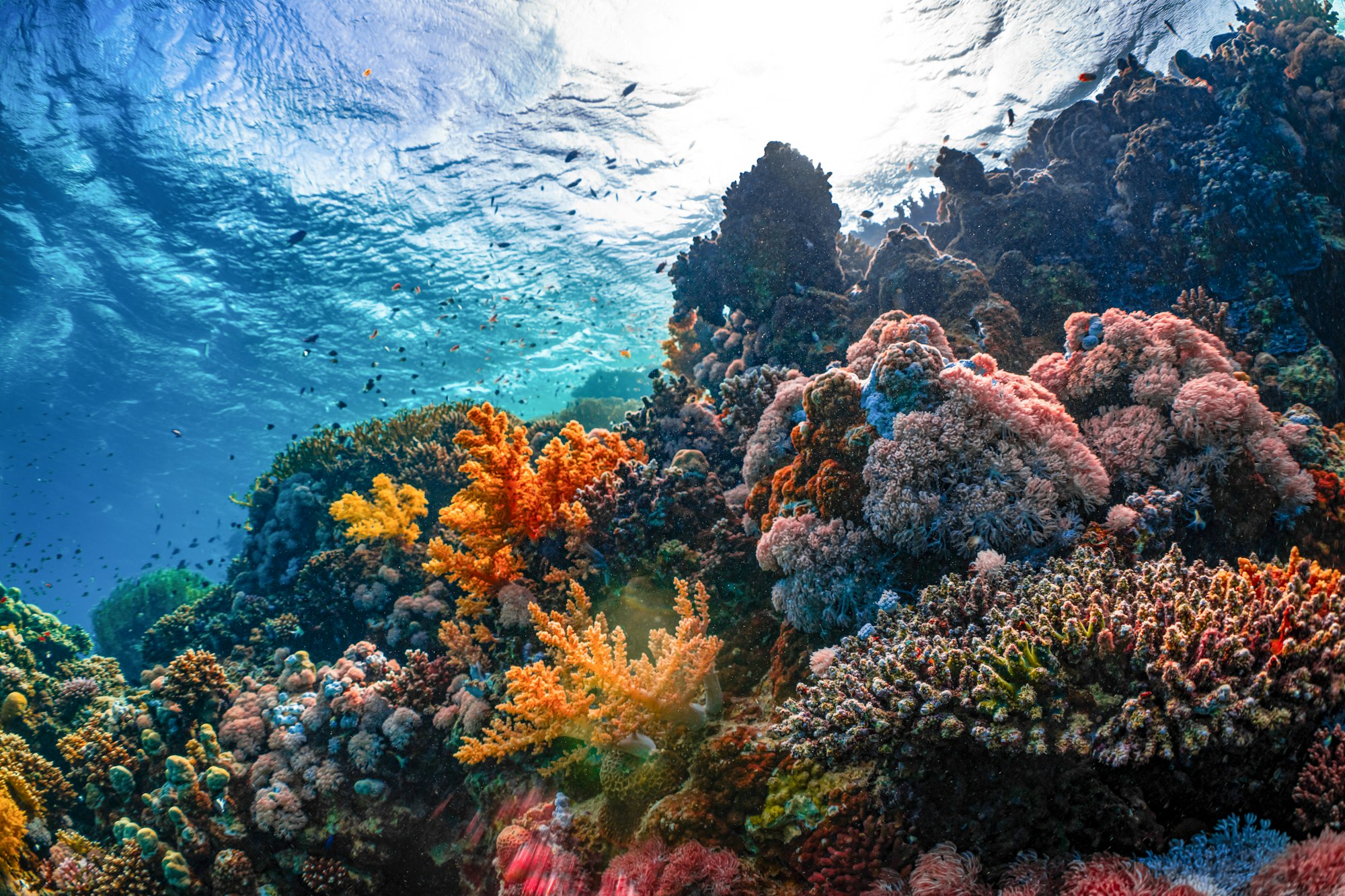
Thomas reef
27.9922°N 34.4615°E · wall
The smallest of the four Straits of Tiran reefs and widely rated the prettiest, Thomas is a current-swept wall and plateau hung with gorgonian fans and soft coral, with a deep canyon below recreational limits — an advanced drift dive.
Overview
Thomas Reef is the smallest of the four coral towers strung across the Straits of Tiran — Gordon, Thomas, Woodhouse and Jackson — the chain that splits the narrow channel between Sinai and the Saudi coast into two shipping passages. Despite its modest footprint, Thomas is routinely singled out as the most beautiful of the four, and it is the one most experienced Sharm divers ask for by name. The reef rises from very deep water almost to the surface, presenting near-vertical walls on most sides and a broad sandy plateau off the south-eastern shoulder at roughly 25 m. Because there is no practical mooring, it is dived as a live-boat drift.
Why divers come
Colour is the headline. The walls carry dense growths of Dendronephthya soft corals, black coral and whip corals, and the plateau edge is lined with a rank of large gorgonian sea fans that operators describe as one of the finest displays in the northern Red Sea. Beneath that, on the southern side, the reef drops into its signature feature: a deep canyon running parallel to the wall, crossed by three fallen-rock spans known locally as the Thomas Arches. Most published descriptions put the canyon mouth at around 30–35 m, with the fissure itself continuing far below — figures near 90 m are commonly cited. That is emphatically beyond recreational limits, and the canyon proper is run as a technical dive; recreational groups see only its rim.
The dive
Boats typically drop divers off a corner and let the current do the work. The standard profile descends the south-eastern wall to the plateau, works along the gorgonian line at 20–25 m, then ascends gradually onto the reef top for a long, shallow finish among pinnacles crowded with anthias. Under settled conditions and with a competent group, a full circumnavigation is possible. The eastern side is usually the calmer flank and the default choice. Guides commonly pause at the canyon rim to look down through the arches without entering — a discipline worth respecting.
Marine life
Whitetip reef sharks are the classic sighting, often resting on the plateau’s sand patches, and grey reef sharks patrol the blue off the corners. Hawksbill turtles feed on the reef top, Napoleon wrasse and lyretail grouper hold station along the wall, and jacks and trevally sweep the current lines. The fans themselves repay a slow look: longnose hawkfish, pipefish and a good variety of nudibranchs live among them. Pelagic encounters are opportunistic, not guaranteed.
Conditions & who should dive it
Thomas has a reputation for the strongest and least predictable currents of the four Tiran reefs. Flow is typically fiercest off the northern and southern points, and a hard counter-current is regularly reported at the eastern corner — divers can round a shoulder and find the water running the other way. The site sits beside an active shipping lane, so surfacing off the reef is a genuine hazard: an SMB deployed on ascent is not optional. Pick-ups on the western side are often impossible in weather, which shapes the whole dive plan. Add the canyon’s pull toward depth and the case is clear — this is an advanced site. Solid drift technique, disciplined gas and depth management, and a briefed plan for separation are the minimum.
When to go
Diving runs year-round from Sharm el-Sheikh. Water is warmest and calmest roughly June through October, with cooler, sometimes windier conditions from December to March when exposed sites in the straits are more often cancelled. Visibility is excellent in most seasons; whether Thomas runs on a given day is usually decided by wind and current, not by month.
Getting there
Thomas is a day-boat site, typically the middle dive of a three-reef Tiran itinerary departing Sharm el-Sheikh’s marinas, around an hour or so out. There is no shore access.
A note on protection
The Tiran reefs fall within Egypt’s protected-area system administered alongside Ras Mohammed National Park, and a park fee is levied per diver — usually collected by the operator or in cash on the boat. Rules are straightforward and enforced: no anchoring, no gloves on many operators’ boats, no touching or collecting. Given the density of fragile gorgonian and soft coral growth here, and the current that can push a diver into it, buoyancy control is a conservation measure as much as a skill.
- Straits of Tiran Diving, Sinai Peninsula, Red Sea — Dive The World
- Thomas Reef, Straits of Tiran — PADI Dive Site Directory
- Thomas Reef — Camel Dive Club & Hotel, Sharm el-Sheikh
- Thomas Reef — Oonas Dive Club
- Diving the Straits of Tiran, Red Sea — Scuba Diver Life
- Thomas Reef — Red Sea Diving, Sharm el-Sheikh Dive Sites
Sea-surface temperature and wave height from Open-Meteo Marine (ERA5 reanalysis, monthly averages).
175 verified species observations (81 species) logged within ~11 km of this site between 1968 and 2023, from the Ocean Biodiversity Information System.
- Grampus griseus · Risso's dolphin
- Stenella attenuata · Pantropical spotted dolphin
- Tursiops truncatus · Common bottlenose dolphin
- Stenella longirostris · Spinner dolphin
- Tursiops · Bottlenose dolphins
- Rhincodon typus · Whale Shark
- Tursiops aduncus · Indian ocean bottlenose dolphin
- Stenella · Spinner dolphins
- Bathygobius fuscus
- Istigobius decoratus
- Meiacanthus nigrolineatus
- Trimma mendelssohni
Scientific survey records skew toward sampled taxa (molluscs, corals) and do not reflect what you are guaranteed to see on a dive.
Source: OBIS (obis.org), aggregated Darwin Core occurrence records.
Conditions change with the tide and the season. If you have dived this site, share what it was actually like — date, visibility, current, and what you saw. Real, recent reports from divers are exactly what this guide is built to collect.
Send a conditions report ›