Umm Gamar
27.1925°N 33.9092°E · wreck
Umm Gamar
An elongated island reef north of Hurghada featuring three hollow coral towers swarming with glassfish, a sandy cave at 27 metres, and the remnants of a small patrol boat wreck on the slope.
Overview
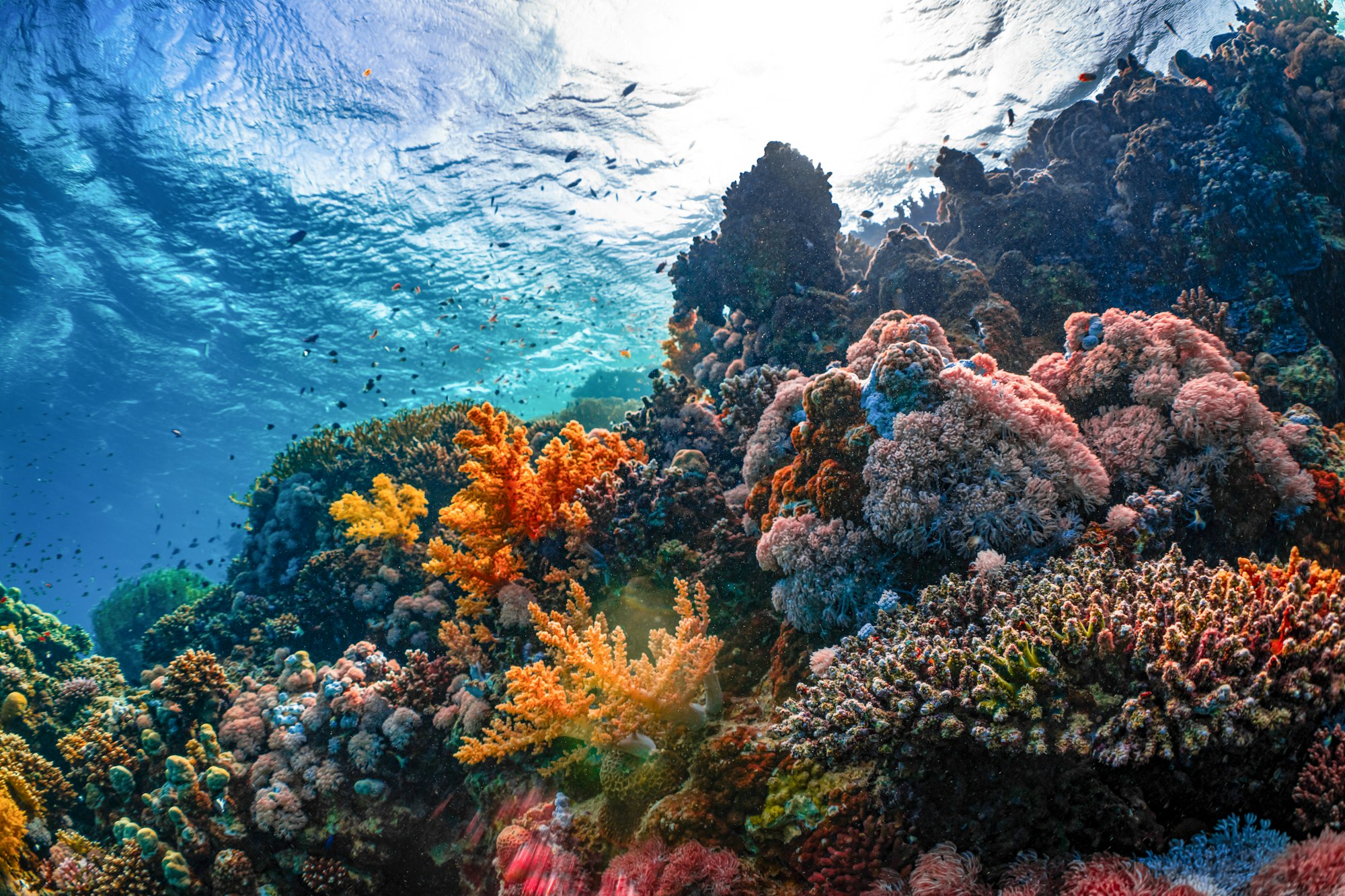
Umm Gamar — meaning “Mother of the Moon” in Arabic, a reference to the island’s crescent shape — is a narrow, elongated reef running north to south approximately 60 minutes by boat northeast of Hurghada. The reef’s eastern face drops as a near-vertical wall from the surface to beyond 35 metres, while the plateaus at the northern and southern ends sit at around 20 metres. The site’s most distinctive features are three coral towers rising from the eastern edge of the northern plateau: the first two are hollow pinnacles densely packed with glassfish (silverside), their interiors draped in purple soft corals; the third has a large sandy cave at 27 metres. A small Egyptian patrol boat wreck lies on the slope at Shabrur Umm Gamar, the companion reef just northwest. Manta rays visit in February and March; titan triggerfish guard nests in September.
Site Information
- Location: Offshore Hurghada, northern Egyptian Red Sea
- Entry Type: Boat dive
- Site Type: Wreck dive
- Difficulty Level: Intermediate
- Maximum Depth: 25 meters
- Typical Visibility: 20–30 meters
- Current: Mild to moderate; stronger at the northern tip in poor weather
- Best Time: October to May
Marine Life
The three coral towers on the northern plateau are the site’s signature feature — their hollow interiors are filled with dense clouds of glassfish attended by hunting red-toothed triggerfish and groupers. Giant moray eels inhabit the wall crevices. Schools of fusiliers and hunting jackfish sweep along the eastern face. Hawksbill turtles and spotted eagle rays are regular sightings. Blue-spotted stingrays rest on the sandy patches at the base of the wall. Manta rays appear at the northern tip in late February and March. In September, titan triggerfish become notably territorial around nesting pits on the plateau. Whitetip reef sharks occasionally patrol the deeper sections of the eastern wall.
Dive Profile
Begin on the northern plateau at 18–20 metres and locate the three coral towers — the first two are immediately rewarding for their glassfish-packed interiors and soft coral growth; the third has a cave at 27 metres worth a brief visit. From the towers, drift south along the eastern wall at 15–20 metres, scanning the water column for passing pelagics. The wall continues deeper but the most productive dive stays at 10–25 metres. Finish the dive on the reef flat at 5–10 metres for a comfortable safety stop. Strong-weather conditions make the northern “halg” (channel) inaccessible — confirm with the captain before planning this section.
Entry and Exit
Day boat from Hurghada (approximately 60-minute transfer each way). Entry by giant stride. The dive is suitable for intermediate and advanced divers alike, though strong-weather conditions at the exposed northern tip require Advanced Open Water competence. Deploy an SMB before ascending. Night dives at Umm Gamar are offered by some operators and reveal Spanish dancers, octopuses, and hunting eels.
Tips and Recommendations
- Plan your first dive on the northern plateau to visit the coral towers when energy and air are highest
- Shine a torch into the hollow towers from outside to see the full density of the glassfish school inside
- The sandy cave at 27 metres rewards a brief penetration for a torch-lit view of the interior ceiling covered in soft corals
- September visits bring titan triggerfish nesting — give territorial fish wide berth, especially near sandy areas
- Pair with Shabrur Umm Gamar (Little Umm Gamar) for a second dive on the patrol boat wreck
Safety Considerations
Umm Gamar’s northern tip and the halg channel between the main reef and Shabrur Umm Gamar are exposed to open-sea swell and can have unpredictable surface conditions. Titan triggerfish in nesting season (September) will aggressively defend a conical territory extending upward from their nest — if one approaches directly, swim horizontally out of its cone and ascend elsewhere. Fire coral is present on the reef crest. Always carry an SMB for all ascents at this offshore site.
Photography
The hollow coral towers at the northern plateau are among the most photogenic structures in the Hurghada area — shooting into the glassfish-filled interiors from outside with a wide-angle lens and single strobe creates cascading silver light effects. The cave interior at 27 metres rewards a torch and a macro lens for soft coral detail. Giant moray eels in wall crevices and blue-spotted stingrays on the sand bottom are reliable subjects. Manta ray encounters in February–March offer rare wide-angle opportunities at this site.
Sources: Divezone - Red Sea, Dive the World - Egypt Red Sea, Red Sea Scuba Diving, PADI - Diving in Egypt. Last updated 2026-04-04.
Sea-surface temperature and wave height from Open-Meteo Marine (ERA5 reanalysis, monthly averages).
582 verified species observations (351 species) logged within ~11 km of this site between 1758 and 2017, from the Ocean Biodiversity Information System.
- Sousa chinensis · Chinese white dolphin
- Tursiops aduncus · Indian ocean bottlenose dolphin
- Apogon coccineus
- Halichoeres marginatus
- Grampus griseus · Risso's dolphin
- Gymnothorax flavimarginatus
- Chlorurus sordidus
- Lethrinus nebulosus
- Lethrinus microdon
- Amblygobius albimaculatus
- Amphiprion bicinctus
- Hipposcarus harid
Scientific survey records skew toward sampled taxa (molluscs, corals) and do not reflect what you are guaranteed to see on a dive.
Source: OBIS (obis.org), aggregated Darwin Core occurrence records.
Conditions change with the tide and the season. If you have dived this site, share what it was actually like — date, visibility, current, and what you saw. Real, recent reports from divers are exactly what this guide is built to collect.
Send a conditions report ›