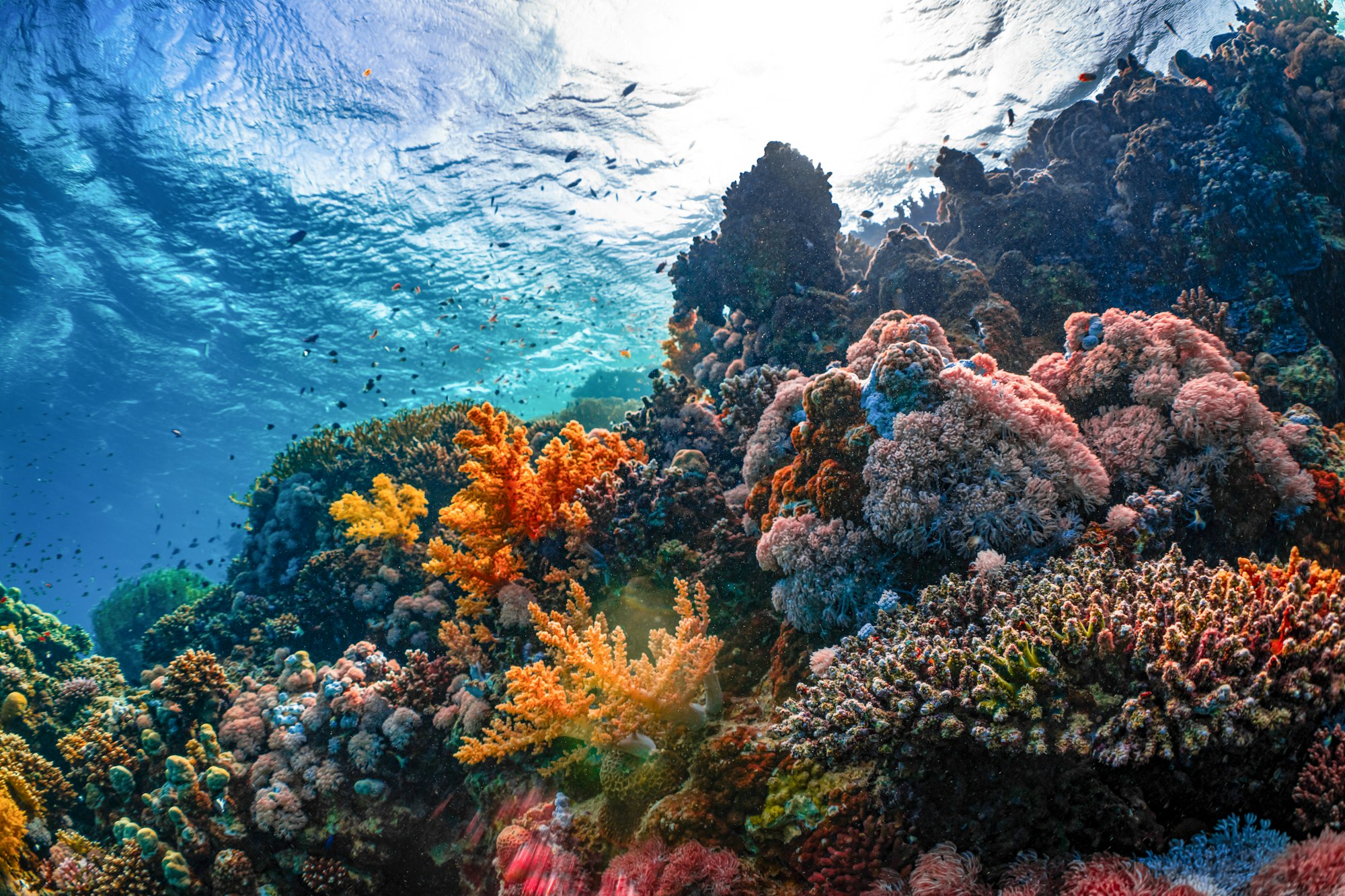
Woodhouse Reef
28.0012°N 34.4650°E · wall
The longest and narrowest of Tiran's four reefs, Woodhouse is dived almost exclusively as a south-to-north drift along a coral wall, drawing advanced divers with a deep canyon and the current-swept saddle toward Jackson.
Overview
Woodhouse is the second reef from the north in the chain of four that studs the Strait of Tiran — Jackson, Woodhouse, Thomas, Gordon, running north to south and named for nineteenth-century British hydrographers. It is the longest of the group and by far the narrowest, described by operators as roughly a kilometre of reef top with no lagoon, no sheltered lee and no fixed mooring along most of its length. That single geographic fact governs everything about how it is dived.
Why divers come
The draw is the reef itself: an uninterrupted coral wall you fly along rather than swim, with a canyon feature and a coral-covered ledge system on the eastern flank. It is quieter than Jackson and Thomas — documentation for Woodhouse is genuinely thinner than for its neighbours, and much of what exists comes from operator site notes rather than published survey work — which also means fewer boats and, on a good day, a long stretch of undisturbed reef to yourself.
The dive
Boats drop divers in the water at the southern end, usually as a negative or immediate descent, and the group drifts north along the eastern wall. Operators consistently describe a canyon on the eastern side that runs parallel to the reef axis before opening onto a sandy ledge and a coral plateau against the drop-off. Reported depths for the canyon’s opening vary between sources — commonly cited figures range from around 25 m to about 30 m — and several operators note it is narrow enough that the sensible line is to stay above it rather than penetrate it. Working depths for the drift are typically in the 20–30 m band early on, shallowing as the dive progresses. A large red anemone near the canyon is a recurring landmark in operator descriptions.
Marine life
Hard and soft coral cover is the constant: broccoli coral, gorgonian fans and dense anemone colonies along the wall. Schooling fish are prolific — fusiliers, snapper, surgeonfish and unicornfish — with bigeye trevally and passing tuna in the blue. Turtles are regularly reported. Reef sharks are possible rather than guaranteed, and eagle rays pass along the drop-off. Sand patches below the plateau are worth scanning for resting sharks, though nothing here should be treated as a reliable encounter.
Conditions & who should dive it
This is an advanced site, and the reason is the absence of a pick-up point. Because there is no shelter along the reef, the boat follows the group rather than waiting at a mooring; a diver who separates from the guide or surfaces early can drift out of the reef’s lee and into open water. The Strait is an active shipping corridor — the Enterprise Passage on the Egyptian side and the Grafton Passage nearer Tiran Island carry southbound and northbound traffic respectively — so an unmarked diver on the surface is a serious problem, not an inconvenience. Carry an SMB, deploy it, and stay with the guide.
Current is the second factor. It commonly builds through the dive and can shift direction, and the saddle between Woodhouse and Jackson at the northern end is known locally as “the washing machine” for its swirling, multidirectional flow and downcurrent potential. In choppy surface conditions, operators advise turning the dive before pushing that far north. Good buoyancy, comfort with negative entries and honest personal limits are prerequisites.
When to go
Diveable year-round from Sharm el-Sheikh, but Woodhouse is weather-dependent more than most: the drift only runs when sea state allows the boat to track the group safely. Late spring and autumn generally offer the best combination of settled conditions and comfortable water. Winter brings stronger northerlies that can close the site outright.
Getting there
A standard day-boat trip from Sharm el-Sheikh marinas, usually run as a two- or three-dive Tiran itinerary combining Woodhouse with Jackson, Thomas or Gordon.
A note on protection
The Straits of Tiran reefs sit within Egypt’s protected-area system administered alongside Ras Mohammed National Park, and daily park and marine-park fees apply to divers and snorkellers. Rates change; confirm the current amount with your operator when booking.
Sea-surface temperature and wave height from Open-Meteo Marine (ERA5 reanalysis, monthly averages).
165 verified species observations (73 species) logged within ~11 km of this site between 1968 and 2023, from the Ocean Biodiversity Information System.
- Grampus griseus · Risso's dolphin
- Stenella attenuata · Pantropical spotted dolphin
- Tursiops truncatus · Common bottlenose dolphin
- Stenella longirostris · Spinner dolphin
- Tursiops · Bottlenose dolphins
- Rhincodon typus · Whale Shark
- Tursiops aduncus · Indian ocean bottlenose dolphin
- Bathygobius fuscus
- Istigobius decoratus
- Stenella · Spinner dolphins
- Meiacanthus nigrolineatus
- Trimma avidori
Scientific survey records skew toward sampled taxa (molluscs, corals) and do not reflect what you are guaranteed to see on a dive.
Source: OBIS (obis.org), aggregated Darwin Core occurrence records.
Conditions change with the tide and the season. If you have dived this site, share what it was actually like — date, visibility, current, and what you saw. Real, recent reports from divers are exactly what this guide is built to collect.
Send a conditions report ›