Yolanda Reef
27.7247°N 34.2583°E · wreck
Yolanda Reef is one of the most famous dive sites in the Red Sea and one of the world’s most celebrated wreck-reef combinations. Located at the southern tip of the Sinai Peninsula within Ras Mohammed National Park, the site is named after the MV Yolanda, a Spanish-built cargo ship that grounded in 1980 whose cargo — porcelain toilets, bathtubs, bathroom fittings, and other sanitary ware — remains scattered among the reef as a surreal and iconic dive feature.
Overview
The Yolanda was a 74-metre, 1,907 GRT vessel built in 1964 in Gijón, Spain. On 1 April 1980 she ran aground at Ras Mohammed while en route from Piraeus, Greece, to Aqaba, Jordan. From 1981 to 1985 the wreck was a popular shallow dive site, but in March 1987 a storm swept the entire hull off the reef edge. The hull now lies at 145–160 metres and was only rediscovered in 2005. What remains accessible to recreational divers is the original cargo field: porcelain bathtubs, toilets, sinks, and pipes scattered across the reef at depths of 5–14 metres, integrated into the coral growth over four decades. The reef itself is exceptionally healthy, and the site is usually dived as a combination with Shark Reef in the same national park. Current at Ras Mohammed can be strong, and the site is often done as a drift dive along the reef edge.
Site Information
- Location: Ras Mohammed National Park, Sinai Peninsula, Red Sea, Egypt
- Entry Type: Boat dive
- Site Type: Wreck dive
- Difficulty Level: Intermediate
- Maximum Depth: 14 meters
- Typical Visibility: 20-30 meters (65-100 feet)
- Current: Moderate to strong (can be very strong at Ras Mohammed)
- Best Time: September to May
Marine Life
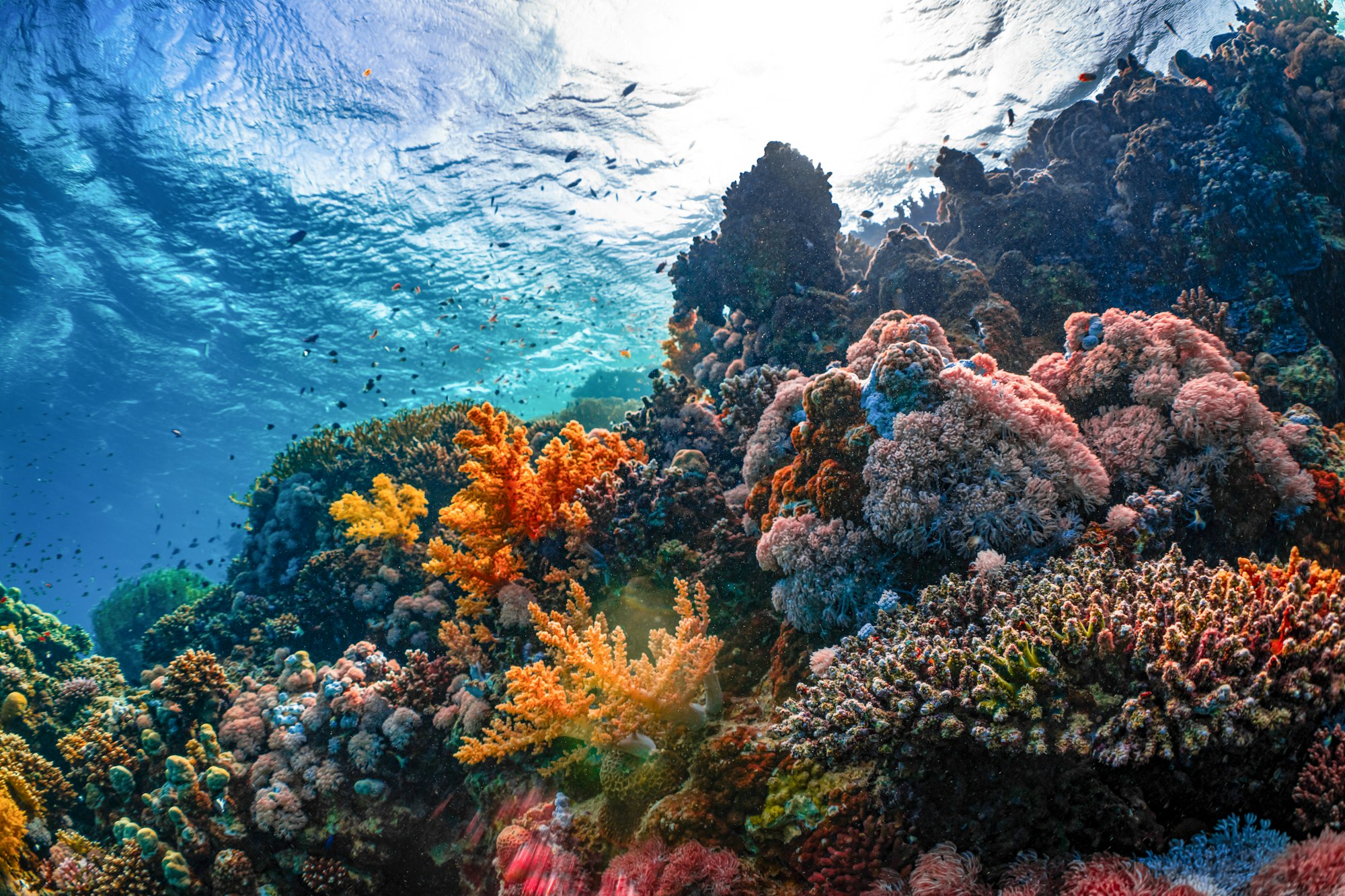
Ras Mohammed hosts some of the most impressive reef fish biomass in the entire Red Sea, and Yolanda Reef is no exception. Large humphead wrasse are near-guaranteed sightings. Reef sharks — grey reef and whitetip reef sharks — cruise the reef edge. Schools of barracuda and jack wheel in the blue water. The reef surface supports enormous numbers of anthias, butterflyfish, and parrotfish. Sea turtles rest on the shallow coral platform. Moray eels are plentiful in the reef crevices. The porcelain cargo among the coral has itself become colonized, with soft corals and encrusting growth turning the bathroom fixtures into an integral part of the reef ecosystem.
Dive Profile
Depending on current direction, the dive may be conducted as a drift or a navigated circuit. The shallow wreck section starts at around 5-14 meters, with the coral reef extending around it. Begin by exploring the porcelain cargo field among the reef, then work along the reef wall in the direction of the current. Monitor air consumption carefully as the site is often dived as a long single dive. Safety stop in the shallows over the reef top. Strong current can accelerate the drift, so keep the reef in sight and be ready to deploy an SMB if pulled into open water.
Entry and Exit
Access exclusively by dive boat from Sharm el-Sheikh operators. Entry by back roll or giant stride from the dive deck. Ras Mohammed National Park requires a park entry fee. Boats moor at designated points; follow the dive briefing on current conditions. Surface pickup by inflatable or dive boat after SMB deployment.
Tips and Recommendations
- Check current conditions thoroughly before the dive — Ras Mohammed can be unpredictable
- The porcelain cargo is fragile and historically protected within the national park; do not disturb or handle it
- Combine this dive with Shark Reef, the adjacent site, for a full Ras Mohammed experience
- Strong current dives here can be outstanding — go with the flow rather than fighting it
- An SMB is mandatory for this site given the open-water drift potential
Safety Considerations
Current at Ras Mohammed is the primary hazard and can shift from moderate to very strong depending on tide and wind. Divers should be comfortable with drift diving and capable of deploying an SMB mid-water. The site lies within a national park where anchoring is prohibited and mooring must be used. Fire coral is abundant on the reef flat. Never stand on or rest on the coral. Always carry a safety sausage (SMB) and signal mirror.
Photography
Yolanda Reef is among the most photographed sites in the Red Sea. The juxtaposition of porcelain bathroom fixtures with encrusted tropical coral is inherently compelling and produces images that are instantly recognizable to any dive photographer. Wide-angle shots with toilets and soft corals in the same frame are the signature shot. Fish life — particularly humphead wrasse portraits and reef shark silhouettes — rounds out the photography potential. The site rewards both wide-angle and macro work.
Sources: Yolanda Wikipedia, Wrecks at Risk - Jolanda, Camel Dive Club - Yolanda Reef, Divernet - British Divers Discover Yolanda. Last updated 2026-05-25.
Sea-surface temperature and wave height from Open-Meteo Marine (ERA5 reanalysis, monthly averages).
372 verified species observations (269 species) logged within ~11 km of this site between 1828 and 2018, from the Ocean Biodiversity Information System.
- Rhincodon typus · Whale Shark
- Grampus griseus · Risso's dolphin
- Stenella attenuata · Pantropical spotted dolphin
- Tursiops · Bottlenose dolphins
- Tursiops truncatus · Common bottlenose dolphin
- Vinciguerria mabahiss
- Priolepis cincta · Banded Reef Goby
- Tursiops aduncus · Indian ocean bottlenose dolphin
- Pseudorca crassidens · False killer whale
- Stenella longirostris · Spinner dolphin
- Grammistes sexlineatus
- Ecsenius frontalis
Scientific survey records skew toward sampled taxa (molluscs, corals) and do not reflect what you are guaranteed to see on a dive.
Source: OBIS (obis.org), aggregated Darwin Core occurrence records.
Conditions change with the tide and the season. If you have dived this site, share what it was actually like — date, visibility, current, and what you saw. Real, recent reports from divers are exactly what this guide is built to collect.
Send a conditions report ›