Victory Wreck
4.1799°N 73.5254°E · wreck
The Maldive Victory is the country's most famous wreck — a cargo ship that struck the reef off the airport in 1981 and now sits upright in 35 m of water. A current-swept deep dive on an artificial reef of soft coral and fish, for advanced and wreck-trained divers.
Overview
The Maldive Victory is the best-known wreck in the country. A cargo ship built in Liverpool in 1958, she was running from Singapore to Malé when she struck the reef off Hulhulé — the airport island — at night on Friday the 13th of February, 1981. Everyone aboard survived. Today she rests upright on the sand in about 35 m of water, a short boat ride from the airport, and is a protected site.
The dive
The wreck stands tall and intact enough to read as a ship: the mast reaches to around 12 m, the bridge to roughly 18 m, and the hull meets the sand near 35 m. Experienced, wreck-trained divers penetrate the bridge and cargo areas with a guide and lights, but the ship has sharp edges and this is not casual poking-around. Because the wreck sits in a channel, current is a constant factor — divers drop fast down the mooring line and, on a strong day, hold on rather than drift off.
Marine life
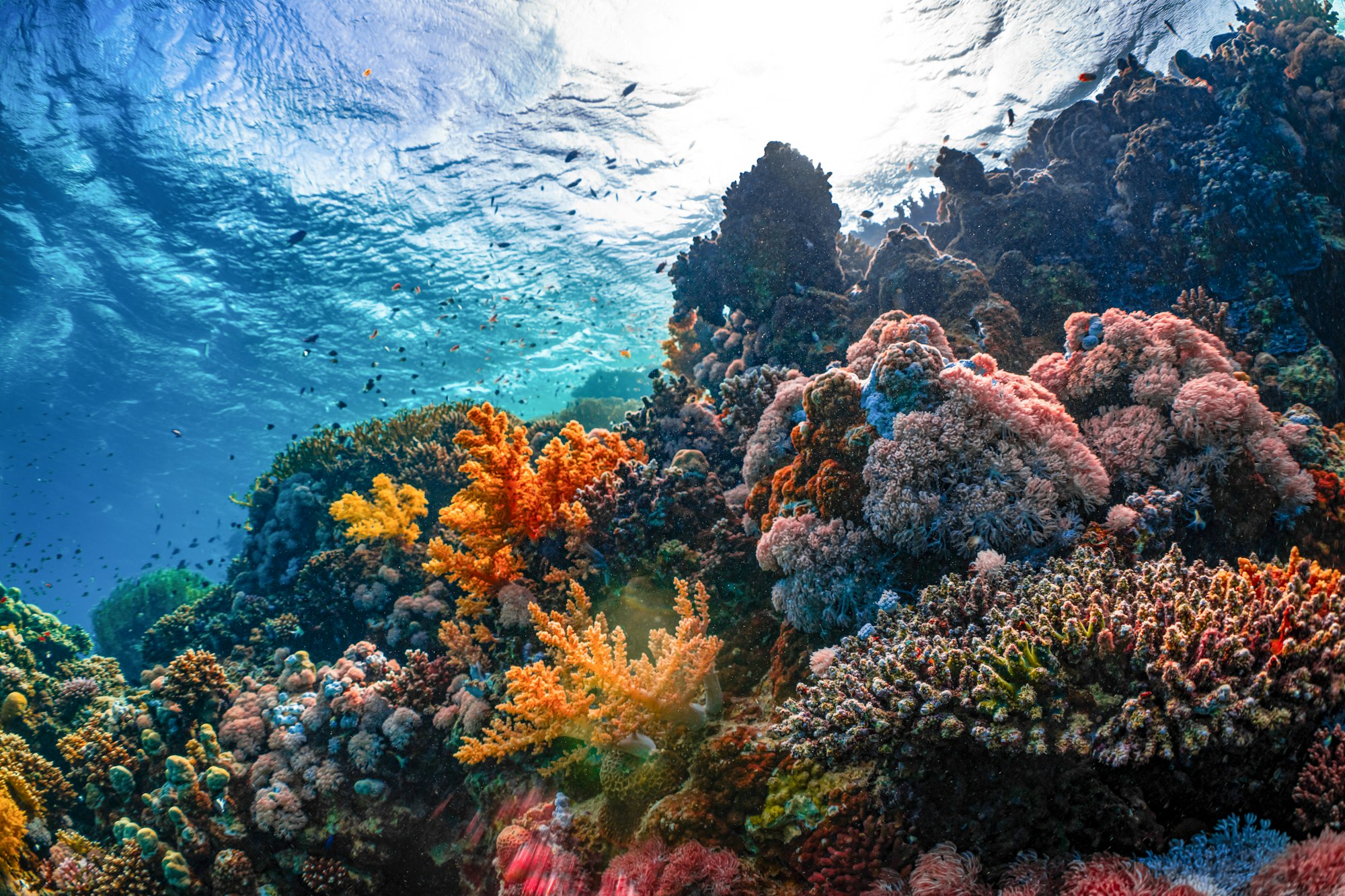
Four decades underwater have turned the hull into a thriving artificial reef. A 2019 survey recorded dozens of coral genera and fish species here — batfish, fusiliers and groupers, with hunting trevally in the water column, lionfish and soldierfish around the structure, moray eels in the recesses, and nudibranchs and pipefish toward the stern. Turtles and the occasional eagle ray pass through. Note: bridge construction in 2016 damaged part of the superstructure and smothered coral for a time; the site reopened in 2019 and its marine life has been recovering.
Conditions & who should dive it
This is a deep, current-swept dive — expect moderate to strong flow (roughly one to three knots), best dived at slack tide. A Deep Diver certification is effectively required, Advanced Open Water at minimum, and Wreck Diver training for any penetration. Visibility runs 20–30 m, best in the dry season, with water around 27–30 °C at depth. It is not a site for newly certified divers.
When to go
The dry season, roughly December to April, gives the best visibility. Early morning, when the current is lightest, is the ideal window; midday light is best for photography.
Getting there
The wreck is exceptionally accessible — about 15 minutes by speedboat from Hulhulé and 10 from Hulhumalé. It’s dived on day trips from Malé, Hulhumalé and Maafushi, by resort dive centres, and on liveaboards, with a surface buoy marking the mooring.
Sea-surface temperature and wave height from Open-Meteo Marine (ERA5 reanalysis, monthly averages).
1447 verified species observations (389 species) logged within ~11 km of this site between 1778 and 2023, from the Ocean Biodiversity Information System.
- Chordata
- Istiblennius edentulus
- Sargocentron microstoma
- Gymnothorax undulatus
- Corythoichthys flavofasciatus
- Variola louti
- Amblycirrhitus bimacula
- Corythoichthys haematopterus
- Saurida gracilis
- Nectamia fusca
- Scorpaenodes parvipinnis
- Chaetodon trifasciatus
Scientific survey records skew toward sampled taxa (molluscs, corals) and do not reflect what you are guaranteed to see on a dive.
Source: OBIS (obis.org), aggregated Darwin Core occurrence records.
Conditions change with the tide and the season. If you have dived this site, share what it was actually like — date, visibility, current, and what you saw. Real, recent reports from divers are exactly what this guide is built to collect.
Send a conditions report ›