Carnatic
27.5793°N 33.9269°E · wreck
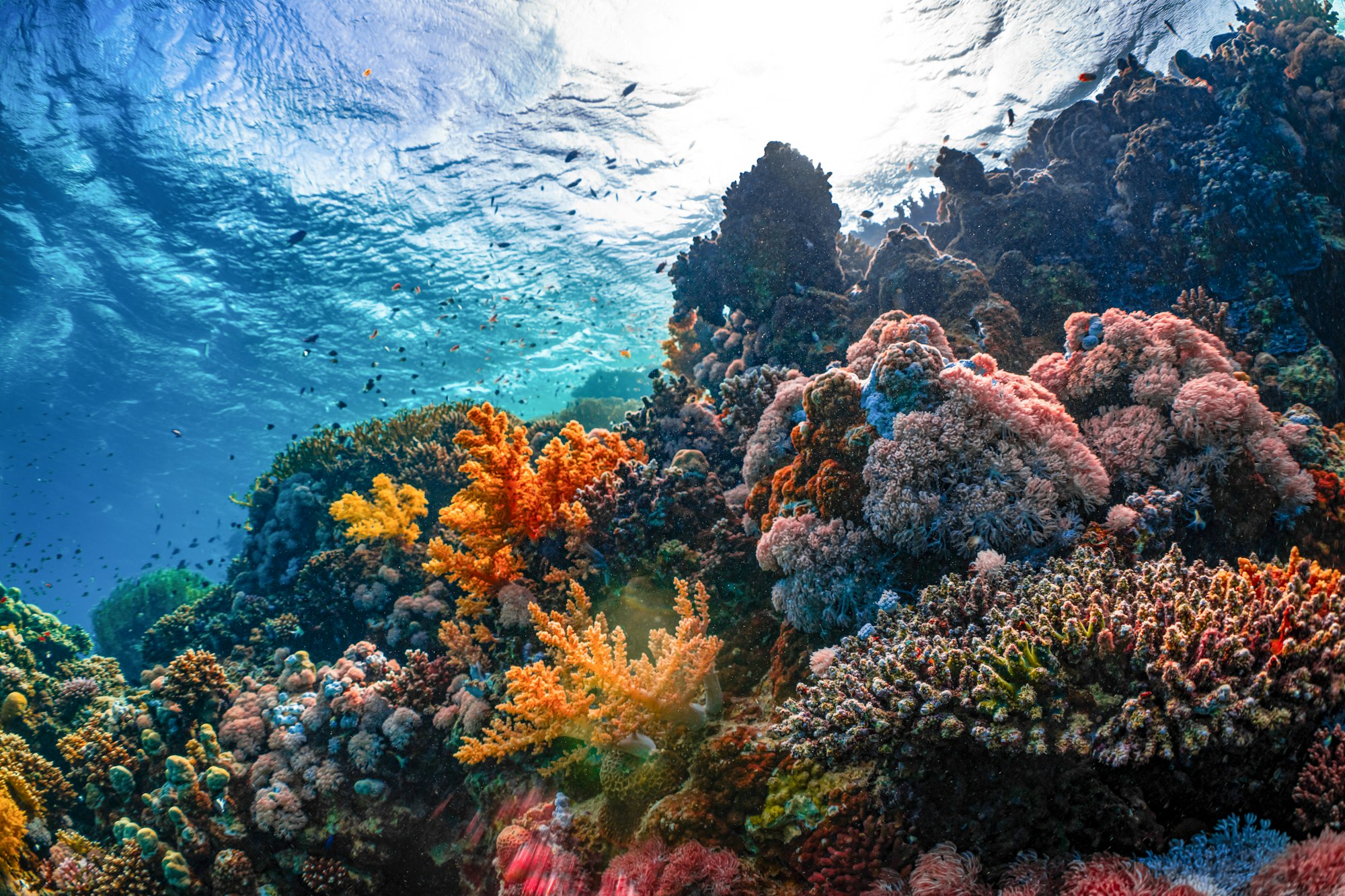
A British P&O sail-and-steam liner wrecked on Abu Nuhas in 1869, the oldest of the reef's wrecks — its rotted decking leaves a skeletal lattice of iron ribs and beams at around 27 m, an intermediate wreck dive.
Overview
Sha’ab Abu Nuhas is a shallow, near-triangular reef in the Strait of Gubal, lying a short distance north of Shadwan Island and roughly 40 km north of Hurghada. Its northern flank sits directly in the path of shipping funnelling out of the Gulf of Suez, and the tally of hulls piled along that side has earned it the nickname “ship graveyard.” Four wrecks are dived recreationally, but the Carnatic is the one divers travel for — a 90-metre British P&O steamer lost in 1869, by a wide margin the oldest of them and among the oldest diveable wrecks anywhere in the Red Sea.
Why divers come
The appeal is structural, not merely historical. More than a century and a half of immersion has consumed the ship’s wooden decking entirely, leaving the iron frame standing bare: a long, curving cage of ribs, beams and deck supports through which daylight falls in bands. Divers routinely compare the effect to swimming inside a cathedral, and the skeleton is thickly upholstered in soft corals. Few wrecks anywhere combine this much age, this much light and this much shape.
The dive
The Carnatic lies on her port side, parallel to the reef on a sand bottom. Reported depths vary a little between operators — figures from about 22 m over the shallower structure to roughly 27–28 m at the deepest point are all commonly quoted. The hull is broken into three parts: a largely intact stern carrying the rudder and a prominent propeller, a collapsed and coral-covered midships section where the boilers lie exposed, and an intact bow. Most guided dives run the length of the frame, drop briefly to the stern gear, then work back shallower along the reef for the safety stop. The open lattice means light penetrates well and guides often lead swim-throughs rather than true dark penetration.
The wreck’s history
Built in the early 1860s by Samuda Brothers on the Thames for the Peninsular & Oriental Steam Navigation Company, the Carnatic was a hybrid of her transitional era — a compound steam engine paired with a full sailing rig — running the Suez-to-Bombay leg in the years just before the Suez Canal opened. She struck Abu Nuhas on 12 September 1869. The ship held together at first, and the master kept passengers and crew aboard rather than putting them into the boats. After roughly 34 hours on the reef she broke in half. Lives were lost in that collapse; accounts most often give the toll as 31, though figures differ between sources and the number should be treated as approximate. A subsequent Board of Inquiry found the master at fault. Her manifest included cotton, copper, Royal Mail and wine — the bottles that survive in the holds gave her the enduring nickname “the Bottle Wreck.” She also carried gold specie valued at the time around £40,000, and contemporary salvage, mounted within weeks, is documented as having recovered it. The persistent stories of treasure still hidden in the hull are folklore, not record. She was rediscovered by divers in 1984.
Marine life
The wreck functions as an artificial reef. Expect dense clouds of glassfish in the sheltered sections, resident groupers, lionfish hanging under the beams, moray eels, crocodilefish and scorpionfish lying camouflaged on the ironwork, plus nudibranchs for those who look closely. Encounters with larger pelagics are occasional rather than expected.
Conditions & who should dive it
Visibility is typically good, often in the 15–30 m range. Currents at Abu Nuhas can run medium to strong, particularly where flows converge at the reef’s northern corner, and the site is exposed — surface conditions turn choppy and surge can be felt over the shallower structure. The real hazard, however, is the wreck itself. The collapsed lattice is full of fallen beams, hanging plate and snagging points; overhead sections, silt and entanglement risk are genuine. Treat any entry beyond the open-frame swim-throughs as overhead diving requiring wreck training, proper equipment and a guide who knows the layout. Good buoyancy is non-negotiable.
When to go
Roughly May to October brings the warmest water and the calmest surface. Winter diving is entirely feasible but cooler and windier, with a greater chance of a trip being weathered off this exposed reef.
Getting there
Almost all visits arrive by boat. Northern Red Sea liveaboards out of Hurghada and Port Ghalib treat Abu Nuhas as a standard stop and hold a real advantage — early and late slots on the wreck before day boats arrive. Day trips run from Hurghada and El Gouna, at the cost of a long transit each way.
A note on protection & respect
The Carnatic is a grave site as well as a dive site. Take nothing — the bottles and fittings belong to the wreck and removing them is prohibited. The ironwork is fragile and heavily coral-encrusted: no touching, no fin contact, no forcing passages. Dive it as a monument that happens to be underwater.
Sea-surface temperature and wave height from Open-Meteo Marine (ERA5 reanalysis, monthly averages).
26 verified species observations (12 species) logged within ~11 km of this site between 1990 and 2012, from the Ocean Biodiversity Information System.
- Tursiops aduncus · Indian ocean bottlenose dolphin
- Tursiops · Bottlenose dolphins
- Stenella attenuata · Pantropical spotted dolphin
- Grampus griseus · Risso's dolphin
- Conus striatus
- Conomurex
- Muricella sayad
- Pseudoparacis erythraeensis
- Verrucella gubalensis
- Acanthogorgia gubalensis
- Astrogorgia milka
- Animalia
Scientific survey records skew toward sampled taxa (molluscs, corals) and do not reflect what you are guaranteed to see on a dive.
Source: OBIS (obis.org), aggregated Darwin Core occurrence records.
Conditions change with the tide and the season. If you have dived this site, share what it was actually like — date, visibility, current, and what you saw. Real, recent reports from divers are exactly what this guide is built to collect.
Send a conditions report ›