Giannis D
27.5774°N 33.9232°E · wreck
A 1969 Japanese-built freighter that struck Abu Nuhas reef in 1983 with a cargo of timber, the Giannis D draws divers for its steeply canted stern and glassfish-filled engine room — an intermediate wreck dive on the Red Sea's most famous ships' graveyard.
Overview
Sha’ab Abu Nuhas sits in the Strait of Gubal, at the northern end of the Egyptian Red Sea shipping lane between Hurghada and Sharm El Sheikh. The reef has claimed enough vessels to earn its nickname as the region’s ships’ graveyard: the Giannis D, the Victorian-era Carnatic, the Chrisoula K and the Kimon M all lie along its northern slope, with the deeper Seastar beyond recreational limits. Of the group, the Giannis D is usually the first wreck a boat drops on, and the one divers remember.
Why divers come
Two things set this wreck apart. The first is its condition: the bow and stern survive largely intact while the midships has folded into a crumpled tangle, so a single dive moves between recognisable ship and pure wreckage. The second is the tilt. The stern lies canted steeply onto its port side, and once you are inside the accommodation block and engine room the reference frame goes wrong — floors slope where they shouldn’t, ladders run sideways, and stairwells that appear to climb are in fact descending. Divers routinely describe swimming semi-sideways through it. The funnel, still carrying its painted “D”, is the wreck’s signature photograph.
The dive
Most profiles start deep and work shallow. Boats or tenders drop divers toward the stern, where the seabed lies at roughly 24 m, and the route passes the propeller and rudder before rising into the stern superstructure. The engine room, at around 13 m, is the highlight: a multi-level space, comparatively open and well lit through skylights and blown-out plating, usually packed with shimmering clouds of glassfish. From there the dive tracks forward over the collapsed midships to the bow section and its horizontal mast, before a shallow finish — the masts and upper structure reach into the top few metres, giving an easy safety stop.
The wreck’s history
The ship was launched in Japan in 1969 as the Shoyo Maru, a cargo vessel of roughly 100 m. She was renamed Markos in 1975 and became the Giannis D in 1980 under Greek ownership. On 19 April 1983, sailing from Rijeka toward Jeddah and Hodeida with a cargo of sawn timber, she struck the north-western corner of Abu Nuhas. She did not go down at once; the crew were taken off, and sources consistently report no loss of life. Salvage failed, and the hull eventually broke into the three sections divers see today.
Marine life
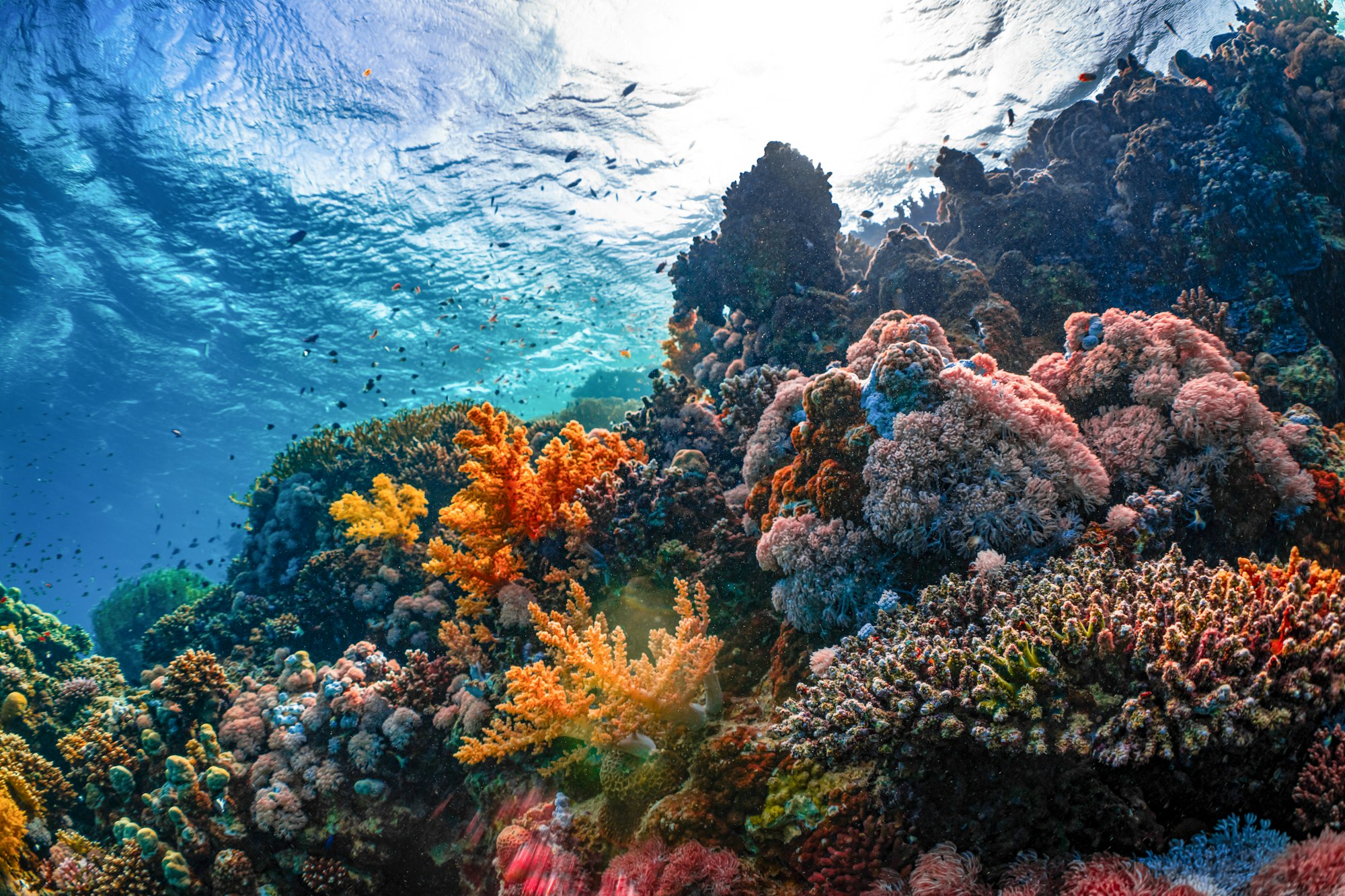
Four decades of coral growth have turned the hull into a working reef. Soft corals cover the railings and davits, glassfish fill the interior spaces, and lionfish hover almost everywhere. Look for scorpionfish and gobies camouflaged along the bow mast, giant morays in the wreckage, and groupers holding station in the shadows. Bannerfish, jacks and occasional barracuda patrol the reef slope on the way back up.
Conditions & who should dive it
Visibility is typically good, often in the 20–30 m range, with water temperatures roughly 22–28°C through the year. The wreck is genuinely exposed: it sits on the reef’s northern side, facing the prevailing wind, so the surface can be choppy and current or swell can drive noticeable surge through the wreck’s interior. Treat the stern superstructure and engine room as a real overhead environment. Multiple openings make it more forgiving than many penetrations, but that is not the same as safe — proper wreck training, a torch, and a guide who knows the internal layout are the baseline, and the disorienting tilt is itself a hazard for silting and lost reference. Outside routes suit a comfortable intermediate diver; inside routes do not suit anyone learning on the day.
When to go
Diveable year-round. Summer brings the warmest water and calmest seas; winter is cooler and windier, and the northern Strait of Gubal is where trips most often lose days to weather. Spring and autumn are the usual compromise.
Getting there
Abu Nuhas is reached only by boat, roughly 40 km north of Hurghada and around 50 km from Sharm El Sheikh. It is a standard stop on northern Red Sea liveaboard itineraries and is also run as a long day trip from Hurghada, El Gouna and Sharm. Because moorings on the exposed north side are limited, most operators anchor in shelter behind the reef and shuttle divers by tender.
A note on protection
The wrecks are steadily deteriorating, and research groups — including the Wrecks at Risk project run by the University of Edinburgh with Alexandria University — are documenting Red Sea wrecks photogrammetrically to guide their management. Divers can help simply: no souvenirs, careful buoyancy around fragile plating and coral growth, and no forcing routes through collapsing midships structure.
Sea-surface temperature and wave height from Open-Meteo Marine (ERA5 reanalysis, monthly averages).
26 verified species observations (12 species) logged within ~11 km of this site between 1990 and 2012, from the Ocean Biodiversity Information System.
- Tursiops aduncus · Indian ocean bottlenose dolphin
- Tursiops · Bottlenose dolphins
- Stenella attenuata · Pantropical spotted dolphin
- Grampus griseus · Risso's dolphin
- Conus striatus
- Conomurex
- Muricella sayad
- Pseudoparacis erythraeensis
- Verrucella gubalensis
- Acanthogorgia gubalensis
- Astrogorgia milka
- Animalia
Scientific survey records skew toward sampled taxa (molluscs, corals) and do not reflect what you are guaranteed to see on a dive.
Source: OBIS (obis.org), aggregated Darwin Core occurrence records.
Conditions change with the tide and the season. If you have dived this site, share what it was actually like — date, visibility, current, and what you saw. Real, recent reports from divers are exactly what this guide is built to collect.
Send a conditions report ›