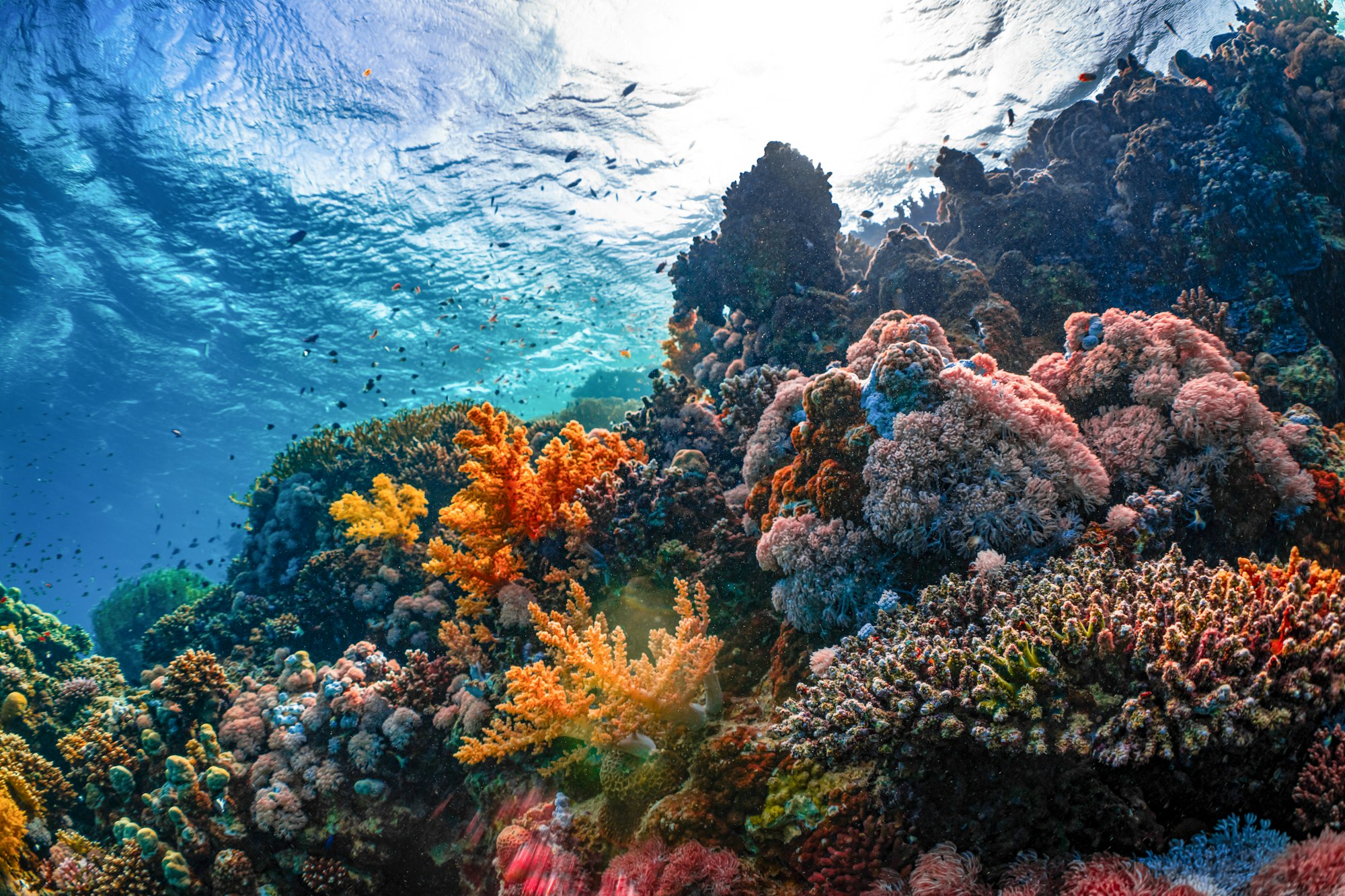
Barracuda Point
4.1147°N 118.6289°E · wall
Sipadan's signature wall dive, where a swirling tornado of chevron barracuda gathers over a reef corner plunging into the Celebes Sea — a current-swept advanced drift famous for big-fish action and turtles.
Overview
Barracuda Point sits on the north-eastern shoulder of Sipadan, Malaysia’s only true oceanic island, rising some 600 metres from the seabed roughly 35 kilometres off Semporna in Sabah’s Celebes Sea. Sipadan is a strictly protected marine area: resorts that once stood on the island were removed in 2004–05, and diving today is day-trip only under a daily permit quota (see below). The site itself is a sloping reef that turns a sharp corner into a channel, with a plateau where the wall drops away vertically into the blue — the meeting point of reef and open ocean that funnels nutrient-rich current past the corner.
Why divers come
The draw is the site’s namesake spectacle: a dense, slow-turning tornado of chevron barracuda, often several thousand strong, coiling in a spiral that can briefly enclose a diver. When the current builds, that spiral can flatten into a shimmering “wall” of fish stretching out of sight. It is one of tropical diving’s genuine set-pieces — though, honestly, it is not guaranteed on every dive. Alongside the barracuda, huge schools of bigeye trevally (jackfish) mass in the shallows, making Barracuda Point one of the most reliable big-fish dives in Southeast Asia.
The dive
This is a boat entry and typically dived as a drift. Divers usually descend along the wall, then ride the current around the corner and down the channel, where the barracuda and jackfish congregate over the plateau. Sources describe conditions ranging from gentle cruising to fast “flying” drifts; a reef hook is commonly used to hold position in the school when current is strong. Most of the action sits in the 10–25 metre range along the wall, though the drop-off continues far beyond recreational limits — there is no reason to chase depth here.
Marine life
Beyond the barracuda and jackfish, expect green and hawksbill turtles in good numbers, grey reef and whitetip reef sharks patrolling the wall, bumphead parrotfish (whose grazing can cloud the water), Napoleon wrasse, dogtooth tuna and garden eels in the sand. Reliable draws are the schooling fish, turtles and reef sharks; larger pelagics such as hammerheads or eagle rays are reported but occasional, not to be expected.
Conditions & who should dive it
Barracuda Point is an advanced site. Currents can be strong and shift quickly, particularly toward the northern end where divers are cautioned against being swept off the reef, and surface conditions can be choppy. Visibility is typically good (often 20–30 metres, better in peak season) and water temperature sits around 26–30°C year-round. Operators generally require an Advanced Open Water certification or equivalent, plus comfort with drift diving and buoyancy control; it is not a site for newly certified divers.
When to go
Sipadan is diveable much of the year. Most sources point to roughly March–May as the calmest, clearest window, with the best visibility and largest schools. Conditions remain good through the drier months, while some operators note reduced availability or seasonal reef-recovery periods later in the year — worth checking directly when booking.
Getting there
There is no accommodation on Sipadan itself. Divers stay on nearby Mabul or Kapalai, or take day trips from Semporna, and reach the site by boat. Access is governed by a daily permit system administered through licensed operators. Reported quotas vary by source and have risen over time — figures around 176 historically and roughly 250+ more recently, covering both divers and snorkellers — with each operator typically holding only a handful of permits per day. Because of this, a permit is usually secured only by booking a multi-day package; three or more nights meaningfully improves your odds.
A note on protection
Sipadan’s permit cap exists to limit pressure on a fragile oceanic reef. Diving here is no-touch and no-glove by convention: no anchoring, no collecting, and reef hooks should be placed only on bare rock or dead substrate, never live coral. Respecting the quota and the turtles’ space is part of the privilege of diving one of the region’s most protected sites.
Sea-surface temperature and wave height from Open-Meteo Marine (ERA5 reanalysis, monthly averages).
344 verified species observations (175 species) logged within ~11 km of this site between 1849 and 2018, from the Ocean Biodiversity Information System.
- Coelorinchus commutabilis
- Trimma yanoi
- Gadomus filamentosus
- Nezumia evides
- Ventrifossa nigrodorsalis
- Hymenocephalus nascens
- Trimma agrena
- Trimma tevegae
- Apristurus platyrhynchus
- Trimma stobbsi
- Pycnochromis atripes
- Synchiropus delandi
Scientific survey records skew toward sampled taxa (molluscs, corals) and do not reflect what you are guaranteed to see on a dive.
Source: OBIS (obis.org), aggregated Darwin Core occurrence records.
Conditions change with the tide and the season. If you have dived this site, share what it was actually like — date, visibility, current, and what you saw. Real, recent reports from divers are exactly what this guide is built to collect.
Send a conditions report ›