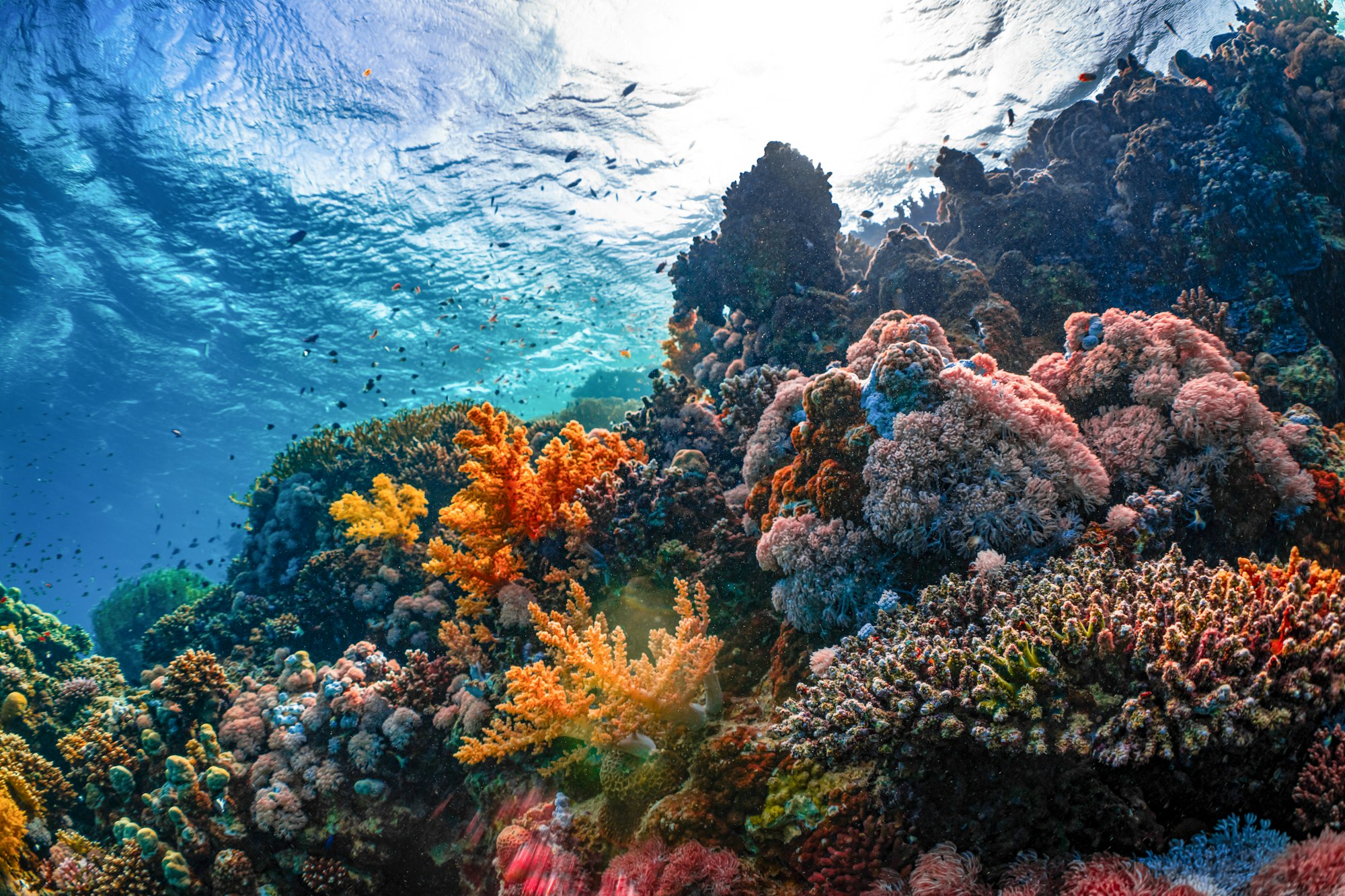
Hanging Gardens
4.1183°N 118.6322°E · wall
A vertical soft-coral wall on Sipadan's southwest side, named for cascades of pastel Dendronephthya and gorgonian fans spilling down the drop-off, with turtles, reef sharks and schooling fish; a gentle, photogenic wall dive.
Overview
Hanging Gardens sits on the southern to southwestern side of Sipadan, the small oceanic island that rises straight from the floor of the Celebes Sea off Semporna, Sabah. Like most of Sipadan’s dive sites it is a wall: the reef crest breaks the surface, then the drop-off falls away almost from the shallows, descending in a series of terraces before plunging into deep blue water. The site takes its name from the soft corals that spill down these ledges — a living echo of the mythical Hanging Gardens of Babylon.
Why divers come
The draw is the coral itself. Where many Sipadan sites are famous for pelagic action, Hanging Gardens is prized as the island’s most decorative wall. Colonies of pastel Dendronephthya soft corals — lemon, lavender and antique-rose — appear to cascade from the underside of each ledge, interspersed with large gorgonian sea fans, black coral and barrel sponges. It is a slower, more contemplative dive, and a favourite of underwater photographers and macro hunters.
The dive
Boats drop you over the reef edge and the wall does the work. The drop-off begins barely a metre from the surface and steps down through coral-draped terraces; guides typically keep divers in the richest 10–25 m band, well within the site’s 40 m working maximum, as the wall itself continues far deeper into the abyss. Currents are usually gentle to moderate, so this is often a relaxed drift along the face, letting the reef slide past while you scan the crevices. Turtles are so numerous here that divers routinely lose count.
Marine life
Green and hawksbill turtles rest on the ledges in numbers, and reef sharks — grey reef and whitetip — patrol the deeper wall. Tucked into the coral and cavities you’ll find sweetlips, emperor angelfish, coral groupers, hawkfish, gobies and moray eels, while clouds of anthias, damselfish and chromis shimmer over the shallows. Crinoids and small critters nestle in the gorgonian branches, and schooling fish gather along the edge. Occasional larger visitors — bumphead parrotfish and, more rarely, hammerheads passing along the wall — add to the mix.
Conditions & who should dive it
Visibility is typically excellent, often 20–30 m or more. Currents at Hanging Gardens are generally light, making it one of Sipadan’s gentler walls, though conditions on any oceanic island can shift. The main hazard is depth: the wall drops off with no bottom in sight, so buoyancy control and depth discipline matter. Sipadan diving is best suited to divers with some wall and drift experience, and Advanced Open Water certification is commonly recommended or required by operators. It is well within reach of a competent Open Water diver diving conservatively with a guide.
When to go
Sipadan is diveable year-round, with the calmest seas and best visibility typically from around April to December. Green turtles are present all year. Sea conditions and marine encounters vary, so treat any single window as a guideline rather than a guarantee.
Getting there
There are no resorts on Sipadan itself — accommodation was removed from the island in the mid-2000s to protect it — so all diving is by day boat from the nearby islands of Mabul and Kapalai, or from Semporna on the Sabah mainland. The crossing from Mabul takes roughly 15–25 minutes.
A note on protection
Sipadan is a protected marine area, and access is capped by a strict daily permit quota (widely reported at 178 permits per day) allocated among licensed operators. Permits must be arranged in advance through your dive centre, and demand is high in peak season, so book early. Divers are asked to keep well off the reef, avoid touching coral or turtles, and follow their guide’s briefing — this fragile wall is exactly what the quota exists to preserve.
Sea-surface temperature and wave height from Open-Meteo Marine (ERA5 reanalysis, monthly averages).
357 verified species observations (182 species) logged within ~11 km of this site between 1849 and 2018, from the Ocean Biodiversity Information System.
- Coelorinchus commutabilis
- Trimma yanoi
- Gadomus filamentosus
- Nezumia evides
- Ventrifossa nigrodorsalis
- Hymenocephalus nascens
- Trimma agrena
- Trimma tevegae
- Apristurus platyrhynchus
- Trimma stobbsi
- Pycnochromis atripes
- Synchiropus delandi
Scientific survey records skew toward sampled taxa (molluscs, corals) and do not reflect what you are guaranteed to see on a dive.
Source: OBIS (obis.org), aggregated Darwin Core occurrence records.
Conditions change with the tide and the season. If you have dived this site, share what it was actually like — date, visibility, current, and what you saw. Real, recent reports from divers are exactly what this guide is built to collect.
Send a conditions report ›