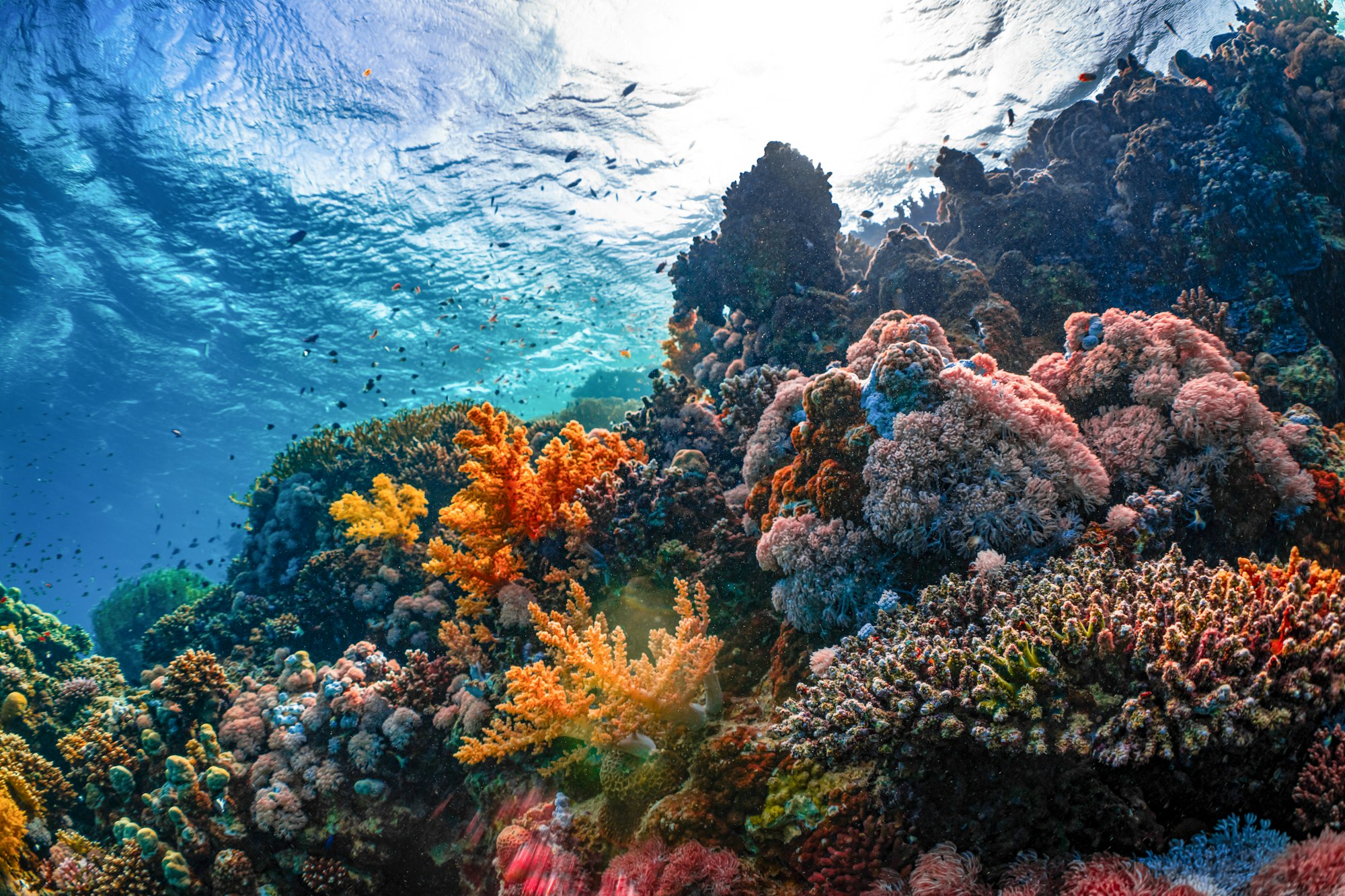
Ray of Hope Nassau
25.0583°N 77.4750°W · wreck
Ray of Hope Nassau
A 200-foot Haitian cargo freighter deliberately sunk as an artificial reef off Nassau in 2003, resting upright at 12–18 metres in clear Bahamian water and one of the most accessible wreck dives in the archipelago.
Overview
The Ray of Hope is a 200-foot cargo freighter deliberately sunk as an artificial reef off the southwest coast of New Providence Island, Nassau, on 7 July 2003. Nassau port authorities donated the vessel to Stuart Cove’s Dive Bahamas for sinking — it became the 16th wreck placed on the southwestern side of New Providence. Stuart Cove’s own account of the sinking (named crew: Operations Manager David Eads, Facilities Manager Mark Lessard, and Maintenance Manager Alex Paul) notes that although the ship was registered as a Haitian freighter at the time of donation, hull side plates found aboard indicated an earlier Belize registration, and plaques discovered in the office and engine room pointed to German construction — so her full origin and build history is not fully documented, beyond the Haitian registration under which she was donated. The ship sits upright with its bow at approximately 12 metres (40 feet) and the stern sloping down to 18 metres (60 feet), making this one of the most accessible and diver-friendly wrecks in Nassau. The Bahamas’ clear water delivers 20–30 metres of visibility at this site. The wreck is fully intact, allowing divers to explore its interior, cabins, and gangways, including a large open cargo hold crossed with beams that cast shadows across the floor. It sits adjacent to an older, more deteriorated wreck called Bahama Mama (and, more recently, a tugboat called Big Crab, scuttled in 2015), creating a multi-wreck dive option just off the Tongue of the Ocean drop-off. Caribbean reef sharks and nurse sharks regularly patrol the area; Stuart Cove’s own materials describe the site as used for shark encounters, though this audit did not find a source explicitly confirming a formal structured shark-feeding program specifically at this wreck (as opposed to elsewhere in Stuart Cove’s operations) — that detail from the prior version of this page should be treated as unconfirmed for this specific site.
Site Information
| Detail | Value |
|---|---|
| Depth Range | 12–18 m |
| Difficulty | Beginner to Intermediate |
| Entry Type | Boat |
| Site Type | Wreck |
| Visibility | 25–35 m |
| Current | Light to moderate |
| Water Temp | 24–28°C |
Marine Life
Divers Alert Network (DAN), a highly credible non-commercial source, confirms the following species specifically at the Ray of Hope: large resident black grouper, nurse sharks and Caribbean reef sharks, bar jacks at cleaning stations, butterflyfish among the sponge-covered davits and windlass, and green sea turtles passing through occasionally. The previous version of this page referenced glassfish, sweepers, spotted moray eels, an unspecified “diverse invertebrate community,” and southern stingrays on “the open sandy bottom at 50 meters” — that 50-metre figure is inconsistent with the wreck’s actual 12–18 m depth and appears to be a leftover error from an earlier, since-corrected depth mistake in this site’s data (the site’s depth was previously and incorrectly recorded as 50 m and was corrected to 18 m at the data level, but this stray sentence in the marine-life text was not updated to match). It has been removed. The specific claims of glassfish, sweepers, spotted moray eels, and stingrays could not be traced to a site-specific source during this audit and have accordingly been dropped in favor of the DAN-confirmed list above.
Dive Profile
Descent to the bow at approximately 12 metres. The wreck slopes gently toward the stern at 18 metres. The accessible depth allows generous bottom times — a complete circuit of the wreck takes 30–45 minutes. Interior exploration of the hold, cabins, and gangways is possible from multiple deck hatches. The adjacent Bahama Mama wreck can be included in a single dive for experienced divers.
Entry and Exit
Boat dive from Nassau-based operators. Entry by backward roll or giant stride. Permanent mooring on the wreck. DSMB essential for the ascent — the wreck’s position requires a free-water ascent in open water away from the structure.
Tips and Recommendations
The accessible depth (12–18 m) makes this one of Nassau’s most diver-friendly wrecks, suitable for newly certified divers. A torch greatly enhances the interior sections — the hold and cabins have interesting structure but reduced natural light. Morning dives have the best light and least boat traffic. Stuart Cove’s runs structured shark-feeding dives at this site if the shark encounter experience is a priority.
Safety Considerations
Interior sections should not be penetrated beyond natural light without wreck diving training. Silt disturbance in the interior can reduce visibility rapidly. DSMB recommended for the ascent. The site is operated by Stuart Cove’s — follow divemaster briefings for the shark encounter component.
Photography
The accessible depth (12–18 m) means excellent natural light — strobes are optional for exterior shots. Wide-angle shots of the superstructure with a diver descending provide scale. Interior shots through portholes and deck openings use the classic “window frame” wreck photography composition. The shark encounters at this site provide additional photographic opportunities.
Additional Resources
- Stuart Cove’s Dive Bahamas: Nassau-based operator that regularly dives Ray of Hope
- Combine with Stuart Cove Wall for a Nassau two-tank deep dive day
Sources: DreamWrecks - Ray of Hope Bahamas, DeeperBlue - The Ray of Hope Is the Newest Wreck Dive in the Bahamas, Stuart Cove’s Dive Bahamas - News and Links, Divers Alert Network - The Beat Goes On in Southwest New Providence. Last updated 2026-07-17.
Sea-surface temperature and wave height from Open-Meteo Marine (ERA5 reanalysis, monthly averages).
1609 verified species observations (273 species) logged within ~11 km of this site between 1905 and 2019, from the Ocean Biodiversity Information System.
- Apogon maculatus
- Neoniphon vexillarium
- Thalassoma bifasciatum
- Acanthurus bahianus
- Acyrtus rubiginosus
- Lutjanus apodus
- Acanthurus coeruleus
- Gambusia manni
- Pterois · lionfish
- Paraclinus nigripinnis
- Labrisomus nuchipinnis
- Gramma loreto
Scientific survey records skew toward sampled taxa (molluscs, corals) and do not reflect what you are guaranteed to see on a dive.
Source: OBIS (obis.org), aggregated Darwin Core occurrence records.
Conditions change with the tide and the season. If you have dived this site, share what it was actually like — date, visibility, current, and what you saw. Real, recent reports from divers are exactly what this guide is built to collect.
Send a conditions report ›