Maaya Thila
4.0914°N 72.8620°E · thila
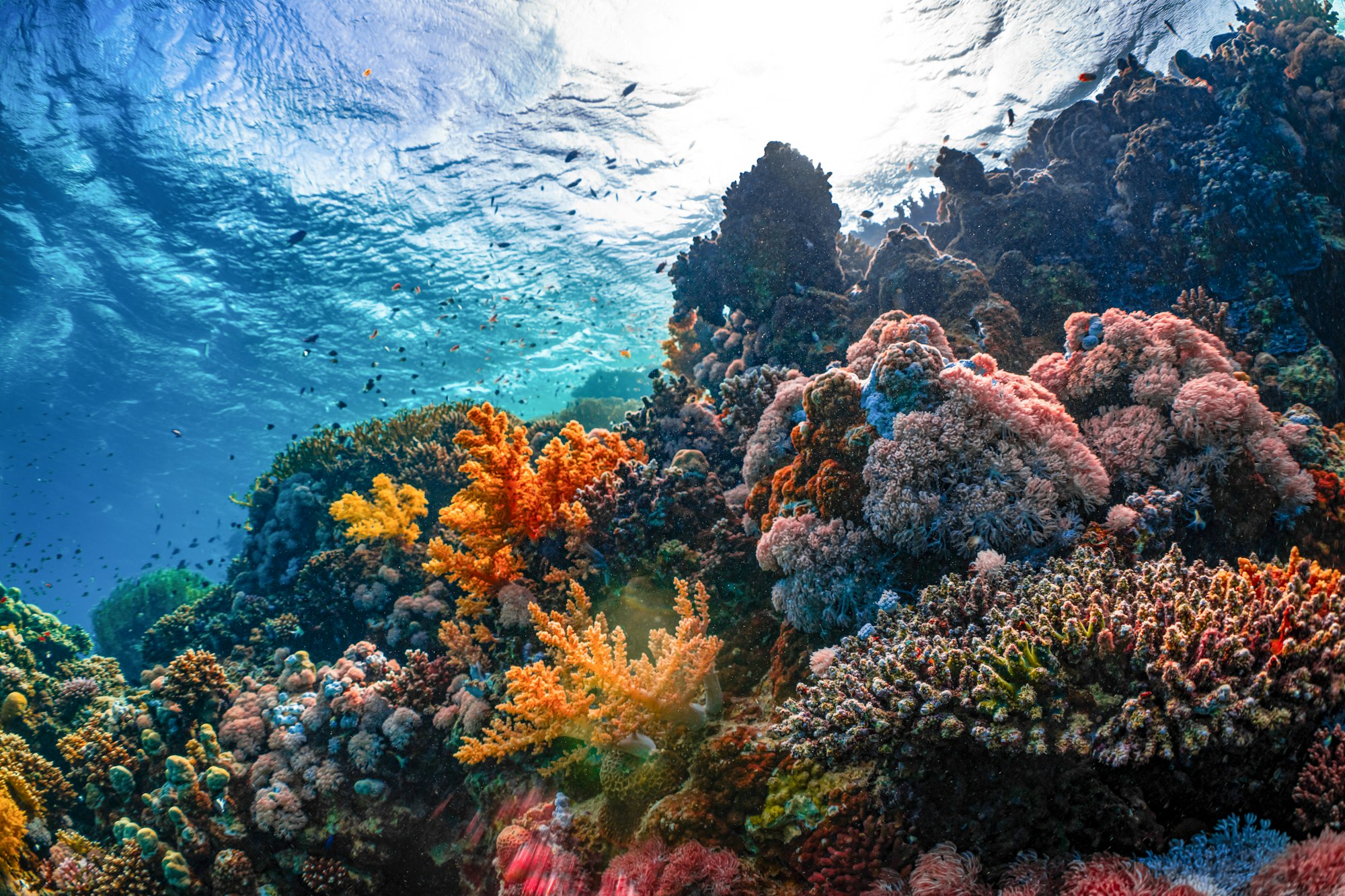
Maaya Thila is a small round pinnacle in North Ari Atoll and one of the Maldives' most famous dives — a protected reserve circled by white-tip reef sharks day and night, with a world-class night dive where the sharks turn hunter.
Overview
Maaya Thila is one of the Maldives’ most famous dives and a designated marine reserve in North Ari Atoll. It is a small, roughly circular pinnacle — compact enough to circle in a single dive when the current allows — with a reef top around 6–10 m and walls dropping past 30 m, where a satellite rock extends to about 40 m. The thila is honeycombed with caves, overhangs and swim-throughs, and its plankton-rich summit is part of why so much life gathers here.
Why divers come
Maaya Thila is a reliable shark dive around the clock. White-tip reef sharks are the signature — dozens circle the reef by day — alongside grey reef sharks cruising the blue, schooling barracuda, hunting giant trevally and dog-tooth tuna, resting hawksbill turtles, and overhangs draped in vivid orange Tubastraea soft coral. It’s the after-dark dive, though, that made the site world-famous.
The night dive
By day the white-tip reef sharks rest; after dark they turn into coordinated pack hunters, and Maaya Thila becomes one of the best night dives on the planet. The sharks learn to use divers’ torch beams to pin down fish sheltering in the coral, then strike — a fast, chaotic hunt playing out in the light. Expect dozens of white-tips on the hunt, giant trevally slamming into prey, marble stingrays, octopus, moray eels, Spanish dancer nudibranchs, sleeping turtles under the overhangs, and clouds of glassfish. It is a genuine spectacle, and deservedly a bucket-list dive.
Marine life
White-tip and grey reef sharks, hawksbill turtles, giant trevally, dog-tooth tuna, great barracuda and barracuda schools, marble stingrays, moray eels (including honeycomb morays), octopus, and a long cast of reef fish across the pinnacle. Manta rays are a seasonal visitor during the southwest monsoon and are not guaranteed.
Conditions & who should dive it
Current is moderate to strong and variable — whether you complete a full loop of the thila depends on the flow. In stronger current the site is best left to experienced divers, and a surface marker buoy is essential. Visibility often exceeds 30 m in the dry season, with water around 26–29 °C. Always dived with a guide; the night dive in particular demands good buoyancy and torch discipline.
When to go
The dry season, roughly November to April, brings the calmest water and best visibility. May to November is the wetter southwest monsoon — lower visibility, but the season when mantas are most likely. For the famous night dive, a liveaboard that overnights nearby gives you the best shot.
Getting there
Maaya Thila is primarily a liveaboard site and a fixture of central-Maldives safari itineraries — boats moor nearby after dinner for the night dive. Day boats from North Ari operators and some local-island dive centres can also reach it, though the liveaboard is the most dependable way to dive it, especially after dark.
Sea-surface temperature and wave height from Open-Meteo Marine (ERA5 reanalysis, monthly averages).
160 verified species observations (109 species) logged within ~11 km of this site between 1984 and 2018, from the Ocean Biodiversity Information System.
- Rhinoclavis aspera
- Nembrotha cristata
- Terebra guttata
- Goniobranchus gleniei
- Goniobranchus geometricus · キカモヨウウミウシ
- Mitra mitra
- Terebra babylonia
- Chromodoris
- Hypselodoris emma
- Hastula solida
- Conus maldivus
- Monoplex aquatilis
Scientific survey records skew toward sampled taxa (molluscs, corals) and do not reflect what you are guaranteed to see on a dive.
Source: OBIS (obis.org), aggregated Darwin Core occurrence records.
Conditions change with the tide and the season. If you have dived this site, share what it was actually like — date, visibility, current, and what you saw. Real, recent reports from divers are exactly what this guide is built to collect.
Send a conditions report ›