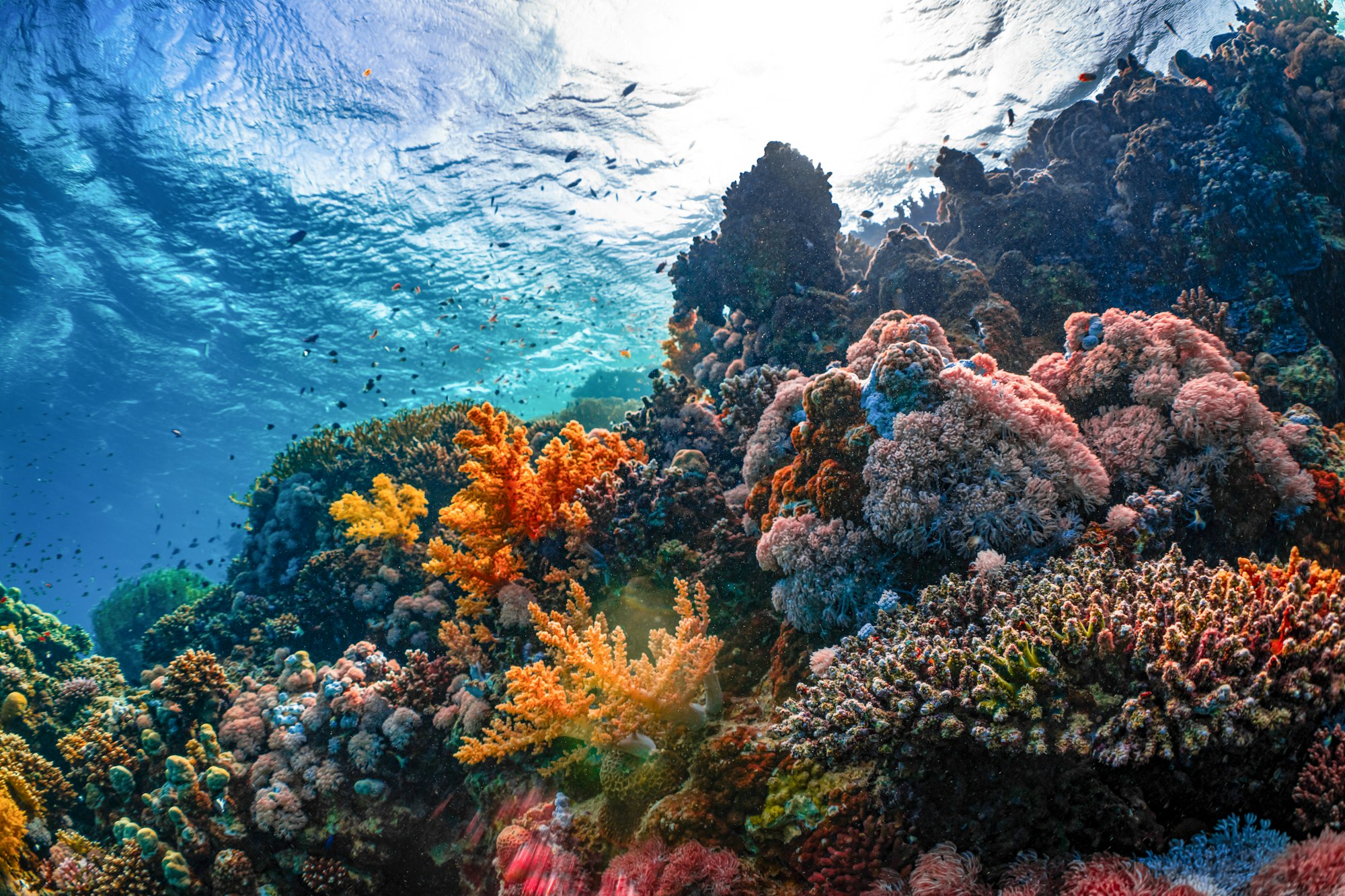
Rasdhoo Madivaru
4.2643°N 72.9995°E · wall
Rasdhoo Madivaru is one of the Maldives' few dawn hammerhead dives — a blue-water descent off an outer-reef corner at first light, hoping for schooling scalloped hammerheads. They are never guaranteed; the resident grey reef sharks of Madivaru Corner rarely disappoint. An advanced, deep dive.
Overview
Rasdhoo Madivaru — often called Hammerhead Point — is one of the very few places in the Maldives where you can reasonably try for schooling scalloped hammerheads. It sits on a horseshoe-shaped reef beside Madivaru island in Rasdhoo Atoll, where the outer corner drops straight into deep ocean blue. That deep water right at the reef’s edge is what brings hammerheads up to divable depth at first light.
The hammerhead dive
This is a dawn, blue-water dive. Boats leave before sunrise (Kuramathi’s dive centre departs around 5:45 am), and divers descend into open water off the wall — often with no reef, no bottom, and no visual reference — to hover around 30 m and wait. After daybreak the sharks drop back into the deep.
Be realistic: hammerheads are not guaranteed. Every operator says so. The sharks are wary of divers and keep their distance, and local dive guides are candid that sightings have become uncommon — even in the best months (January–April) the odds are roughly even, and when they do appear it is often just a few animals rather than a big school. Go for the experience of the blue-water dive, and treat a hammerhead as a bonus.
The reliable alternative
Right alongside is Madivaru Corner, an outer-reef drift over a plateau at 15–22 m dropping to sand around 26 m, where resident grey reef sharks rarely disappoint. It’s the dependable counterpart when the hammerheads don’t show.
Marine life
Beyond the hammerheads: grey reef and white-tip reef sharks, schooling eagle rays, dogtooth tuna, hunting giant trevally, barracuda and Napoleon wrasse, with turtles on the reef. Mobula and manta rays visit seasonally (roughly November–April), and silvertip sharks turn up occasionally.
Conditions & who should dive it
A deep, blue-water dive with moderate to strong current at an exposed outer corner. It demands Advanced Open Water or deep training, solid buoyancy and depth experience — holding a mid-water hover with no reference is the hard part. Visibility runs 10–30 m, best in the dry season, with water around 26–29 °C.
When to go
Diveable year-round, with the dry season (December–April) giving calmer, clearer water; mantas are most likely November–April. Hammerheads have no strong season — the dry months simply offer better visibility and, some say, slightly better odds.
Getting there
Rasdhoo’s local island has several dive shops and guesthouse dive packages, reached by scheduled speedboat from Malé (around US$35 each way) or a slower public ferry. Resorts in the atoll — Kuramathi, Veligandu — are close too; Kuramathi’s dive centre reaches Hammerhead Point in about 8 minutes. Liveaboards also call here.
Sea-surface temperature and wave height from Open-Meteo Marine (ERA5 reanalysis, monthly averages).
109 verified species observations (63 species) logged within ~11 km of this site between 1958 and 2022, from the Ocean Biodiversity Information System.
- Sargocentron diadema
- Scarus
- Ariosoma
- Gnatholepis anjerensis
- Valenciennea sexguttata
- Fusigobius neophytus
- Asterropteryx semipunctata
- Blenniella periophthalmus
- Epinephelus merra
- Plectranthias raki
- Nectamia fusca
- Parapercis millepunctata
Scientific survey records skew toward sampled taxa (molluscs, corals) and do not reflect what you are guaranteed to see on a dive.
Source: OBIS (obis.org), aggregated Darwin Core occurrence records.
Conditions change with the tide and the season. If you have dived this site, share what it was actually like — date, visibility, current, and what you saw. Real, recent reports from divers are exactly what this guide is built to collect.
Send a conditions report ›