Blue Corner
7.1343°N 134.2213°E · wall
Blue Corner
Arguably the most famous dive site on Earth, where ocean currents converge on a submerged reef promontory to deliver non-stop pelagic action
Overview
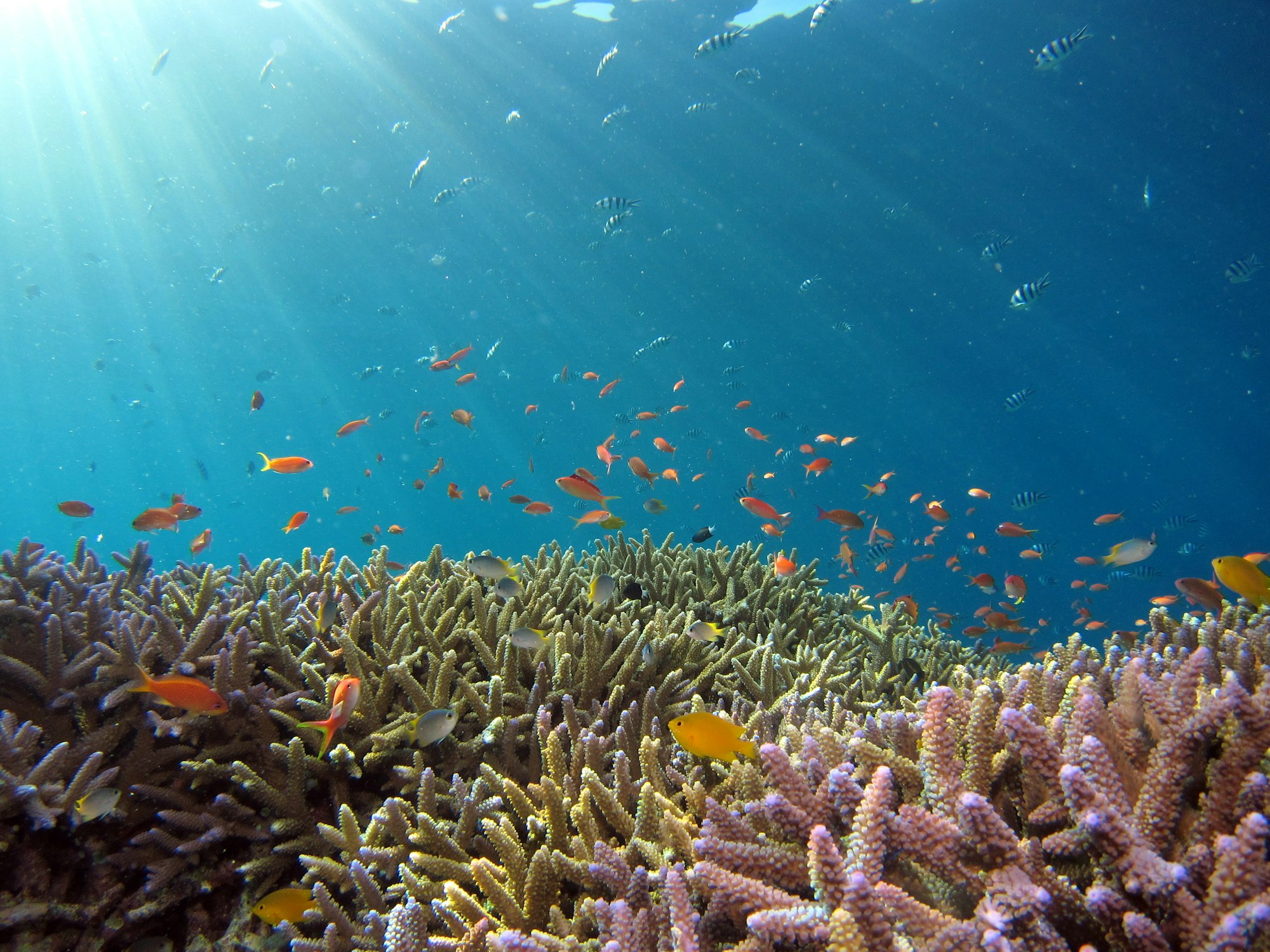
Blue Corner is a submerged reef plateau jutting into open ocean southwest of Ngemelis Island, consistently ranked among the top dive sites in the world by dive publications. The site’s position at the convergence of deep ocean currents funnels nutrients and attracts an extraordinary density of large marine life. Divers typically hook into the reef at around 15 meters and hang in the current, watching the parade of grey reef sharks, Napoleon wrasse, eagle rays, and massive schools of barracuda and bigeye jacks. Blue Corner is widely cited as the origin of the reef hook technique — the stainless-steel hook-and-line system that allows divers to anchor to dead coral and hover in current without finning. The reef top is a garden of hard corals alive with surgeonfish, triggerfish, and fusiliers. Visibility runs 16 meters on outgoing tides and exceeds 28 meters on incoming tides.
Site Information
- Location: Southwest of Ngemelis Island, Rock Islands, Palau, Micronesia
- Entry Type: Boat dive
- Site Type: Wall dive
- Difficulty Level: Advanced
- Maximum Depth: 30 meters
- Typical Visibility: 16–40 meters depending on tide direction
- Current: Strong to very strong, variable direction; can shift horizontally and vertically mid-dive
- Best Time: Year-round; incoming current brings the best visibility and pelagic activity
Marine Life
Grey reef sharks are the defining species at Blue Corner, patrolling the corner in groups documented at up to dozens per dive; over 13 shark species have been recorded at the site. Napoleon wrasse are regular visitors. Spotted eagle rays glide past in small formations. Large schools of bigeye jacks and barracuda form at the corner. Dogtooth tuna and bluefin trevally hunt along the wall edge. The reef top supports titan triggerfish, surgeonfish, unicornfish, and fusiliers. Whitetip reef sharks rest in crevices along the wall. Hawksbill and green sea turtles are seen on most dives.
Dive Profile
The dive begins with a descent to the reef plateau at around 12–15 meters. Most guides lead divers to the corner’s edge where the current is strongest. Divers clip reef hooks to dead coral and inflate their BCDs slightly to hover above the reef, watching sharks and rays in the water column. After the hook phase, divers drift along the wall, which drops vertically to well over 300 meters. The wall section between 15–30 meters features overhangs, small caves, and dense soft coral growth. Ascent is made along the wall, with a safety stop at 5 meters on the reef top.
Entry and Exit
Exclusive boat access from Koror-based day boats (approximately 45 minutes) or liveaboards anchoring nearby. Entry is by giant stride into the blue. The boat captain reads the current direction to determine drop point. Exit is typically a drift pickup — deploy your SMB during your safety stop so the boat can track and collect you.
Tips and Recommendations
- Bring a reef hook and practice using it beforehand — this is essential gear at Blue Corner
- Carry your hook clipped to a 1-meter line attached to your BCD D-ring for hands-free hovering
- Dive the incoming current for the best visibility and most active pelagic encounters
- Morning dives often produce the strongest current and most active marine life
- Keep your camera ready during descent — the action often starts before you reach the reef
Safety Considerations
Strong, unpredictable currents are the primary hazard. Down-currents along the wall can rapidly push divers to dangerous depths, and current direction can shift mid-dive. Carry a signaling device and SMB at all times. Stay close to your group and guide. This site is not appropriate for newly certified divers. Hooks should only be attached to dead coral or rock to prevent reef damage. Monitor air consumption carefully.
Photography
Blue Corner is a wide-angle paradise. A fisheye or rectilinear wide-angle lens captures the shark parades, eagle ray fly-bys, and barracuda schools that define this site. Shoot upward against the blue water for dramatic silhouettes. The reef top offers macro opportunities with nudibranchs and small critters, but most photographers come here for the big stuff.
Sources: Palau Dive Adventures – Blue Corner, Fish N Fins Palau, Dive The World – Palau. Last updated 2026-06-25.
Sea-surface temperature and wave height from Open-Meteo Marine (ERA5 reanalysis, monthly averages).
2634 verified species observations (310 species) logged within ~11 km of this site between 1954 and 2017, from the Ocean Biodiversity Information System.
- Chaetodon ephippium
- Myripristis
- Chlorurus sordidus
- Acanthuridae
- Eviota pellucida
- Hemigymnus melapterus
- Scarus dimidiatus
- Parupeneus multifasciatus
- Chaetodon kleinii
- Epinephelus merra
- Callogobius
- Saurida gracilis
Scientific survey records skew toward sampled taxa (molluscs, corals) and do not reflect what you are guaranteed to see on a dive.
Source: OBIS (obis.org), aggregated Darwin Core occurrence records.
Conditions change with the tide and the season. If you have dived this site, share what it was actually like — date, visibility, current, and what you saw. Real, recent reports from divers are exactly what this guide is built to collect.
Send a conditions report ›