Chuyo Maru
7.3403°N 134.4393°E · wreck
Chuyo Maru
A WWII Japanese coastal freighter sitting upright on the sandy floor of West Malakal Anchorage at 40 meters, nicknamed the “Lionfish Wreck” for its exceptional density of lionfish
Overview
The Chuyo Maru was a Japanese coastal freighter sunk during Operation Desecrate One, the American air raid on Palau in late March–early April 1944. The vessel was struck by 500-lb bombs dropped during the operation and sank on the evening of 1 April 1944. Though its position was recorded, the wreck was not salvaged after the war and was forgotten until April 1989, when wreck hunters Francis Toribiong and Klaus Lindemann rediscovered it.
Sources provide slightly conflicting specifications. Fish N Fins Palau and the TracesOfWar database report the ship as approximately 285 feet (87 meters) long and 1,941 tons; the Wrecked In My rEvo dive log reports an overall length of approximately 295 feet (90 meters). Build year is reported as 1942 by one source and 1943 by another. The vessel was owned by Toyo Kisen Kaisha, Tokyo, and powered by a coal-burning quadruple-expansion steam engine. These discrepancies cannot be resolved without access to the original ship registry; we note them rather than choose one version.
The wreck sits upright with the deck at approximately 30 meters (90 feet) and the keel at 40 meters (120 feet). The forward kingpost tower reaches to about 12 meters (35 feet) depth. Located in West Malakal Anchorage, it is a short boat ride from Koror dive shops — sources cite 5 to 20 minutes depending on operator.
Site Information
- Location: West Malakal Anchorage, Koror, Palau, Micronesia
- Entry Type: Boat dive
- Site Type: Wreck dive
- Difficulty Level: Advanced
- Maximum Depth: 40 meters
- Typical Visibility: 15–30 meters (50–100 feet); better on forward half of wreck
- Current: Light to moderate
- Best Time: Year-round; calm conditions preferred for deep wreck diving
Marine Life
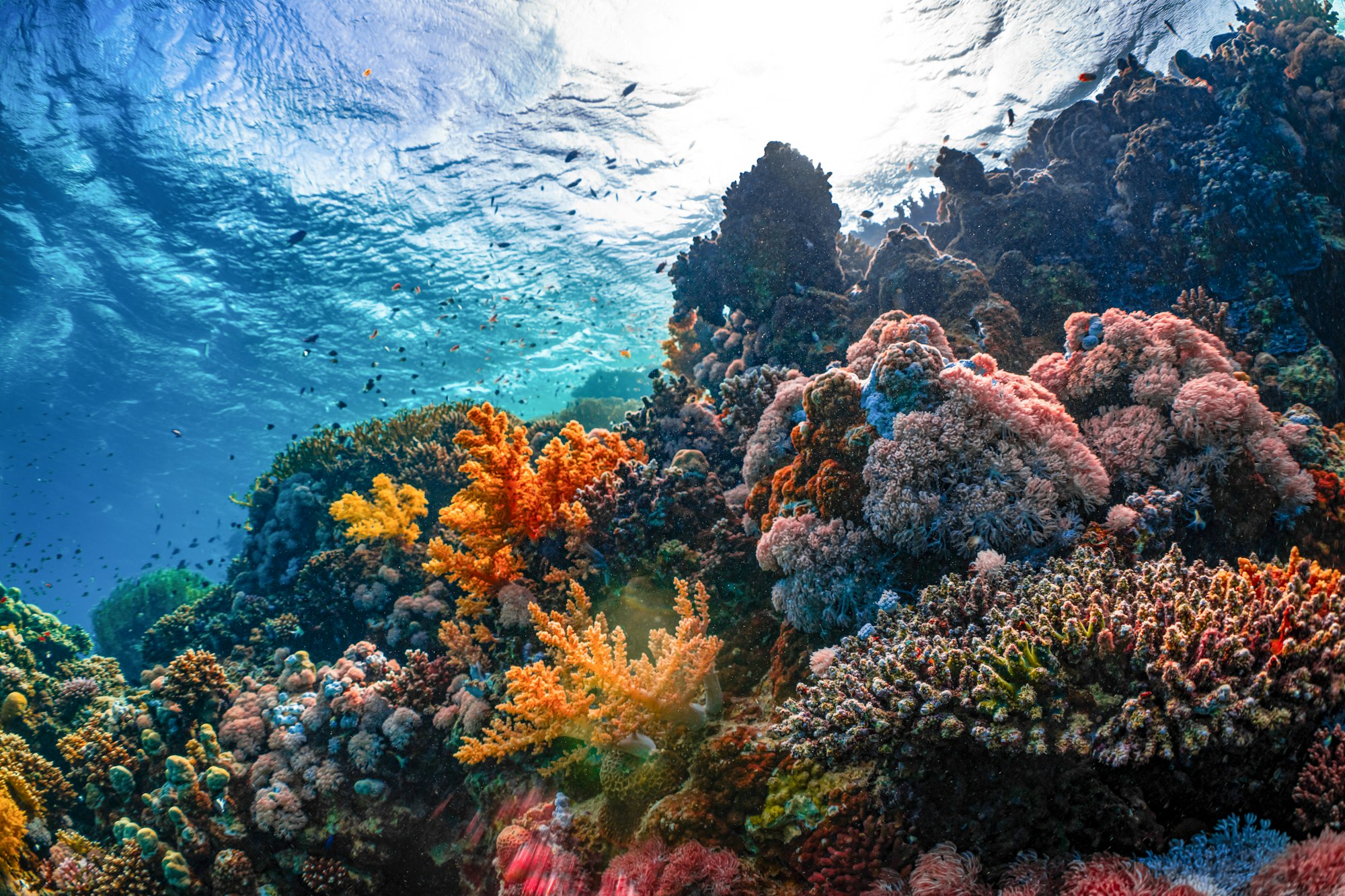
The Chuyo Maru earned the nickname “Lionfish Wreck” for the exceptionally high number of lionfish that inhabit the structure. Hard corals, black corals, spiral corals, and Cock’s Comb oysters cover sections of the hull. Translucent shrimps inhabit the coral growths. Colorful tropical fish are abundant throughout the wreck. The stern gun and ammunition boxes are heavily encrusted with marine growth. Note: additional specific species claims in earlier versions of this page have been removed as they were not confirmed at this specific wreck by independent sources.
Dive Profile
This is a deep dive requiring careful planning. The forward kingpost tower at 12 meters is visible on descent and serves as an orientation landmark. The main deck at 30 meters and the engine room — featuring a quadruple-expansion steam engine with skylights — are the primary features. The bow section has an anchor winch, cable coils, and two anchors on the port side of the deck. The bridge area has deteriorated but retains remnants of the brass compass and telegraph. Cargo holds are empty. The stern features a deck gun, four ammunition boxes, and two depth charge launchers. Plan for 15–20 minutes of bottom time at 30–40 meters with appropriate ascent schedule. Nitrox strongly recommended.
Wreck penetration into the engine room and holds is possible for trained wreck divers. Live ammunition is present on this wreck — do not touch or disturb any ordnance.
Entry and Exit
Boat dive from Koror (approximately 5–20 minutes depending on operator). Entry by giant stride with a direct descent along the mooring line to minimize surface current exposure. Exit by ascending along the line to the safety stop. The boat typically remains moored above the wreck.
Tips and Recommendations
- Use Nitrox (EANx32 or EANx36) to maximize bottom time and reduce decompression obligation at depth
- Carry a powerful primary torch and backup light for the interior sections
- The forward kingpost tower is an excellent orientation point visible from 12m depth
- Plan the dive and dive the plan — at 30–40 meters, gas runs out faster than you expect
- Dive computers with appropriate gas settings are essential
Safety Considerations
This dive reaches recreational depth limits. Narcosis is a real factor at 40m. Wreck penetration adds overhead-environment risk — silt-out, entanglement, and disorientation are all possible without proper training. Never penetrate without wreck diving training, redundant lights, and a clear exit strategy. Live ordnance is present; never handle anything that could be ammunition. Carry a safety sausage and audible signaling device. A surface interval of at least two hours is recommended before any subsequent deep dive.
Photography
Wide-angle captures the scale of the hull and superstructure. The lionfish congregating on the railings are photogenic subjects accessible throughout the depth range. Position a diver near the stern gun or along the railing for scale shots. Interior photography requires powerful lights and careful buoyancy to avoid silt. Plan shots in advance — limited bottom time at depth means knowing what you want before you descend.
Sources: Fish N Fins Palau – Chuyo Maru, Wrecked In My rEvo, Pete LePage Scuba. Last updated 2026-06-25.
Sea-surface temperature and wave height from Open-Meteo Marine (ERA5 reanalysis, monthly averages).
24768 verified species observations (374 species) logged within ~11 km of this site between 1947 and 2026, from the Ocean Biodiversity Information System.
- Cheilodipterus
- Eviota
- Callogobius
- Cheilinus fasciatus
- Exyrias belissimus
- Gobiidae
- Amblygobius
- Halichoeres
- Acanthuridae
- Centropyge vrolikii
- Halichoeres trimaculatus
- Yongeichthys criniger
Scientific survey records skew toward sampled taxa (molluscs, corals) and do not reflect what you are guaranteed to see on a dive.
Source: OBIS (obis.org), aggregated Darwin Core occurrence records.
Conditions change with the tide and the season. If you have dived this site, share what it was actually like — date, visibility, current, and what you saw. Real, recent reports from divers are exactly what this guide is built to collect.
Send a conditions report ›