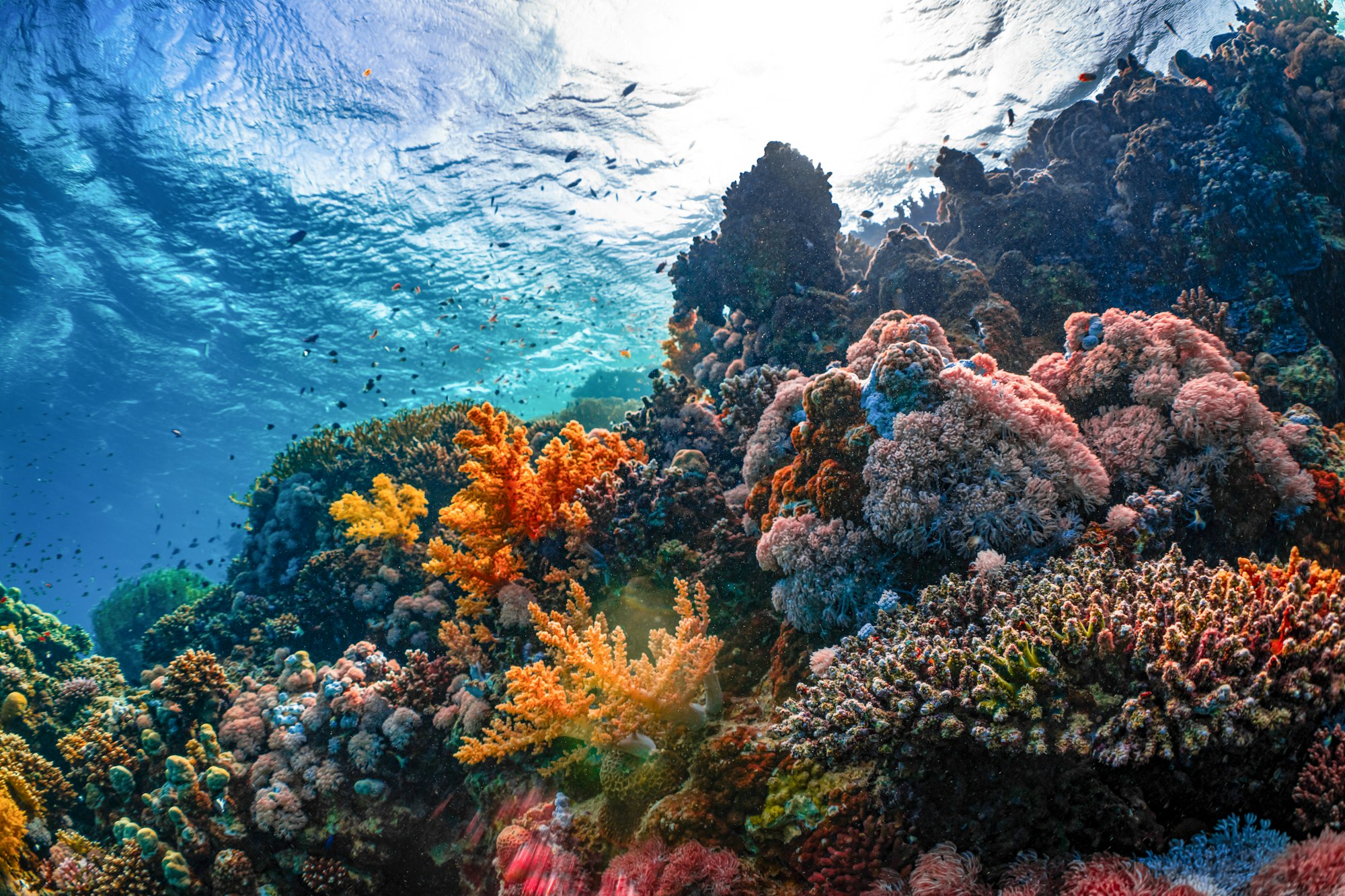
Blue Magic
0.5074°S 130.7368°E · pinnacle
A submerged seamount in Raja Ampat's Dampier Strait whose current-swept summit hosts manta cleaning stations, wobbegongs, reef sharks and schooling pelagics — an advanced, often reef-hook dive where mantas are likely in season but never guaranteed.
Overview
Blue Magic is a submerged seamount in the eastern Dampier Strait, the narrow, nutrient-charged channel between Kri Island and the much larger island of Waigeo in Raja Ampat, West Papua. Unlike the sheltered fringing reefs that make up much of the region’s diving, the pinnacle sits squarely in open-ocean flow: it rises from deep water to a shallow summit, spreads into a plateau of bommies and coral heads, then slopes away steeply into blue on all sides. Sources place the reef top at roughly 7–12 m depending on tide and the working base of the dive around 25–30 m.
Raja Ampat sits at the heart of the Coral Triangle and is widely described as the most biodiverse marine region on Earth, with survey counts in the hundreds of coral species and well over a thousand reef fish species. Blue Magic is one of the sites where that abundance is concentrated into a single, compact piece of topography.
Why divers come
The draw is manta rays. The plateau and its coral outcrops function as cleaning stations, where mantas hold position while wrasse and butterflyfish pick parasites from their skin and gills. Both species reported in the area — the smaller reef manta and the larger oceanic manta — have been recorded here, which is unusual and part of the site’s reputation. Beyond mantas, the current attracts schooling jacks, barracuda, giant trevally and dogtooth tuna, with reef sharks patrolling the drop-offs.
The dive
Most operators run Blue Magic as a negative or fast descent onto the summit, since a slow drop risks being swept past the pinnacle entirely. A common profile works the deeper slope first — 20–25 m along the reef, watching the blue — then ascends to the plateau to spend the bulk of the dive at the cleaning stations, finishing the safety stop over the shallow top. Reef hooks are standard equipment here; divers hook into dead coral rubble or bare rock (never live coral), settle low behind structure, and wait rather than swim. Fighting the current burns gas fast and pushes divers off the productive ground.
Marine life
At the cleaning stations, mantas may circle for several passes. Wobbegong sharks lie flat under ledges and on the coral shelf and are easy to overlook. Whitetip, blacktip and grey reef sharks are commonly reported. Schools of bumphead parrotfish move through the water column, and the summit holds solid macro — pygmy seahorses, nudibranchs, mantis shrimp, octopus and porcelain crabs — for divers who look small between the big-animal passes.
Conditions & who should dive it
This is an advanced site. Currents are typically moderate to strong and can shift direction and strength across the dive; operators generally schedule around tidal windows rather than diving it on demand. Good buoyancy, comfort with a negative entry, reef hook competence and disciplined SMB and gas management are prerequisites. Water sits in the high 20s Celsius year-round; visibility ranges widely, and — importantly — the plankton-rich water that brings mantas in is the same water that cuts visibility. Clear water and lots of mantas rarely arrive together.
When to go
Blue Magic is diveable year-round, but manta activity is plankton-driven and seasonal, with sightings most often reported from roughly October–November through March–April. Raja Ampat’s broader high season runs through these months. Mantas are wild animals moving on food, not a scheduled attraction: a strong season improves the odds substantially, but no operator can promise an encounter, and blank dives happen.
Getting there
Access is by boat, either from a Dampier Strait land resort on Kri or the surrounding islands, or from a liveaboard. The journey typically runs Jakarta or Makassar to Sorong, then ferry or speedboat to Waisai on Waigeo, from which the strait’s sites are short boat runs.
A note on protection
Raja Ampat is a network of Marine Protected Areas, and all visitors must pay the marine park entry permit — an environmental services fee, priced separately for foreign and Indonesian visitors and valid 12 months — which funds patrols and MPA management; a separate visitor entry ticket also applies. Indonesia declared full protection for both manta species across its exclusive economic zone in 2014, at the time the world’s largest manta sanctuary. Underwater, standard manta etiquette applies: never touch or chase, stay low and downstream of cleaning stations, don’t block a manta’s path or swim over it, and keep bubbles away from animals above you. Mantas leave stations that divers crowd — the site’s reliability depends on divers behaving well.
- Blue Magic Raja Ampat: Dive with Manta Rays & Sharks — Papua Diving
- Blue Magic Dive Site in Raja Ampat, Indonesia — La Galigo Liveaboard
- Blue Magic dive site in Raja Ampat — Dive Concepts
- Blue Magic: manta ray festival in Raja Ampat — Petites Bulles d'Ailleurs
- Raja Ampat Marine Park entry permit or Environmental Service Fee — Stay Raja Ampat
- Indonesia declares largest manta ray sanctuary in the world — Phys.org
Sea-surface temperature and wave height from Open-Meteo Marine (ERA5 reanalysis, monthly averages).
271 verified species observations (123 species) logged within ~11 km of this site between 1990 and 2025, from the Ocean Biodiversity Information System.
- Acanthurus lineatus
- Ctenochaetus striatus
- Hippocampus bargibanti
- Hippocampus denise
- Hippocampus pontohi
- Pseudamia hayashii · Hayashi's Cardinalfish
- Pseudochromis fuscus · Brown Dottyback
- Cypho
- Trimma xanthum · Yellow-red Pygmygoby
- Asterropteryx
- Apogon · three-saddle cardinalfish
- Hemiscyllium
Scientific survey records skew toward sampled taxa (molluscs, corals) and do not reflect what you are guaranteed to see on a dive.
Source: OBIS (obis.org), aggregated Darwin Core occurrence records.
Conditions change with the tide and the season. If you have dived this site, share what it was actually like — date, visibility, current, and what you saw. Real, recent reports from divers are exactly what this guide is built to collect.
Send a conditions report ›