Boo Windows
2.2216°S 130.6117°E · reef
A limestone islet in southern Misool whose underwater base is pierced by two shallow, coral-framed windows — Raja Ampat's most photographed swim-throughs, wrapped in soft coral, sea fans, wobbegongs and schooling fish. Intermediate, with current on the exposed faces.
Overview
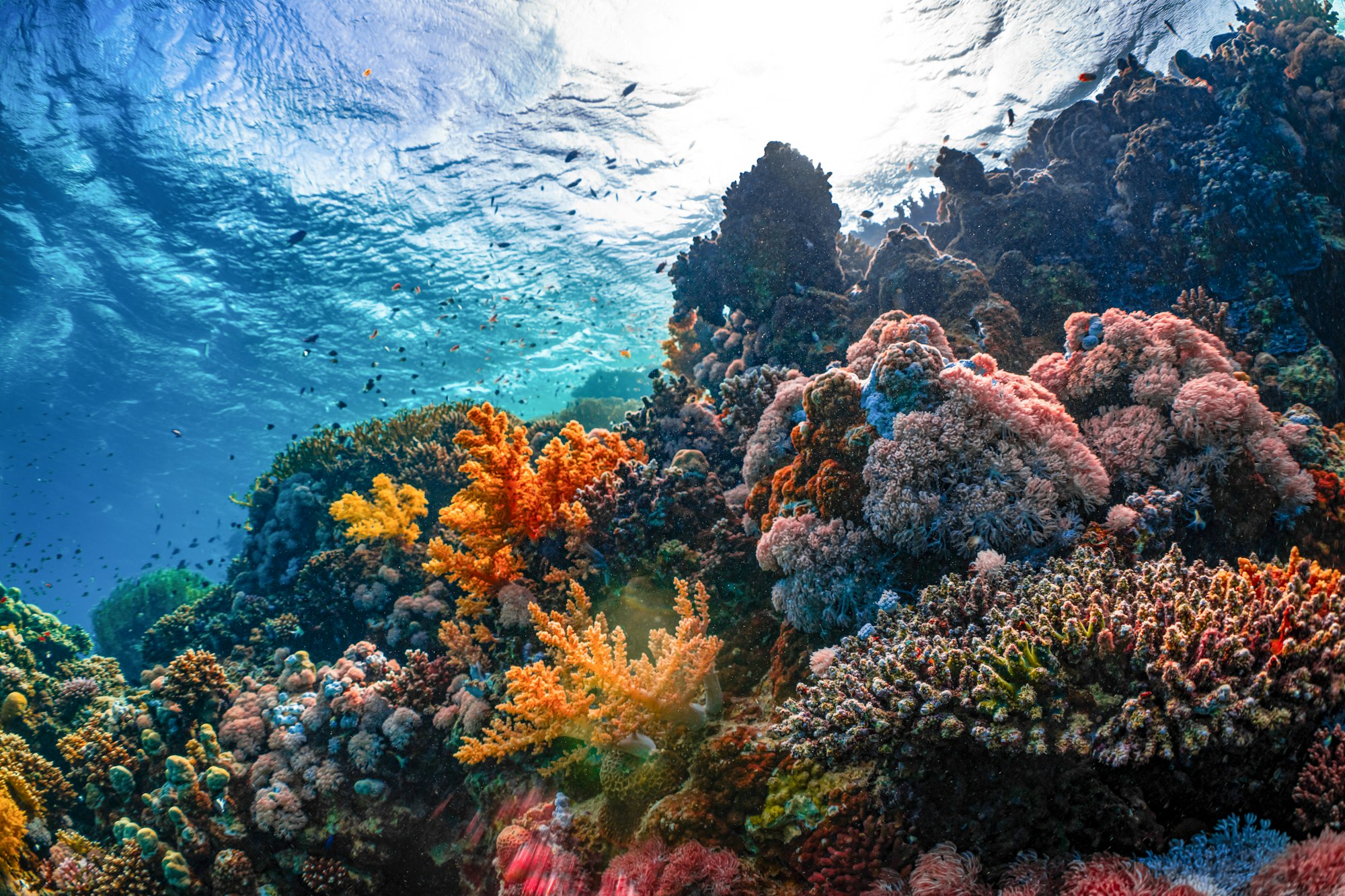
Boo Windows — also written Boo Rock or Boo Besar — is a small limestone islet in the southern reaches of Misool, the remote southern cluster of Indonesia’s Raja Ampat archipelago. Seen from the surface it reads as two separate rocks; underwater they are joined by a single continuous reef, which is the first surprise of the dive. The second is the feature the site is named for: the base of the larger rock is pierced clean through by openings that Misool Resort describes as two swim-through “windows” carved into the island. They sit very shallow — sources put the piercings from the surface down to roughly five metres — which is precisely why they photograph so well.
Why divers come
This is one of the most reproduced images in Indonesian diving: a diver silhouetted in a blue-lit aperture, the rim crusted with soft coral. Because the windows are shallow, they can be shot on available light without strobes, and a photographer can keep working them through a safety stop as the sun angle and tide shift. But the topography alone would not carry the site. Boo sits inside some of the densest soft coral and sea fan growth in Raja Ampat, and the reef connecting the two rocks is, in DivePhotoGuide’s phrase, dripping with soft corals and schooling fish.
The dive
Most operators drop on one of the points and work around. The reef shelf sits at about five to ten metres before rolling off into a wall that continues well past recreational limits — descriptions run from around 35 metres to 40-plus. In mild conditions a full circumnavigation of the rock is achievable on a single dive, ending at the windows in the shallows. The southwest face is steep and the most exposed to current, and that is where patrolling sharks tend to show. Note a tidal wrinkle worth planning around: the soft corals on the western side only open on certain tidal phases, so experienced guides shoot that side on the rising tide first.
Marine life
Wobbegong sharks — the carpet sharks Raja Ampat is known for — rest under plate and table corals here and are a reliable find for divers who slow down and look under things. Whitetip reef sharks cruise the exposed faces, and current draws in schooling batfish, fusiliers, sweetlips and clouds of glassfish and sweepers. On the macro side the site delivers pygmy seahorses on the sea fans, nudibranchs, mantis shrimp and scorpionfish. Larger visitors including napoleon wrasse, barracuda schools and turtles are reported, though these are encounters rather than guarantees.
Conditions & who should dive it
Boo is honestly an intermediate-to-advanced site, and which of those it is depends entirely on the day. Current ranges from mild to strong, and the southwest face is the exposed side. The windows themselves are shallow, tight enough to concentrate divers, and floored with material that silts easily — good buoyancy is not a nicety here but the difference between a clean photograph and a ruined one for everyone behind you. Divers comfortable with moderate current, negative entries and reef hooks will get the most out of it; anyone still working on trim should dive it on a slack tide with a guide. Visibility in Misool is variable but generally 25 metres or better, with water around 26–30°C.
When to go
Raja Ampat’s calm season runs roughly October through April, and Misool operators concentrate their itineraries in that window; the months either side of the turn of the year are often cited as the visibility peak. Conditions outside that period can be rough enough that southern Misool is simply not run. Confirm dates with your operator rather than assuming — southern Misool is the most weather-exposed part of the archipelago.
Getting there
There is no day-trip option. Misool is genuinely remote, and Boo is reachable only by liveaboard on a Raja Ampat itinerary that includes the south, or by staying at Misool Resort, which places the site about fifteen minutes from its jetty. Access is typically via flights to Sorong, then a boat transfer of several hours.
A note on protection
Boo lies within the Misool Marine Reserve, a roughly 300,000-acre (about 1,220 km²) privately funded reserve established in 2005 and leased directly from local villages. It comprises two no-take zones joined by a restricted-gear corridor, patrolled around the clock by an 18-person local ranger unit working from three stations and five boats — over 1,000 patrols a year. The Misool Foundation reports fish biomass up 248% between 2007 and 2021 and shark numbers up 190% since 2012. The sharks you see at Boo are, in a real sense, a result you are looking at.
Sea-surface temperature and wave height from Open-Meteo Marine (ERA5 reanalysis, monthly averages).
69 verified species observations (45 species) logged within ~11 km of this site between 2002 and 2015, from the Ocean Biodiversity Information System.
- Trimma
- Siphamia papuensis
- Trimma xanthum · Yellow-red Pygmygoby
- Trimma marinae
- Siphamia
- Trimma halonevum
- Gobiidae · Gobies
- Eviota jewettae
- Trimma stobbsi · Stobbs' Pygmy Goby
- Pseudochromis
- Trimma hoesei · Forktail Pygmy Goby
- Eviota sparsa
Scientific survey records skew toward sampled taxa (molluscs, corals) and do not reflect what you are guaranteed to see on a dive.
Source: OBIS (obis.org), aggregated Darwin Core occurrence records.
Conditions change with the tide and the season. If you have dived this site, share what it was actually like — date, visibility, current, and what you saw. Real, recent reports from divers are exactly what this guide is built to collect.
Send a conditions report ›