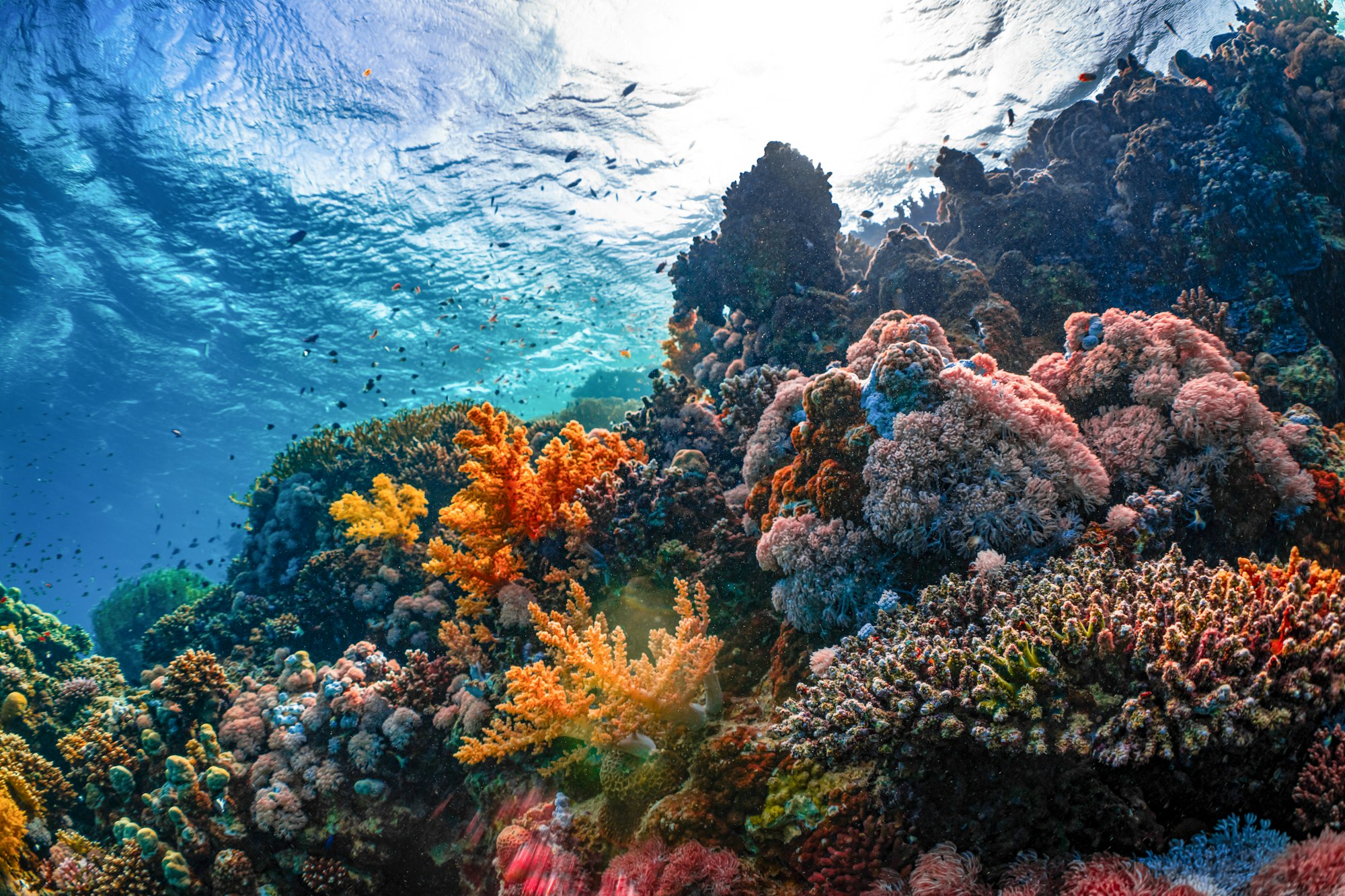
Cape Kri
0.5563°S 130.6915°E · reef
A current-swept sloping reef and ridge off the eastern tip of Kri Island in Raja Ampat's Dampier Strait, famous as the site of Dr. Gerry Allen's record single-dive fish count — an advanced drift dive where reef hooks are standard kit.
Overview
Cape Kri sits off the eastern tip of Kri Island in the Dampier Strait, the channel of fast, nutrient-rich water separating Waigeo from Batanta in Raja Ampat, West Papua. Raja Ampat lies in the heart of the Coral Triangle and is routinely described in scientific and dive literature as the most biodiverse marine region on Earth; Cape Kri is the site most often held up as its emblem. The profile is a reef slope running off the headland, dropping into a plateau and ridge decorated with hard coral, soft coral, big barrel sponges and gorgonian fans. Most operators cite a working maximum around 40 m, with the best action considerably shallower.
Why divers come
Cape Kri owes its fame to ichthyologist Dr. Gerry Allen, long associated with Conservation International’s Bird’s Head Seascape surveys. On a single dive here he tallied 374 fish species in 90 minutes — by his own account “the highest species count I’ve ever tallied on one dive.” The survey is widely reported as taking place around 2012; Allen has noted that more than a decade earlier he counted 327 species on one dive at the same headland, and credited the increase partly to fish becoming habituated to divers. The 374 figure is consistent across the sources checked here, though it is a field count from one observer rather than a formally adjudicated world title, and it is best understood that way.
The dive
Boats typically drop divers up-current so the reef stays on one shoulder while the group descends the slope. Current commonly runs parallel to the reef, so the dive is often a drift with a hold-and-watch phase: divers hook in on bare rock or rubble at a chosen depth and let the fish action come to them. Reef hooks are standard equipment here, not an optional extra. On stronger tides guides may keep the group shallow and hook in near the safety-stop depth, because being pushed too far past the point can put divers into turbulent water or a downward flow off the northern side. An SMB and the discipline to deploy it are essential.
Marine life
The draw is density rather than any single headline animal. Walls of fusiliers, snapper and sweetlips stack up against the current, with jacks, giant trevally and barracuda patrolling the blue edge. Blacktip and whitetip reef sharks are regularly reported, along with Napoleon wrasse, large groupers and hawksbill turtles. Reef mantas pass through the Dampier Strait seasonally, though dedicated cleaning stations elsewhere in the strait are far more reliable for them. Between the schooling fish, the reef also rewards slow looking: pygmy seahorses on fans, nudibranchs, scorpionfish and octopus.
Conditions & who should dive it
This is an advanced site, and honest operators say so. Currents are moderate to strong and can shift with the tide within a single dive, occasionally producing surge or down-current near the point. Divers should be comfortable with drift technique, reef-hook use, buoyancy in moving water and staying with a guide. Newer divers are better served on calmer Dampier Strait reefs before attempting Cape Kri. Water temperature sits in the roughly 27–30°C range year-round; visibility is often 20–30 m but drops during rainy, plankton-rich spells. Timing the dive to the tide matters more here than almost anywhere else in Raja Ampat, so local guides call the schedule.
When to go
Raja Ampat can be dived year-round, but October through April is the settled window, with calmer seas and the best visibility; December to April is the stronger period for manta encounters region-wide. July and August are the windiest and wettest months, when the Dampier Strait gets choppy, visibility can fall sharply and many liveaboards suspend operations.
Getting there
Access is by boat, usually a short ride from resorts on Kri and neighbouring islands or from a liveaboard working the Dampier Strait. The usual route in is a flight to Sorong (via Jakarta or Makassar), then the ferry or a private transfer to Waisai on Waigeo, and onward by small boat.
A note on protection
Raja Ampat’s waters were declared a shark and manta ray sanctuary — reported as the first in Indonesia and the Coral Triangle, covering roughly 46,000 km² — with the enabling regulation ratified in early 2013 after years of local and NGO campaigning. Visitors must also buy the Raja Ampat marine park entry permit, an environmental service fee funding MPA monitoring and patrols; it has commonly been IDR 700,000 for foreign passport holders, valid twelve months, with a separate visitor entry ticket introduced later. Fee amounts and rules change, so confirm current rates through official channels or your operator before travelling.
- Biodiversity Hotspot: Cape Kri Dive Site of Raja Ampat — Papua Diving
- Dr. Gerry Allen Lives to Dive and Count Fish, Part 1 — Bird's Head Seascape
- Cape Kri Dive Site in Raja Ampat, Indonesia — La Galigo Liveaboard
- World's Best House Reef — Cape Kri in Raja Ampat's Dampier Strait — Indo Pacific Images
- Raja Ampat Marine Park Entry Permit / Environmental Service Fee — Stay Raja Ampat
- Indonesia Opens First Shark and Manta Ray Sanctuary — Asian Scientist
- Raja Ampat Dive Season Explained — Bluewater Dive Travel
Sea-surface temperature and wave height from Open-Meteo Marine (ERA5 reanalysis, monthly averages).
264 verified species observations (111 species) logged within ~11 km of this site between 1995 and 2025, from the Ocean Biodiversity Information System.
- Acanthurus lineatus
- Ctenochaetus striatus
- Hippocampus bargibanti
- Hippocampus denise
- Hippocampus pontohi
- Pseudamia hayashii · Hayashi's Cardinalfish
- Pseudochromis fuscus · Brown Dottyback
- Cypho
- Chrysiptera
- Trimma xanthum · Yellow-red Pygmygoby
- Asterropteryx
- Hemiscyllium
Scientific survey records skew toward sampled taxa (molluscs, corals) and do not reflect what you are guaranteed to see on a dive.
Source: OBIS (obis.org), aggregated Darwin Core occurrence records.
Conditions change with the tide and the season. If you have dived this site, share what it was actually like — date, visibility, current, and what you saw. Real, recent reports from divers are exactly what this guide is built to collect.
Send a conditions report ›