Farondi Cave
2.0048°S 130.6393°E · cave
A limestone islet cluster east of Misool where vertical walls drop into a labyrinth of caverns, tunnels and a large cylindrical chimney, best known for Goa Besar and Verena's Garden. Guided overhead sections make it an advanced dive.
Overview
Farondi is a small cluster of limestone islets lying roughly 20 km — about twelve nautical miles — east of Misool island, in the southern reaches of Raja Ampat. Above water it is classic karst: mushroom-shaped cliffs, hidden lagoons and deserted pocket beaches. Below water the same limestone continues straight down, and the rock is riddled with caverns, tunnels, overhangs and at least one substantial vertical chimney. Operators generally group two named dives here — Goa Besar (“large cave”) on the southern side, and Verena’s Garden at the southwest corner — though liveaboard briefings often label the whole thing simply “Farondi Cave.”
Why divers come
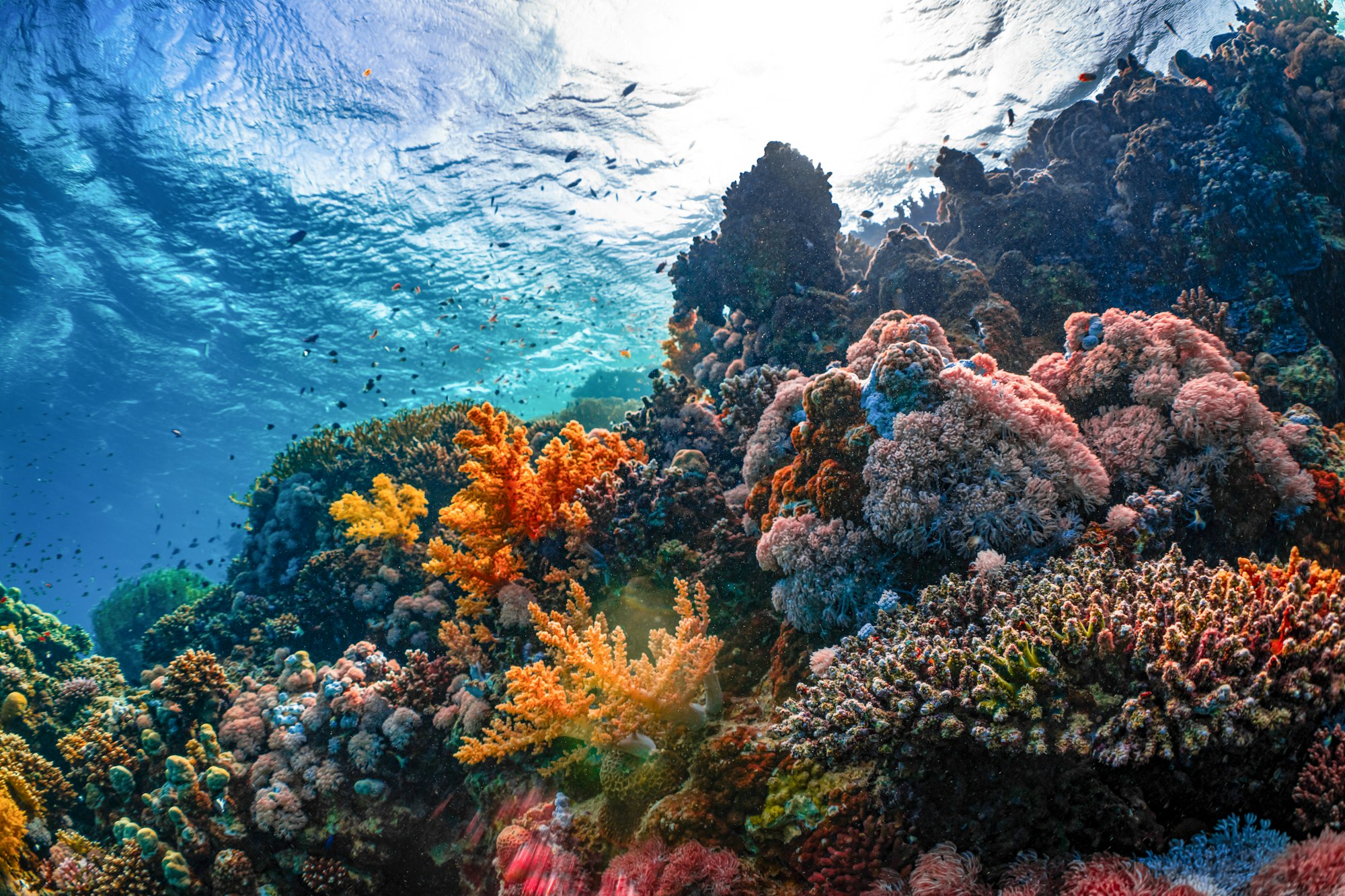
Most of Raja Ampat sells itself on fish soup and coral cover. Farondi sells topography. It is one of the few places in the archipelago where the headline attraction is the rock itself: shafts of light through a ceiling opening, a sand-floored tunnel that opens under your fins, walls draped in soft coral, sea fans, wire coral and encrusting sponges. The marine life is genuinely good, but divers who have done Magic Mountain and Boo Windows come here for something structurally different.
The dive (incl. the overhead sections)
At Goa Besar, the dive typically starts in a shallow soft-coral garden on a ledge and follows the wall down into a large cylindrical hole — effectively a chimney — lined with white, green and red black-coral bushes, wire corals and sponges. Dive The World describes a connected tunnel roughly 20 m long and 10 m wide, bottoming around 25 m, with exits reported in the 26–35 m range. Divebooker similarly reports a long tunnel ending near 25 m over a white sand floor, opening into a larger chamber with stalactites and a ceiling aperture that admits daylight and can serve as an exit toward the surface. One liveaboard itinerary describes the shallow section giving way to a tunnel spanning roughly 5 m to 30 m of depth, then a drift along a steep, winding hard-coral and gorgonian reef.
At Verena’s Garden, the wall dive is gentler. A cavern entrance sits at about 5–12 m, reported as roughly 30 m wide and penetrating around 20 m into the island over a sandy floor; the outer wall at the corner drops to about 35–40 m. Its signature is an enclosed air chamber inside the island wall, lit by small holes in the rock that turn the water surface a shimmering pale blue.
Sources describe these as daylight-zone caverns and swim-throughs with visible exits, not sumped cave passage — but exact routing varies by guide, tide and conditions.
Marine life
Expect wobbegong sharks resting under ledges, sweetlips and midnight snapper hanging in the tunnel mouths, fusiliers, bumphead parrotfish, batfish and signal gobies. Macro is a genuine strength: pygmy seahorses, red ornate ghost pipefish in the black coral, nudibranchs, crustaceans and tiger shrimp. Mobula rays and tuna pass through the area, though not reliably.
Conditions, overhead hazards & who should dive it
Be clear-eyed about this: any passage with rock overhead removes your direct ascent to the surface. Even a lit, guided cavern with a visible exit is an overhead environment. The features here run to 25–30 m — deep enough that gas planning, narcosis and no-decompression limits all bite while you are inside. Sand and silt floors mean a careless fin stroke can drop visibility to nothing for the divers behind you; frog kick and precise trim are not optional. Bring a torch, and dive close behind your guide.
Farondi is best treated as advanced: solid buoyancy, comfort at 30 m, and prior experience with swim-throughs. Raja Ampat generally is rated intermediate-to-advanced, with moderate currents. If a briefing describes true dark penetration beyond the daylight zone, that requires formal cave or cavern training — do not follow a guide into it on a recreational certification. Divers not confident in overhead sections can dive the walls only; guides routinely accommodate this.
Visibility commonly runs 10–30 m and can be excellent in Misool; water sits around 27–30°C year-round.
When to go
The main liveaboard season runs roughly October to April, with calm seas and best visibility; mid-October to mid-December is often cited as the calmest window. Misool’s southern position means visibility can stay strong even outside peak season.
Getting there
Effectively liveaboard-only. Farondi is remote — reached on southern Raja Ampat / Misool itineraries departing from Sorong, which is served by flights via Jakarta or Makassar. Misool Resort also runs dives in the wider region.
A note on protection
Farondi lies within the waters protected by the Misool Marine Reserve, a roughly 1,220 km² (300,000 acre) area comprising two no-take zones and a linking restricted-gear corridor, leased from local villages since 2005. An 18-person local ranger unit patrols from three stations with five boats, conducting over 1,000 patrols annually. Reported results include a 248% rise in fish biomass between 2007 and 2021 and a 190% increase in shark numbers since 2012. Take nothing, touch nothing — the limestone formations and their coral growth are fragile.
- Diving in Raja Ampat, West Papua — Dive The World
- The Goa Farondi Caves — Divebooker
- Misool Is One Of The Best Places To Dive In The World — No Troubles Just Bubbles
- Raja Ampat Dive Cruise — 8 Day Itinerary inc. Misool — Cruising Raja Ampat
- Misool Marine Reserve — Misool Foundation
- Dive Sites — Misool Resort
Sea-surface temperature and wave height from Open-Meteo Marine (ERA5 reanalysis, monthly averages).
194 verified species observations (50 species) logged within ~11 km of this site between 2002 and 2012, from the Ocean Biodiversity Information System.
- Trimma fangi · Spot-faced Pygmygoby
- Eviota korechika
- Trimma haimassum
- Trimma stobbsi · Stobbs' Pygmy Goby
- Eviota zebrina
- Trimma agrena
- Eviota winterbottomi
- Trimma tevegae · Blue-striped Dwarfgoby
- Trimma benjamini
- Trimma lantana
- Trimma macrophthalmum
- Priolepis vexilla
Scientific survey records skew toward sampled taxa (molluscs, corals) and do not reflect what you are guaranteed to see on a dive.
Source: OBIS (obis.org), aggregated Darwin Core occurrence records.
Conditions change with the tide and the season. If you have dived this site, share what it was actually like — date, visibility, current, and what you saw. Real, recent reports from divers are exactly what this guide is built to collect.
Send a conditions report ›