Four Kings
2.2083°S 130.3780°E · pinnacle
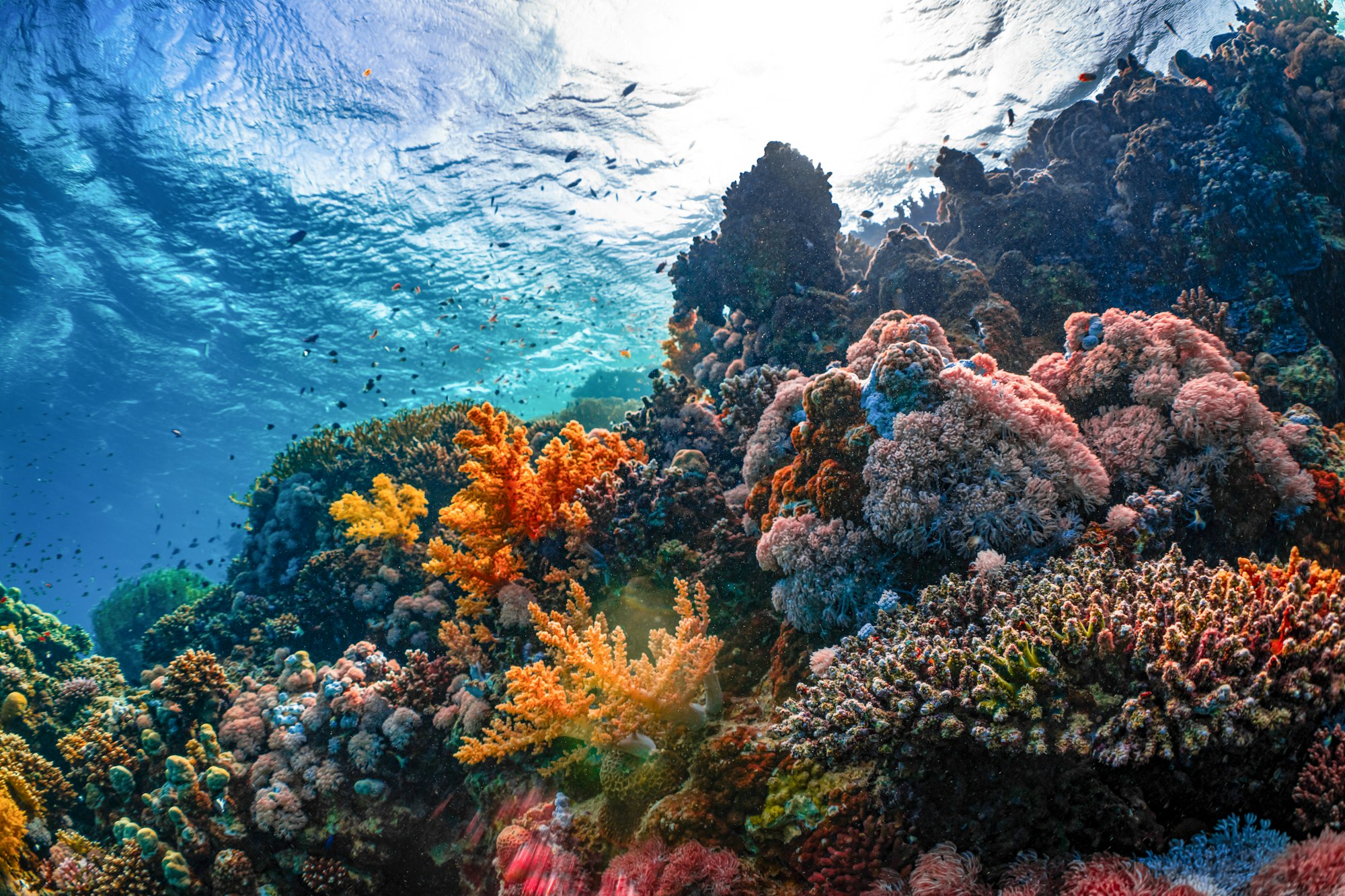
A line of four submerged pinnacles in southern Misool, Raja Ampat, blanketed in soft coral and sea fans, drawing schooling barracuda, trevally and reef sharks — but exposed to strong, shifting current that makes it an advanced dive.
Overview
Four Kings — often written Empat Raja — sits in open water in the southern Misool region of Raja Ampat, Indonesia. Operators place it roughly midway between Jef Pele and the Wayilbatan islands, east of Pele, with no land mass sheltering it on any side. The site is a short run of four submerged pinnacles rising from a base at around 40 m, linked by a ridge system that reads underwater like a small mountain range. Their summits sit at very different depths: sources describe the shallowest crest coming to within roughly 5–7 m of the surface, with others topping out nearer 16, 20 and 25 m. The name is simply the literal translation of Raja Ampat itself — “Four Kings” — a name Papuan tradition ties to the four main islands of the archipelago.
Why divers come
Four Kings is the classic Misool combination in one place: reef structure completely upholstered in soft coral and sea fans, and enough current across it to pull big schools in tight. Because the pinnacles stand isolated in blue water rather than fringing a wall, fish stack up on the current-facing sides in dense, visible aggregations. It is also large — several operators note the site realistically needs two dives to cover, and most itineraries schedule it that way rather than trying to sweep all four rocks in one tank.
The dive
A typical plan drops on the up-current pinnacle, works the deeper flanks first — 25–30 m, where the fish schools and passing sharks concentrate — then steps up the ridge to the shallower crests and finishes the deco-conscious end of the dive in 5–15 m among the soft coral gardens. Descriptions mention a narrow gap of roughly 15 m separating one solitary pinnacle from the other three, and a deeper canyon-like cut between two of them; these gaps and channels are the interesting terrain rather than true enclosed swim-throughs, and they funnel current sharply. Recreational profiles rarely need the full 40 m of base depth. Visibility is commonly quoted in the 10–30 m range, better in the drier months.
Marine life
The reliable headline is schooling fish: chevron barracuda in shoals of several hundred, bigeye trevally and jacks, batfish, sweetlips, fusiliers and parrotfish, with giant trevally hunting the edges. Whitetip and blacktip reef sharks patrol the deeper structure. The pinnacle tops are reported to function as cleaning stations for reef manta rays, and spotted eagle rays are seen gliding between the rocks — encounters worth treating as possible rather than guaranteed. Napoleon wrasse, bumphead parrotfish, scorpionfish and turtles round out the reef cast. Macro is genuinely good too: pygmy seahorses on the sea fans, plus nudibranchs, flatworms and pipefish for divers who slow down in the shallows.
Conditions & who should dive it
This is the honest caveat. Four Kings is exposed. Current here is described as moderate to strong and, because the pinnacles sit in open water, it can accelerate hard through the gaps and shift direction during a dive. Flows run strongest around full and new moon; guides work incoming and outgoing tides and will read the water before anyone gets in. Divers should be comfortable with negative entries, holding position in current, using a reef hook, and deploying an SMB for a blue-water ascent away from the rock. Good buoyancy and air consumption matter — the deeper sections plus current burn gas quickly. Advanced certification and recent current experience are the sensible bar; nervous or infrequent divers are better served on Misool’s sheltered sites. Always follow your guide’s briefing and dive within your own limits.
When to go
Misool’s reliable operating window runs roughly mid-October/November through April, when the seas are calmest and liveaboards run the southern loop. Reports put the best visibility in January and early February, and the strongest manta activity in the region from around mid-February into April. Outside this window many boats reposition and southern Raja Ampat sees rougher crossings.
Getting there
Four Kings is effectively liveaboard territory. Access is by boat from Sorong (or Waisai) in Southwest Papua, itself reached via Jakarta or Makassar, and southern Misool is a long open-water run from the Dampier Strait hub. A handful of Misool-based resorts also reach it by day boat when conditions allow. All divers pay the Raja Ampat marine park entry fee on arrival.
A note on protection
Southern Misool sits inside the Misool Marine Reserve, created in 2005 through a partnership between local villages and Misool Resort and now covering roughly 1,220 km² across two no-take zones linked by a restricted-gear corridor, managed by the Misool Foundation. Fish biomass inside the reserve has reportedly risen sharply since patrols began. The park fee every visiting diver pays helps fund that enforcement — so take nothing, touch nothing, and keep fins and cameras well clear of the soft corals that make this site what it is.
Sea-surface temperature and wave height from Open-Meteo Marine (ERA5 reanalysis, monthly averages).
224 verified species observations (65 species) logged within ~11 km of this site between 2002 and 2013, from the Ocean Biodiversity Information System.
- Trimma stobbsi
- Trimma haimassum
- Eviota sparsa
- Trimma xanthochrum
- Trimma tevegae
- Trimma nasa
- Eviota winterbottomi
- Trimma hoesei
- Trimma yanoi
- Trimma lantana
- Trimma
- Trimma striatum · Red-lined Pygmy Goby
Scientific survey records skew toward sampled taxa (molluscs, corals) and do not reflect what you are guaranteed to see on a dive.
Source: OBIS (obis.org), aggregated Darwin Core occurrence records.
Conditions change with the tide and the season. If you have dived this site, share what it was actually like — date, visibility, current, and what you saw. Real, recent reports from divers are exactly what this guide is built to collect.
Send a conditions report ›