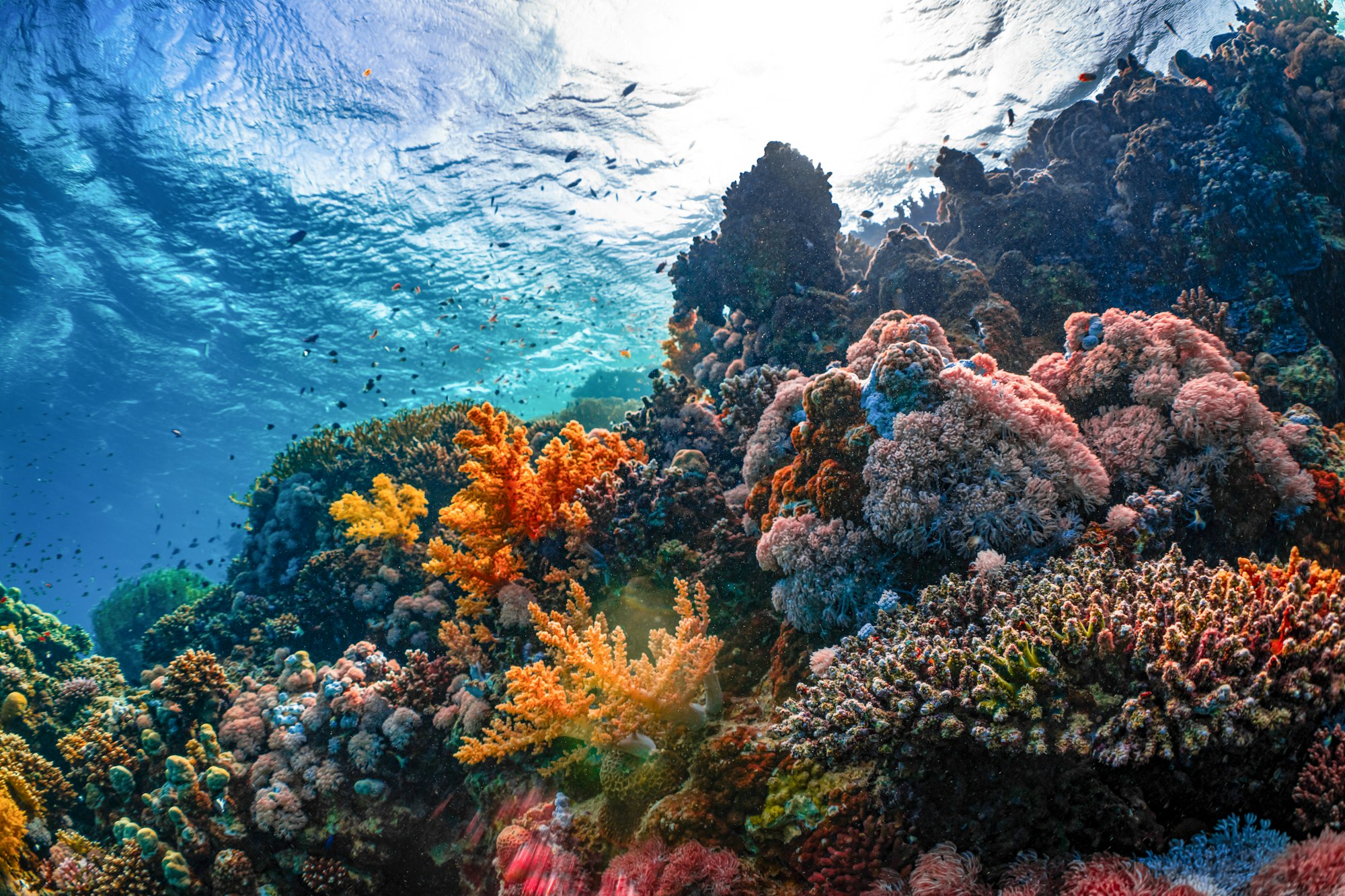
Manta Sandy
0.5533°S 130.5300°E · reef
Raja Ampat's best-known reef manta cleaning station: a shallow sandy channel between Arborek and Mansuar where mantas queue over coral bommies, dived under a strict ranger-enforced code — divers stay low behind a marked rock line, hands off, flash off.
Overview
Manta Sandy sits in the western Dampier Strait, on a shallow reef area between the small island of Arborek and the north coast of Mansuar. The site is exactly what the name promises: a broad sand flat and gentle sandy slope, broken by a few coral bommies. Those bommies are the point. They host cleaner wrasse, and reef mantas come in to hover over them while the wrasse pick parasites and dead tissue from their skin, gills and mouths. Depths at the cleaning station are modest — operators generally describe working around 15–18 m, with most of the dive spent at roughly 16 m.
Why divers come
It is the most reliable and best-known reef manta cleaning station in Raja Ampat, and one of the few places where mantas can be watched behaving naturally at close range in shallow, clear water. On a good day several animals circle in slow rotation over the bommies, queuing and re-queuing. Raja Ampat is also notable for its melanistic (“black”) reef mantas, which turn up here alongside the usual dark-above, white-below morph.
The dive
Boats drop divers near the top of the sand bank; the descent follows the slope down to the cleaning station. Divers settle on the sand at a fixed distance from the bommies and stay put — this is a sit-and-wait dive, not a swim-around. Mild to moderate current is normal, and the marked line doubles as a place to steady yourself. Visibility in the dry season is often reported in the 20–30 m range, though the Dampier Strait’s nutrient-rich water can cut that sharply. Because the dive is shallow and largely stationary, bottom times of close to an hour are common.
Manta etiquette (the rules)
Manta Sandy is actively managed. A permanent ranger station was established with Conservation International, the Marine Megafauna Foundation, local government and the villages of Arborek and Kapisawar, staffed by rangers drawn from those villages. The core rules reported by the managing organisations and operators:
- Book ahead and check in. Operators must book the site and report to the rangers on arrival; marine park tags are checked before anyone enters the water.
- Numbers are capped. Rangers enforce a limit on how many people are in the water at once — the SEA People cite a maximum of 20. Before regulation, the site regularly took dozens of divers from many boats simultaneously.
- Stay behind the line. A line of rocks and coral rubble laid on the sand marks the boundary. All divers must remain behind it; the bommies themselves are a no-go zone.
- Stay low and still. Settle on the sand, keep flat or kneeling, and let the mantas come to you. Do not swim toward, above, or after a manta, and do not block its path.
- No contact, ever. Touching removes the mucus layer protecting the skin and will normally end the encounter. Handling or harassing marine life is prohibited under Raja Ampat MPA rules; both manta species are fully protected under Indonesian law.
- Flash off. Operators advise switching flash off for the whole dive.
- Boats behave. Designated entry and exit points and no-go zones for boats over the cleaning station are part of the ranger protocol.
Snorkelling access at the cleaning station has been tightened over the years and some operators state snorkellers are no longer permitted there — confirm the current position with your operator or the rangers before booking.
Marine life
Reef mantas are the headline. Around them the sand and bommies hold cleaner wrasse, blacktip reef sharks, turtles, bumphead parrotfish, golden trevally and occasional cobia shadowing the mantas. Assorted sand-dwelling oddities turn up for divers who watch the bottom during the wait.
Conditions & who should dive it
Shallow, sandy and usually gentle — but current does run, buoyancy must be good enough to hold a position without stirring silt or drifting past the line, and the etiquette itself demands discipline. Intermediate is a fair call; capable open-water divers manage it with a good guide, but this is not a site to practise on.
When to go
Manta numbers in the Dampier Strait track plankton, and plankton tracks the season. The drier, calmer months roughly October–April are the general Raja Ampat window, with manta activity commonly described as strongest from around December through March or into the following months. Mantas are wild animals: blank dives happen in any month, and no operator can promise them.
Getting there
By boat only, from Waisai, from homestays and resorts around Arborek, Kri, Mansuar and Gam, or from a Dampier Strait liveaboard. A valid Raja Ampat marine park permit is required.
A note on protection
The etiquette here is not decoration. Crowding and pursuit push mantas off cleaning stations, and preliminary data cited by the SEA People after the 2017/18 season indicated more mantas aggregating at the site once diver numbers and boat behaviour were regulated. Following the rules is the reason the dive still works.
- Manta Sandy Ranger Station — The SEA People
- Manta Sandy Ranger Station — Raja Ampat SEA Centre
- How to Dive and Snorkel with Mantas — Papua Diving
- Manta Sandy Dive Site in Raja Ampat — La Galigo Liveaboard
- Rules & Regulations, General Use — Kawasan Konservasi Perairan Raja Ampat
- Raja Ampat — Marine Megafauna Foundation
Sea-surface temperature and wave height from Open-Meteo Marine (ERA5 reanalysis, monthly averages).
113 verified species observations (58 species) logged within ~11 km of this site between 1999 and 2019, from the Ocean Biodiversity Information System.
- Dascyllus aruanus
- Mobula alfredi · Reef manta ray
- Hippocampus denise
- Hoplolatilus
- Diancistrus
- Atherinidae · Hardyheads
- Dermochelys coriacea · Leatherback sea turtle
- Ambassis · Glassies
- Periophthalmus argentilineatus · Barred Mudskipper
- Acentrogobius janthinopterus · Mangrove Goby
- Acreichthys tomentosus · Banded Leather-jacket
- Lepidochelys olivacea · Olive ridley
Scientific survey records skew toward sampled taxa (molluscs, corals) and do not reflect what you are guaranteed to see on a dive.
Source: OBIS (obis.org), aggregated Darwin Core occurrence records.
Conditions change with the tide and the season. If you have dived this site, share what it was actually like — date, visibility, current, and what you saw. Real, recent reports from divers are exactly what this guide is built to collect.
Send a conditions report ›