Melissa's Garden
0.5899°S 130.3152°E · reef
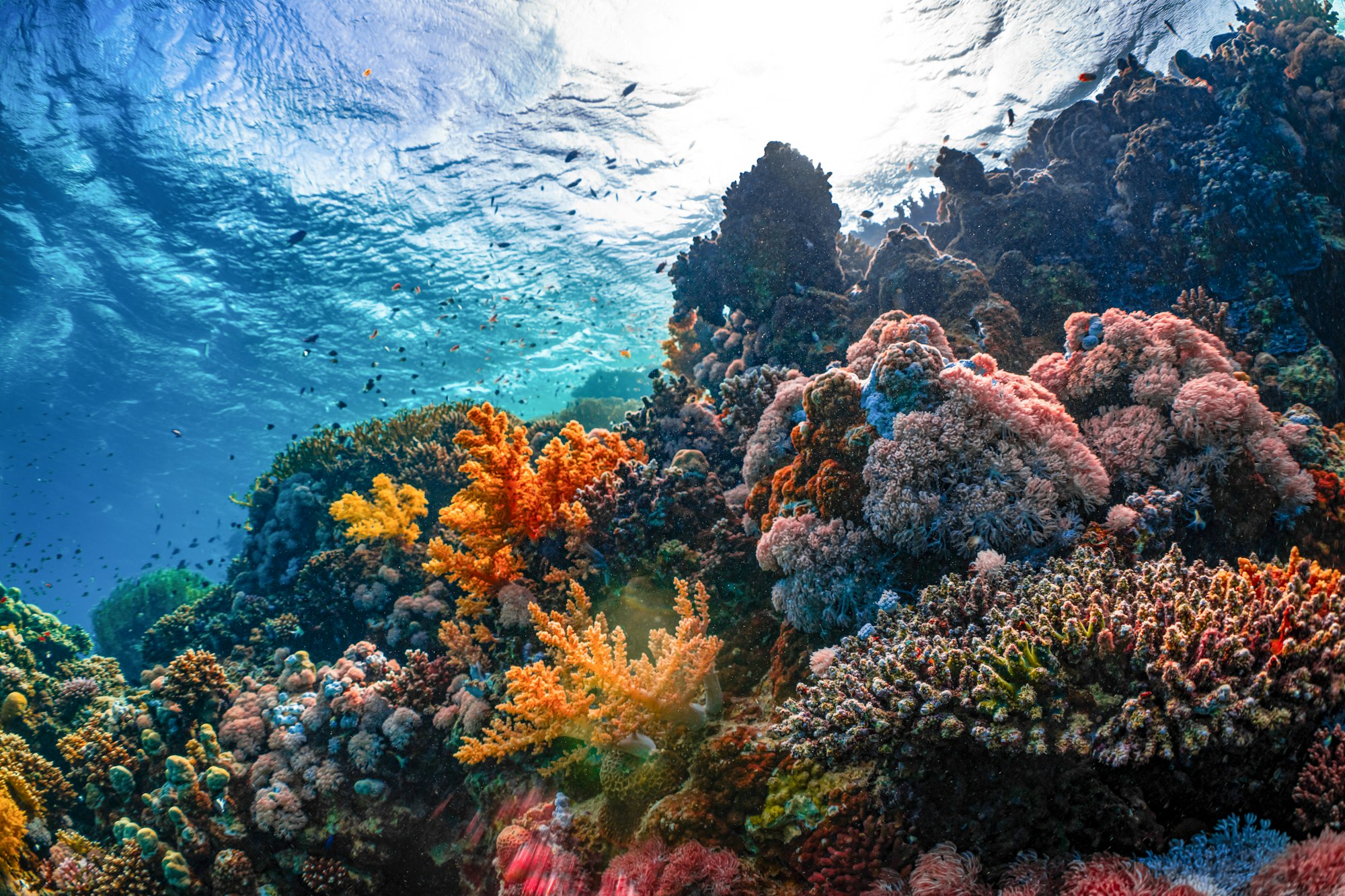
A shallow hard-coral plateau in Raja Ampat's Fam Islands, ringed by bommies and sloping to sand near 25 m, Melissa's Garden is prized for some of the densest, healthiest staghorn and table coral anywhere, in usually moderate conditions.
Overview
Melissa’s Garden lies among the Fam Islands, the limestone cluster northwest of Batanta and close to the Piaynemo (Penemu) chain, just west of the better-known Dampier Strait. Operators place it southeast of the Penemu group near Pulau Keruwo, typically reached as a day trip from Fam-area homestays or as a scheduled stop on northern Raja Ampat liveaboard itineraries.
The site is usually described as an oval, flat-topped reef sitting between islands, with two small pinnacles breaking the surface at either end. The flat top carries the coral garden that gives the site its name; from its edges the reef slopes away to a white sand bottom at roughly 25 metres. Dive operators generally credit the name to Max Ammer, the founder of Papua Diving, who named it after his daughter Melissa — an account repeated across most operator write-ups, though it is operator-sourced rather than independently documented.
Why divers come
The draw is the coral itself rather than big-animal action. Melissa’s Garden is routinely ranked among Raja Ampat’s — and by extension the world’s — finest hard-coral gardens: broad, unbroken sheets of staghorn, table and cabbage coral in the shallows, interspersed with bommies, sponges and dense crinoids. Several operators describe it as looking like a deliberately tended garden. In a region where reef health is already exceptional, this site is singled out for the sheer continuity and condition of its hard coral, with very little rubble or bleaching damage reported in recent operator accounts.
The dive
A common profile is to drop on the southern side, descend the sloping reef to the sand near 25 metres, work the slope and bommies while gradually ascending, then spend the bulk of the dive — and the safety stop — in the shallow garden. Sources put the reef edge at roughly 8–12 metres where it begins its descent, with the richest coral concentrated in about the 5–10 metre band. That structure makes the dive naturally multi-level and generously long on gas.
The shallow top also sits close enough to the surface (around five metres at its shallowest) that snorkellers can enjoy the site from above.
Marine life
Reef fish density is high: clouds of anthias, fusiliers and damselfish over the coral, with snappers, barracuda, angelfish, butterflyfish and parrotfish through the mid-water and along the slope. Bumphead parrotfish and hawksbill turtles are reported. Wobbegong sharks tuck under table corals and ledges, and reef sharks pass along the deeper slope. Macro divers find nudibranchs, ghost pipefish, pygmy seahorses on gorgonians and various shrimps. Manta rays are occasionally mentioned but should be treated as a bonus, not an expectation — the region’s reliable manta sites are elsewhere.
Conditions & who should dive it
Reports on current vary, and it is worth taking that seriously. Some operators call the currents easy and the site suitable for all levels; others describe current as medium and “highly variable,” noting that the reef’s south-side formation offers shelter when it runs. The practical reading: conditions here are usually gentler than the strong-drift sites of the Dampier Strait, but Raja Ampat is a current-driven region and Melissa’s Garden can pick up on a big tide.
Comfortable buoyancy is non-negotiable, because the best coral is shallow and fragile. Divers with solid trim and around 20–25 logged dives will get the most from it; newer divers can dive it safely under guide supervision on a mild tide. Water sits close to 29°C year-round.
When to go
Raja Ampat’s main dive season runs roughly October to April, when seas are calmest and visibility is at its best. The wetter, windier months around June to September see more surface chop and trip disruption, though the region is dived year-round by some operators. Check individual liveaboard schedules, as many reposition seasonally.
Getting there
Access is by boat. Melissa’s Garden is typically reached as a day trip from Fam-area homestays, or as a scheduled stop on northern Raja Ampat liveaboard itineraries. The regional gateway is Sorong, then ferry or transfer to Waisai on Waigeo.
A note on protection
Raja Ampat is a managed marine protected area and every visitor must hold a Marine Park Entry Card (the environmental services fee) before entering. The Marine Park Authority lists it at IDR 700,000 for international visitors and IDR 425,000 for Indonesian citizens, valid twelve months, with under-12s exempt; funds support patrols, monitoring and local community programmes. A separate regency visitor entry ticket also applies and was increased in 2026 — confirm current amounts with your operator, as these fees change.
On the reef itself, standard no-touch rules matter more here than almost anywhere. Branching staghorn and plate corals snap under a careless fin kick or a dropped knee, and recovery takes years. Keep gauges and octopus clipped, hover rather than kneel, take nothing, and follow your guide’s briefing on where the shallow garden may not be crossed.
- Melissa's Garden: Colorful Dive Site of Raja Ampat — Papua Diving
- Melissa's Garden Dive Site in Raja Ampat, Indonesia — La Galigo Liveaboard
- Melissa's Garden dive site in Raja Ampat — Dive Concepts
- Melissa's Garden — Meridian Adventure Dive, Raja Ampat
- Marine Park Entry Card — Kawasan Konservasi Perairan Raja Ampat (Marine Park Authority)
Sea-surface temperature and wave height from Open-Meteo Marine (ERA5 reanalysis, monthly averages).
264 verified species observations (91 species) logged within ~11 km of this site between 1995 and 2019, from the Ocean Biodiversity Information System.
- Trimma haimassum
- Trimma stobbsi · Stobbs' Pygmy Goby
- Trimma habrum
- Eviota sparsa · Sparse Eviota
- Trimma tevegae · Blue-striped Dwarfgoby
- Trimma
- Trimma xanthochrum
- Eviota pellucida
- Trimma hollemani
- Trimma gigantum
- Trimmatom sagma
- Sueviota lachneri
Scientific survey records skew toward sampled taxa (molluscs, corals) and do not reflect what you are guaranteed to see on a dive.
Source: OBIS (obis.org), aggregated Darwin Core occurrence records.
Conditions change with the tide and the season. If you have dived this site, share what it was actually like — date, visibility, current, and what you saw. Real, recent reports from divers are exactly what this guide is built to collect.
Send a conditions report ›