Nudi Rock
2.2184°S 130.5656°E · reef
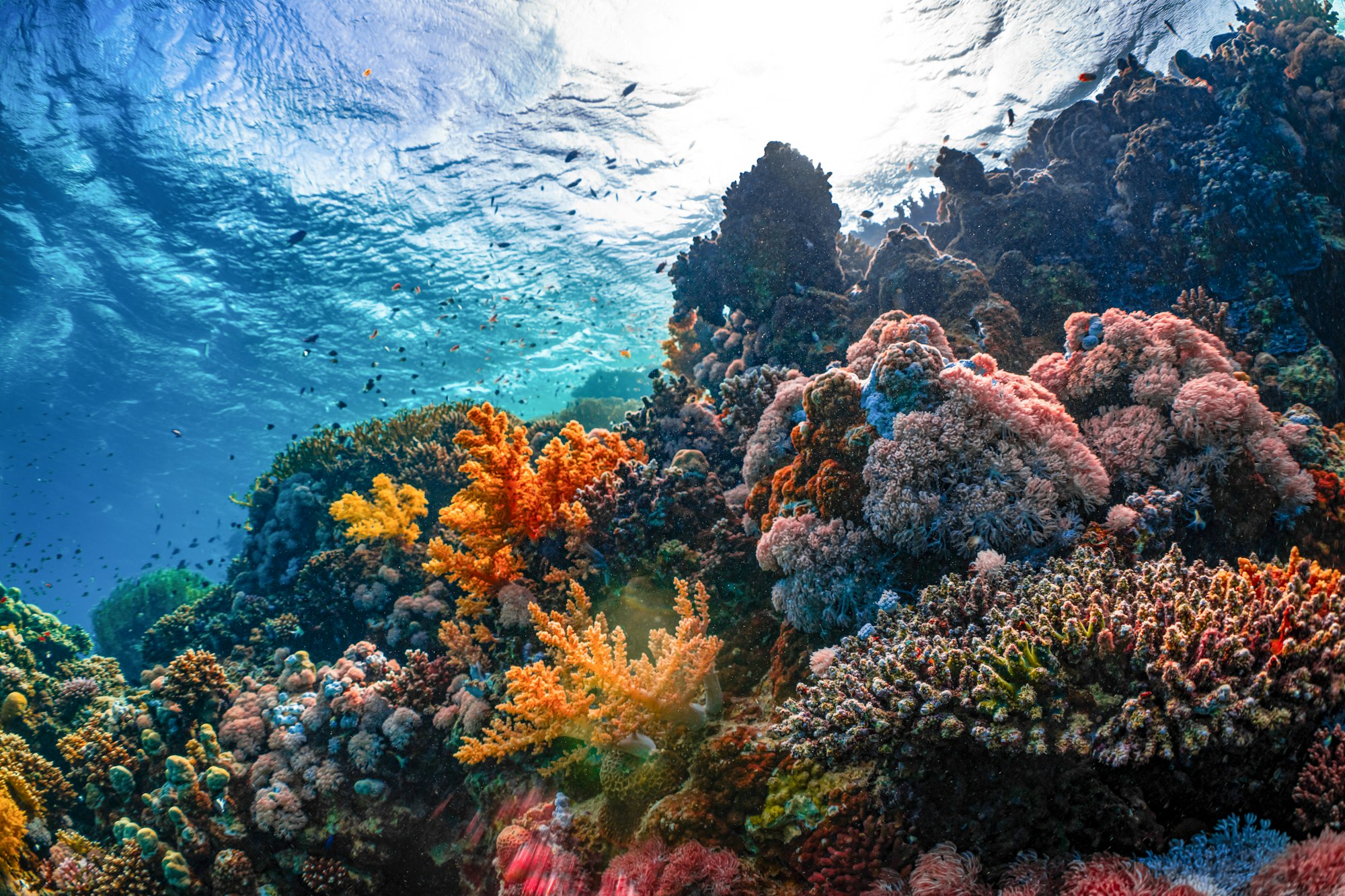
A nudibranch-shaped limestone islet in Misool's Fiabacet chain, ringed by soft-coral walls, sloping hard-coral gardens and pinnacles that gather barracuda and trevally when current runs — intermediate diving with reef-hook conditions.
Overview
Nudi Rock is one of the signature dive sites of southern Misool, in Indonesia’s Raja Ampat archipelago. It is a small limestone islet — Misool Resort places it in the Fiabacet chain, while some operators describe it as lying off Pulau Batbitieru — surrounded by walls, sloping reef and a scatter of pinnacles. The name is not a marketing invention: the jagged rock, seen from the boat, genuinely resembles a nudibranch, and a pair of small trees growing on its crest stand in for the sea slug’s rhinophores. Descriptions vary slightly on whether it is two trees or three, but every operator that names the site agrees on the resemblance.
Why divers come
Two quite different dives are stacked on one small island. The shallows are a wide-angle photographer’s site — dense soft coral, hard coral gardens and, on the north side, a steep face dropping away in colour. The same reef is also a serious macro site: the gorgonian sea fans are reliably populated with pygmy seahorses and cowries, and the soft corals hold the flamboyant nudibranchs the site is named for. When current runs, the pinnacles pull in schooling fish, so a single dive can swing from a 5 cm seahorse to a wall of barracuda.
The dive
Topography is mixed: wall, sloping reef and small pinnacles, with a coral ridge linking toward neighbouring Tank Rock. The northern side is a steep, soft-coral-covered vertical wall. The southern side flattens into a plateau at roughly seven to eight metres that concentrates fish when water is moving. To the east, the bottom is sand at around 25 metres, and this is where operators point divers looking for the big barracuda schools. Maximum depth is generally given as about 28 metres. A common plan is to drift from the up-current side around the pinnacles and finish shallow in the soft coral garden — a profile that suits both the fish action and a long, slow safety stop over the corals.
Marine life
Reported regulars include schooling barracuda, big-eye and giant trevally, snapper, grouper, Napoleon wrasse, turtles and patrolling grey reef sharks; whitetips are also listed. Oceanic manta rays are described as occasional visitors to cleaning activity here rather than a dependable feature. On the macro side: pygmy seahorses (Bargibanti and Denise types are reported on Muricella and Annella fans in Misool generally), porcelain crabs, cowries, and shrimp and clingfish tucked into crinoids. Wobbegong sharks are a genuine Misool signature, but the resort’s own site notes lists them at other sites such as Boo Window rather than at Nudi Rock, so treat a wobbegong here as a bonus, not an expectation.
Conditions & who should dive it
Current is the defining variable. Operators describe medium to strong current, and note that stronger flow brings more fish but makes circumnavigating the island tricky. Reef hooks are commonly recommended. Visibility is good, with one source citing around 15 metres on the day described — Raja Ampat can be far clearer, but plankton-rich water is part of why the reef is so productive. This is best treated as an intermediate site: comfortable buoyancy in current, SMB competence, and willingness to follow the guide’s plan on which side to enter. Newer divers can dive it on a slack or gentle day, but should not assume calm conditions.
When to go
Southern Misool is a seasonal destination. The main season runs roughly October to April, when seas are calmer and rainfall lower; the south in particular is generally described as opening up from around November to March once seasonal swells drop. Manta chances across Raja Ampat are usually cited as highest from December to April. Mid-June to mid-September brings stronger southeast trade winds and rougher water in the south, and many operators shift itineraries north.
Getting there
Nearly all access is via Sorong (SOQ) in West Papua, reachable by direct flights from Jakarta and connections through Makassar or Manado. From Sorong, divers join a liveaboard — Misool routes typically run 7 to 10 nights — or transfer to Misool Resort, from whose jetty Nudi Rock is described as roughly a five-minute speedboat ride.
A note on protection
Nudi Rock sits inside the Misool Marine Reserve, established in 2005 through a partnership between local communities and Misool Resort, and now part of the wider Raja Ampat MPA network. The Misool Foundation reports a reserve of roughly 300,000 acres containing two no-take zones where all extractive activity — fishing, netting, shark finning, turtle egg collection — is prohibited, patrolled around the clock by an 18-person local ranger unit working from three stations with five boats. The Foundation reports fish biomass up 248% between 2007 and 2021 and shark numbers up 190% since 2012. Divers should expect no-take rules to be actively enforced, and should take nothing but photographs.
Sea-surface temperature and wave height from Open-Meteo Marine (ERA5 reanalysis, monthly averages).
63 verified species observations (39 species) logged within ~11 km of this site between 2002 and 2015, from the Ocean Biodiversity Information System.
- Trimma
- Siphamia papuensis
- Gobiidae · Gobies
- Trimma xanthum · Yellow-red Pygmygoby
- Trimma marinae
- Siphamia
- Trimma halonevum
- Eviota jewettae
- Trimma stobbsi · Stobbs' Pygmy Goby
- Trimma hoesei · Forktail Pygmy Goby
- Eviota sparsa
- Xenisthmus semicinctus · Halfbelt Wriggler
Scientific survey records skew toward sampled taxa (molluscs, corals) and do not reflect what you are guaranteed to see on a dive.
Source: OBIS (obis.org), aggregated Darwin Core occurrence records.
Conditions change with the tide and the season. If you have dived this site, share what it was actually like — date, visibility, current, and what you saw. Real, recent reports from divers are exactly what this guide is built to collect.
Send a conditions report ›