Sardine Reef
0.5333°S 130.7139°E · reef
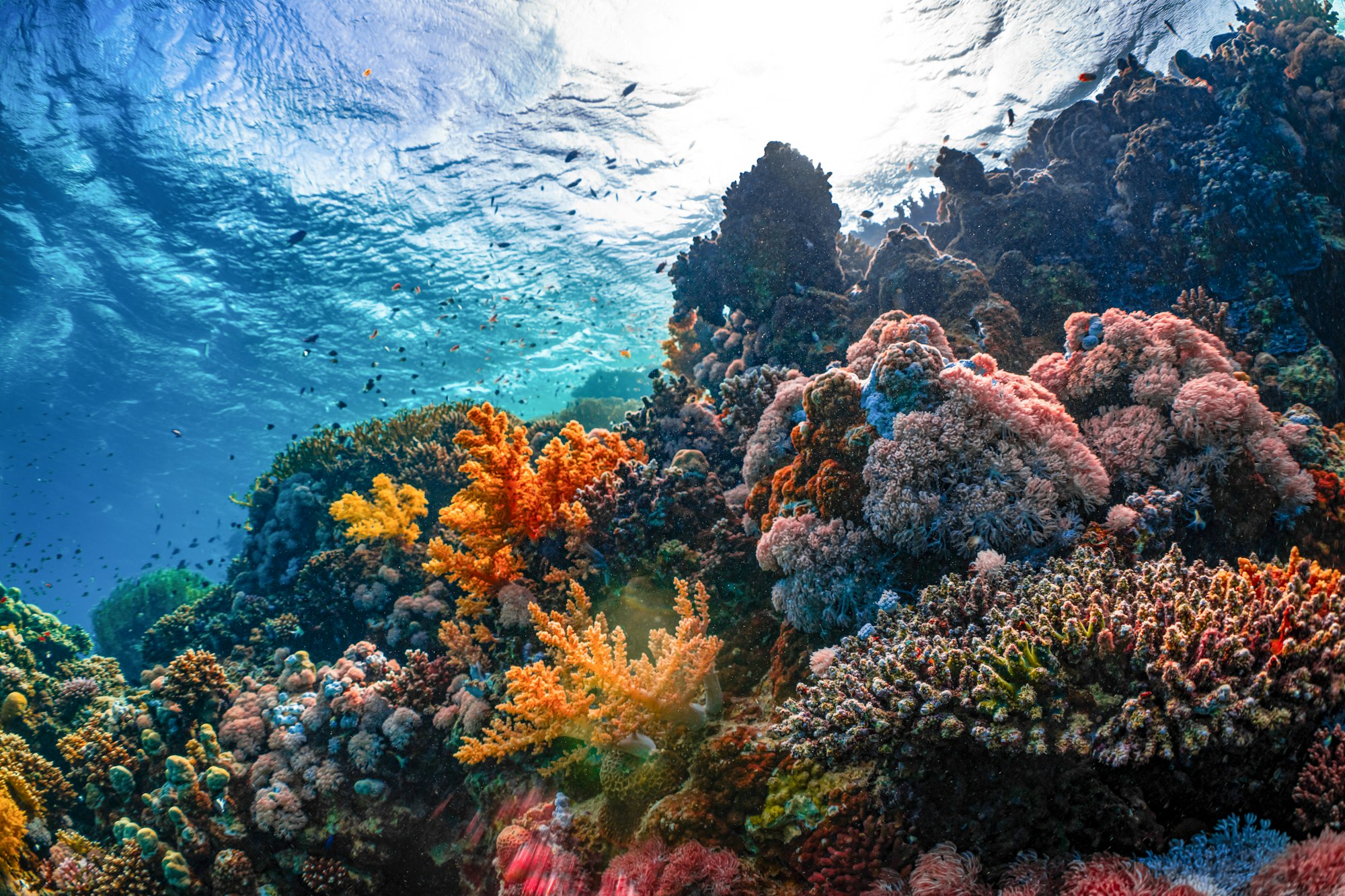
A small submerged ridge in Raja Ampat's Dampier Strait, Sardine Reef is dived for sheer fish density — walls of fusiliers, snapper and trevally over coral-covered slopes — in currents strong enough to demand solid drift-diving experience.
Overview
Sardine Reef lies in the Dampier Strait, the busy channel of moving water that separates Waigeo from Batanta in Raja Ampat, West Papua. It sits off the northeastern side of Kri Island, roughly ten to fifteen minutes by boat from the resorts clustered there, which makes it a staple of both day-boat and liveaboard schedules.
The site is not a wall or a classic seamount but a modest submerged rise. Operators describe it consistently as a small, oval underwater hill around 200 metres long, its summit sitting only about 5 metres below the surface and its flanks sloping away to roughly 30 metres. The reef itself is dressed in soft coral, large gorgonian fans, black coral bushes and scattered coral bommies. Visibility is frequently reported above 30 metres, and water temperature hovers near 29°C for most of the year.
A note on the name: there are no sardines here in any meaningful sense. The name refers to the fish being packed together like a tin of sardines. Papua Diving credits Raja Ampat pioneer Max Ammer with the coinage; that attribution comes from a single operator source, so treat it as local lore rather than settled record.
Why divers come
Fish density. Raja Ampat has more photogenic coral gardens and more reliable manta stations, but Sardine Reef’s reputation rests on volume — the experience of losing sight of the reef behind a moving wall of bodies. The reef’s position in the current-swept strait keeps nutrient-rich water flowing over it, and the schools stack up in the lee to feed. When the flow runs well, multiple independent operators rate it among the most dynamic dives in central Raja Ampat.
The dive
This is normally run as a drift. The topography causes different currents to converge around the mound, which is precisely what concentrates the fish and also what makes the water unpredictable. Dive Concepts notes the site is ideally dived on a falling, east-to-west flow.
A typical profile drops onto the reef, works the current-facing side where the schools gather, and lets the flow carry divers along the slope while gradually shallowing toward the summit for the safety stop. Because the top of the reef is only around 5 metres down, the shallow finish can be genuinely productive rather than dead time.
Marine life
The headline is the schooling biomass: fusiliers in enormous numbers, plus snapper, sweetlips, bannerfish, butterflyfish, damsels, surgeonfish and batfish. Predators work the edges — barracuda, giant trevally, other jacks, Spanish mackerel and rainbow runners.
Sharks are a regular but not guaranteed feature. Blacktip, whitetip and grey reef sharks are reported patrolling the slope, while wobbegongs — the flattened, carpet-patterned ambush sharks that Raja Ampat is unusually good for — rest under ledges and on sandy patches. For macro divers, the gorgonians here are reported to hold pygmy seahorses, with Dive Concepts listing three species (Denise, Bargibanti and Pontohi); confirm with your guide, as pygmy sightings shift with individual fans.
Conditions & who should dive it
Honestly: this is an advanced site. Currents are strong and variable, and converging flow can produce surges and downdrafts. The Raja Ampat Diving Code of Practice warns that divers in the region may encounter very strong currents including down currents and eddies, and that these can be dangerous for inexperienced divers. Prior drift-diving experience, good buoyancy and an SMB are the realistic baseline.
On reef hooks, sources genuinely conflict. Some operators describe responsible hook use; other dive media report that hooks are no longer used under conservation practice. The official MPA regulations published by the Raja Ampat conservation authority prohibit damaging coral but do not name reef hooks specifically, so no ban can be confirmed from the primary source. Ask your operator before packing one and follow their call.
When to go
Central Raja Ampat, including the Dampier Strait, is diveable year-round. The commonly cited window for calmest conditions and best visibility is roughly October to April; the remote south around Misool is more seasonally constrained. Day-to-day, conditions at Sardine Reef track tides and current more than calendar month.
Getting there
Access is by boat from Kri Island and the surrounding Dampier Strait resorts, or as a scheduled stop on liveaboards working the strait. Reaching the region generally means flying to Sorong, then transferring by ferry or charter to Waisai and onward to your accommodation.
A note on protection
Raja Ampat Regency is a declared shark sanctuary — the official conservation authority states that all sharks are protected within its waters, as are both manta species. Blast and cyanide fishing, trawling and purse seining are banned, spearfishing is prohibited for visitors, and feeding or handling marine life is not permitted.
All visitors must buy a Marine Park entry permit (Environmental Service Fee), currently IDR 700,000 for foreign passport holders and valid for 12 months, which funds monitoring and patrols. A separate visitor entry ticket also applies. Confirm current amounts before travelling, as fees are periodically revised.
- Sardine Reef Raja Ampat: Iconic Dive Site Guide — Papua Diving
- Sardine Reef dive site in Raja Ampat — Dive Concepts
- Diving Sardine Reef, Raja Ampat, Indonesia — Diveplanit
- 12 Best Dive Sites in Raja Ampat — Southeast Asia Diving
- Rules & Regulations, General Use — Kawasan Konservasi Perairan di Raja Ampat (official MPA authority)
- Raja Ampat Marine Park entry permit / Environmental Service Fee — Stay Raja Ampat
- Raja Ampat Diving Code of Practice — Stay Raja Ampat
Sea-surface temperature and wave height from Open-Meteo Marine (ERA5 reanalysis, monthly averages).
264 verified species observations (120 species) logged within ~11 km of this site between 1995 and 2025, from the Ocean Biodiversity Information System.
- Acanthurus lineatus
- Ctenochaetus striatus
- Hippocampus bargibanti
- Hippocampus denise
- Hippocampus pontohi
- Pseudamia hayashii · Hayashi's Cardinalfish
- Pseudochromis fuscus · Brown Dottyback
- Cypho
- Trimma xanthum · Yellow-red Pygmygoby
- Asterropteryx
- Apogon · three-saddle cardinalfish
- Hemiscyllium
Scientific survey records skew toward sampled taxa (molluscs, corals) and do not reflect what you are guaranteed to see on a dive.
Source: OBIS (obis.org), aggregated Darwin Core occurrence records.
Conditions change with the tide and the season. If you have dived this site, share what it was actually like — date, visibility, current, and what you saw. Real, recent reports from divers are exactly what this guide is built to collect.
Send a conditions report ›