The Passage
0.4287°S 130.5610°E · channel
A famously narrow, mangrove-fringed channel separating Gam and Waigeo that dives more like a jungle river than a reef — very shallow, tidal-drift, rich in macro life, and entirely dependent on getting the tide timing right.
Overview
The Passage — also called Kabui Passage — is the slim waterway that separates northern Gam from Waigeo, running from the western reach of Kabui Bay out to the open sea. Operators consistently describe it as a narrow, river-like strait roughly 25 metres across, walled by limestone and hung with mangrove and rainforest right down to the waterline. It is one of the few sites in Raja Ampat that does not really look like Raja Ampat: instead of a big blue reef slope, divers find a shaded corridor of rock, roots and overhangs.
Why divers come
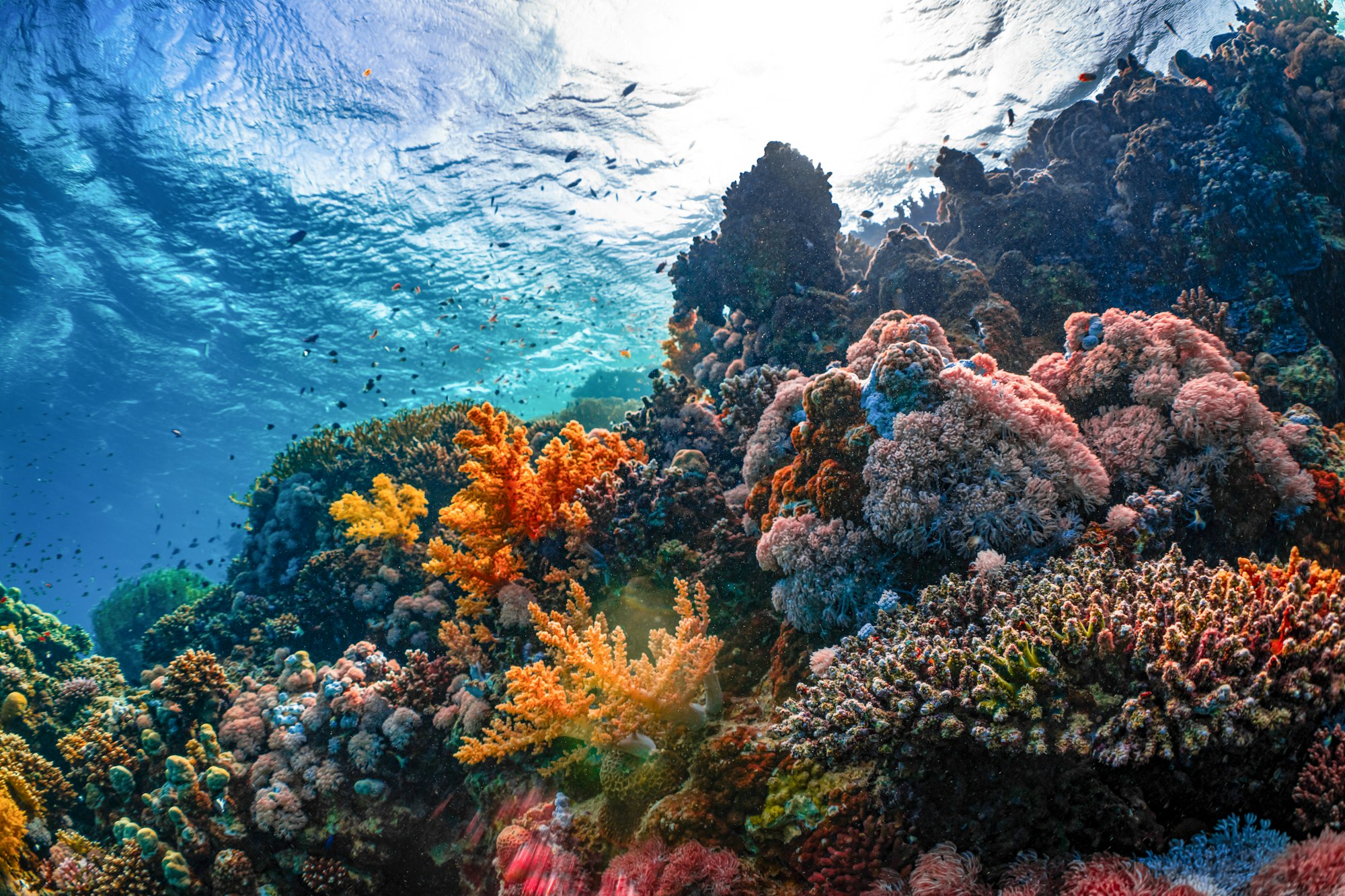
The draw is the setting rather than big-animal action. Overhanging trees meet sea fans in very shallow water, which the Underwater Photography Guide singles out as exceptional terrain for shallow wide-angle photography and video. Steep walls are cut with grottoes, arches, cracks and small swim-through passages, and the low, filtered light coming through the narrow channel gives the place an atmosphere closer to a flooded forest than a coral garden. It is equally rewarding as a macro dive.
The dive
This is a tidal drift, and the tide is the entire dive plan. Water is pushed and pulled through the constriction as the tide turns, and boats time the drop so divers ride the flow through the channel rather than fight it. Depths are modest: the main section of the channel is commonly reported at only around 5 metres, and most of the diving is done shallow — often in the region of 10 metres. Some operators describe the reef structure descending considerably deeper, toward 35 metres, at the wider or outer parts; treat the deep figure as applying to those sections, not the narrows. In practice the shallow profile is a bonus, since gas and no-decompression limits rarely end the dive.
Marine life
The mangrove-and-current combination produces an unusual species mix. Archerfish patrol the surface among the mangrove roots — a genuinely odd sight for a scuba diver. Wobbegong sharks are frequently reported resting along the fringes, and the site is well known for macro: multiple pygmy seahorse species, abundant nudibranchs, flatworms, shrimps, gobies, blennies, octopus and moray eels, alongside soft corals, sea fans, sponges and orange cup corals growing under the overhangs. Fusiliers and blue-spotted stingrays pass through. Raja Ampat is also home to walking (epaulette) sharks, though sightings are a shallow-reef and night-dive phenomenon generally and should not be expected here specifically.
Conditions & who should dive it
Honest expectations matter here. Current can run hard through the constriction when the tide is moving, and the site is regularly described as best suited to divers with solid buoyancy control who will not be pushed off course. Visibility is lower and greener than on Raja Ampat’s open reefs — the water carries nutrients, plankton and mangrove runoff, and after midday the narrow channel and steep walls cut sunlight sharply, so a torch is worth carrying. None of this makes it dangerous, but it does make it a poor choice for a first Raja Ampat dive. Water sits at a comfortable 28–30°C year-round.
When to go
Raja Ampat is diveable all year, with the drier stretch from roughly October to May generally offering lighter winds, calmer seas and better visibility. For this site, though, the tide table matters more than the calendar — a well-timed dive on an average month beats a badly timed one in peak season. Let the dive guide choose the slot.
Getting there
The Passage is reached by boat, typically as a day trip from resorts and homestays on Gam or southern Waigeo, or as a scheduled stop on a liveaboard itinerary. One resort on Gam puts it around 30 minutes away by boat. Not every liveaboard includes it, so divers who specifically want this site should confirm it appears on the itinerary before booking.
A note on protection
The Passage lies inside Raja Ampat’s marine protected area network. All visitors must pay the Environmental Service Fee and carry a Marine Park Entry card, issued by the Raja Ampat marine park authority (BLUD UPTD); patrols check permits of both individuals and operators, and diving without one breaches park regulations. Fees fund patrols, reef protection and local livelihoods. The mangrove fringe here is fragile and the water is shallow — careful trim and no contact with the roots or walls are the minimum courtesy.
- Gam: Should you go? A travel guide for Raja Ampat visitors — Stay Raja Ampat
- The Passage: The Most Enigmatic Dive Site in Raja Ampat — Mikumba Diving
- The Passage dive site in Raja Ampat — Dive Concepts
- The Passage and Gam Island Raja Ampat — Papua Explorers
- Diving the Raja Ampat Islands — Underwater Photography Guide
- The Passage — Hello Papua
- Entry Permits — Kawasan Konservasi Perairan di Raja Ampat (Marine Park Authority)
Sea-surface temperature and wave height from Open-Meteo Marine (ERA5 reanalysis, monthly averages).
129 verified species observations (60 species) logged within ~11 km of this site between 1929 and 2012, from the Ocean Biodiversity Information System.
- Dascyllus aruanus
- Hippocampus denise
- Centropyge eibli
- Eviota rubrisparsa
- Trimma xanthochrum
- Trimma tevegae
- Hoplolatilus
- Oxyurichthys auchenolepis · Scaly-nape Tentacle Goby
- Halichoeres hartzfeldii · Orange-line Wrasse
- Dermochelys coriacea · Leatherback sea turtle
- Pseudamia hayashii · Hayashi's Cardinalfish
- Ostorhinchus fasciatus · Bar-striped Cardinalfish
Scientific survey records skew toward sampled taxa (molluscs, corals) and do not reflect what you are guaranteed to see on a dive.
Source: OBIS (obis.org), aggregated Darwin Core occurrence records.
Conditions change with the tide and the season. If you have dived this site, share what it was actually like — date, visibility, current, and what you saw. Real, recent reports from divers are exactly what this guide is built to collect.
Send a conditions report ›