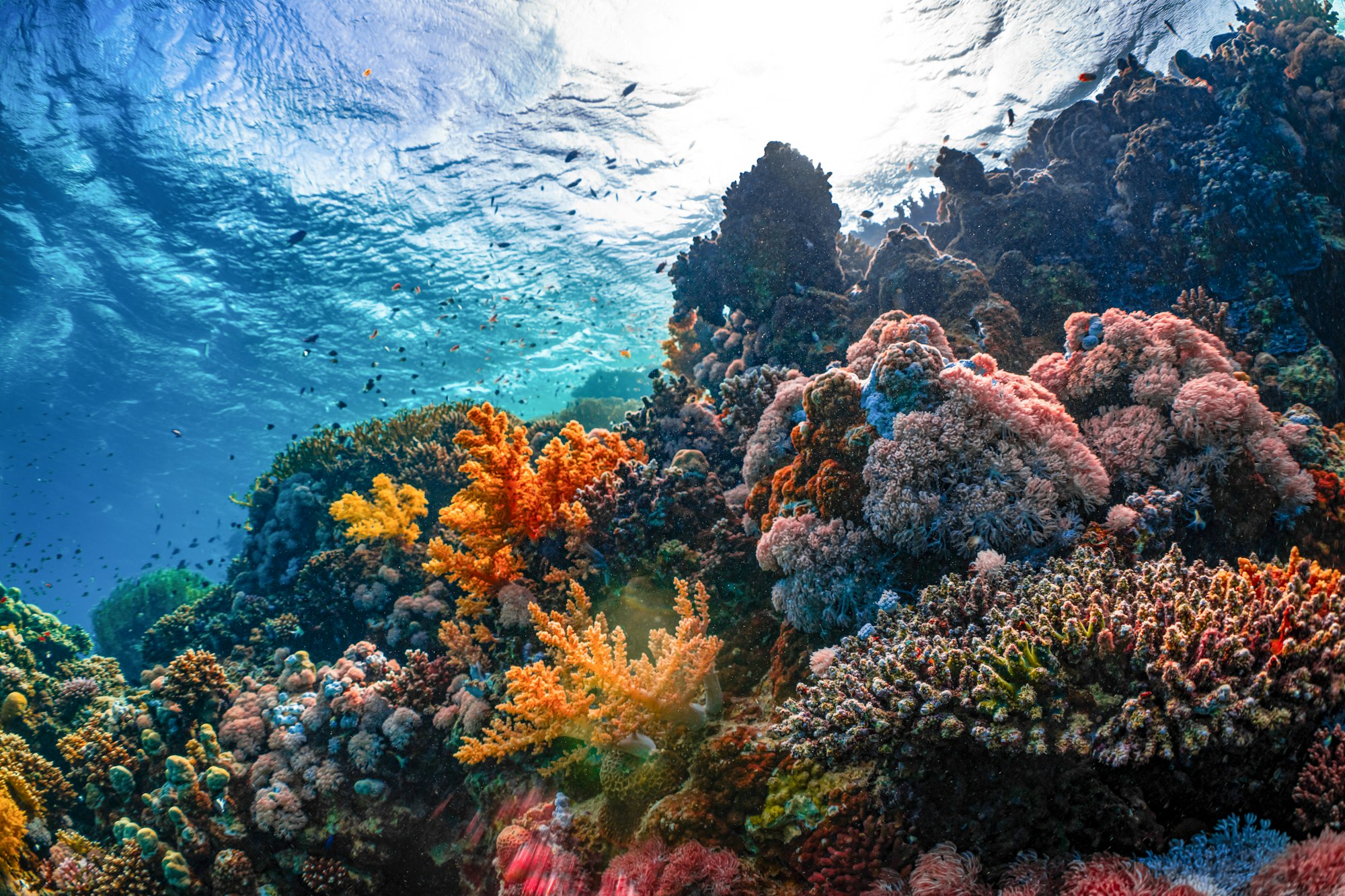
Turtle Cavern
4.1133°N 118.6278°E · cave
A dark overhead cave system inside Sipadan's Drop Off wall, famous for the skeletal remains of green turtles that entered, became disoriented and drowned — an advanced, silt-prone environment reserved for guided or cave-trained divers only.
Overview
Turtle Cavern — more evocatively known as the Turtle Tomb — is an overhead cave system cut into the western wall of Sipadan, the protected oceanic island rising from the Celebes Sea off Semporna, Sabah. Its entrance opens on the famous Drop Off, and beyond the sunlit threshold lies a labyrinth of chambers and tunnels whose floor is littered with the bleached skeletons of sea turtles. It is one of the most atmospheric — and most misunderstood — features in Malaysian diving.
Why divers come
Most of Sipadan’s draw is its wall: schooling barracuda, jackfish tornadoes, reef sharks and a famously dense green-turtle population. The Tomb is different. It is a genuine overhead environment with a somber, almost sacred quality — part natural wonder, part memento mori. The pull is the story and the setting, not the marine life inside, which is essentially barren.
Inside the cavern (the dive)
The entrance is large — operators describe an opening roughly 15–20 m wide at around 14 m depth, on a wall that plunges far deeper. A short swim (about 20 m by one operator’s account) leads into a first chamber and then further passages. Sources report the interior chambers as relatively shallow — on the order of 5 m near the ceiling to roughly 15 m on the floor — but reaching the deepest turtle remains means penetrating well back into the system. One firsthand account places a dolphin skeleton around 150 m inside. Numbers vary between sources; treat all interior distances and depths as approximate.
The turtle tomb (why turtles die here)
The name is literal. Multiple accounts describe turtles that swam into the cave — possibly at night or while resting — then became disoriented in the darkness, failed to find the exit, and drowned because they could not surface to breathe. Their remains, along with a reported dolphin and even a marlin skeleton, have accumulated over many years. The exact mechanism is inference, not established fact, and honest sources present it as such.
Conditions, hazards & who should dive it
This is the section that matters most. The Turtle Tomb is a true overhead environment where the surface is not directly accessible — the single greatest killer in cave diving. Hazards compound quickly: fine silt that a careless fin-kick turns into a whiteout, no natural light beyond the entrance, narrowing passages and tight restrictions, and real disorientation risk (the turtles are the proof). Full penetration to the tomb demands cave-diving certification, redundant gas, guideline reels and torches; firsthand reports mention a warning sign inside instructing divers to turn back unless cave-trained. Recreational divers should treat this as, at most, a guided cavern experience staying near the light zone — and only with an operator who knows the system. It is not a site to “have a look” inside on an open-water ticket.
When to go
Sipadan is diveable year-round, with the calmest seas and best visibility generally from around April to December (conditions vary annually). Any overhead penetration should be attempted only in good visibility and calm conditions.
Getting there
Sipadan has no accommodation — resorts were removed by the mid-2000s — so all diving is by day boat from Mabul, Kapalai or Semporna, typically a short crossing to the island’s western wall. Access requires a Sabah Parks permit under a strict daily quota (long capped around 176–178 divers/day, with reported revisions since); permits are allocated through licensed operators and must be arranged well in advance.
A note on protection & safety
Sipadan is a strictly protected marine area; treat the Tomb as a fragile, non-renewable site — no touching, no collecting, impeccable buoyancy. Overhead diving beyond your training kills experienced divers every year. If you are not cave-certified, stay in the cavern zone with a qualified guide, or admire the Drop Off from outside. There is no dive here worth your life.
Sea-surface temperature and wave height from Open-Meteo Marine (ERA5 reanalysis, monthly averages).
344 verified species observations (175 species) logged within ~11 km of this site between 1849 and 2018, from the Ocean Biodiversity Information System.
- Coelorinchus commutabilis
- Trimma yanoi
- Gadomus filamentosus
- Nezumia evides
- Ventrifossa nigrodorsalis
- Hymenocephalus nascens
- Trimma agrena
- Trimma tevegae
- Apristurus platyrhynchus
- Trimma stobbsi
- Pycnochromis atripes
- Synchiropus delandi
Scientific survey records skew toward sampled taxa (molluscs, corals) and do not reflect what you are guaranteed to see on a dive.
Source: OBIS (obis.org), aggregated Darwin Core occurrence records.
Conditions change with the tide and the season. If you have dived this site, share what it was actually like — date, visibility, current, and what you saw. Real, recent reports from divers are exactly what this guide is built to collect.
Send a conditions report ›