North Horn
13.8014°S 146.5458°E · wall
North Horn is Australia’s most celebrated shark dive, located at the northern tip of Osprey Reef in the Coral Sea, approximately 350km northeast of Cairns, Queensland.
Overview
Osprey Reef is an isolated atoll rising from 1,000-metre-deep Coral Sea, and North Horn is its dramatic northern extremity — a sheer wall plunging into the abyss with a sandy amphitheatre at its base. The site has hosted organised shark feeds since the 1980s, drawing grey reef sharks, whitetip reef sharks, and silvertip sharks in numbers that make it one of the most intense shark diving experiences in the Indo-Pacific.
During the feed — conducted by liveaboard guides using a bait container — divers kneel on the sandy slope at 18–20 metres while 30 to 50 sharks spiral overhead in tightening circles. The sharks are unhurried and entirely focused on the bait, ignoring divers unless someone makes sudden movements. Away from the feed, the wall itself is extraordinary: vertical coral gardens descend past sport diving limits, and hammerhead sharks are regularly sighted in the blue water beyond the wall edge.
Site Information
- Location: North Horn, Osprey Reef, Coral Sea, Queensland, Australia
- Entry Type: Boat dive
- Site Type: Wall dive
- Difficulty Level: Advanced
- Maximum Depth: 20 meters
- Typical Visibility: 30–50 metres
- Current: Variable; typically calm during organised feed dives
- Best Time: August to November (calmest Coral Sea conditions)
Marine Life
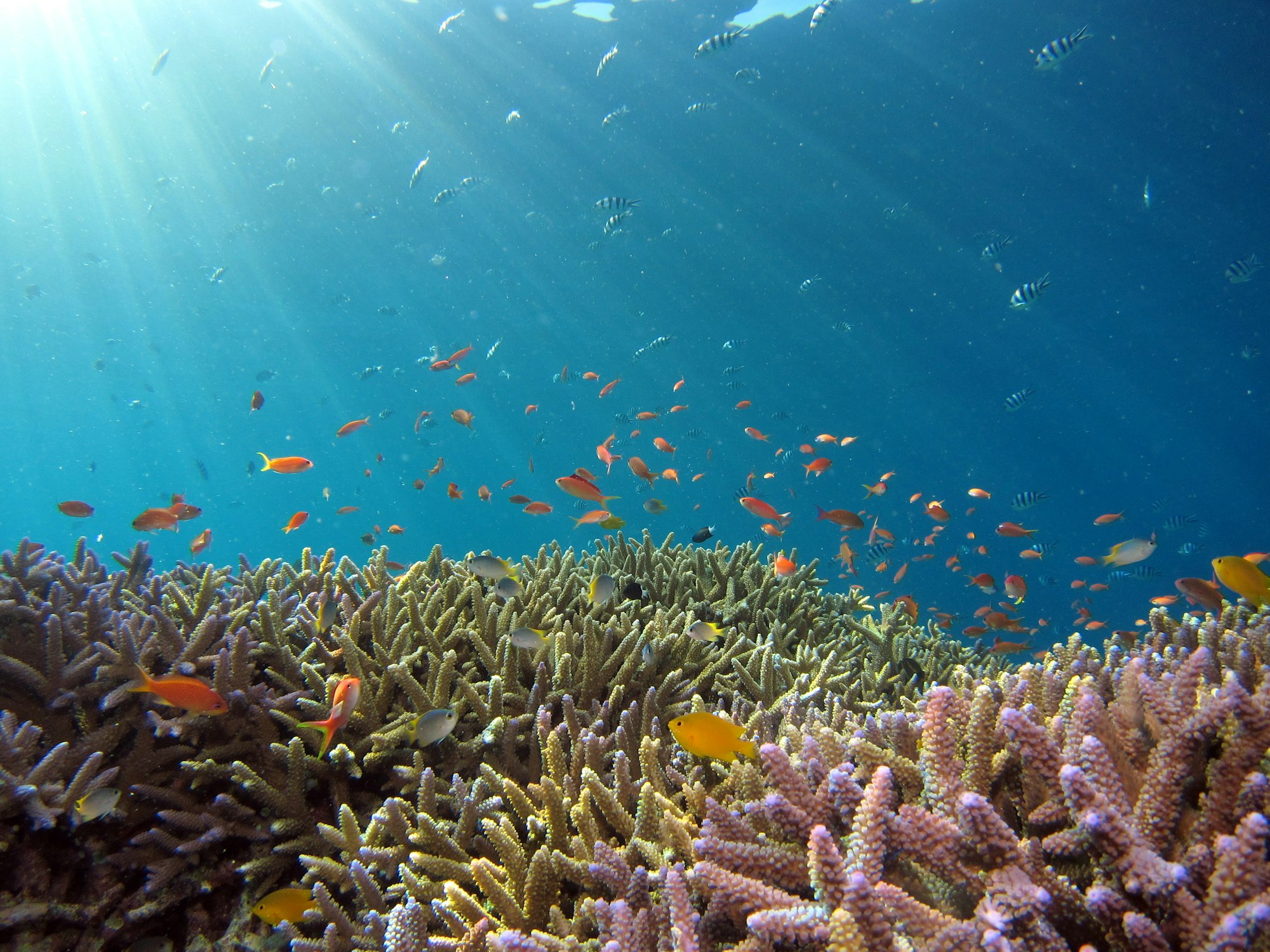
Grey reef sharks are the dominant species, often present in groups of 20 or more during feeds. Silvertip sharks — larger, more robust, and slightly more assertive — patrol the mid-water. Whitetip reef sharks rest on the sandy amphitheatre floor. Oceanic whitetip sharks make occasional appearances, especially in deeper water off the wall. Hammerheads — both scalloped and great — are regularly encountered on early morning dives before the feed. Sea turtles, Napoleon wrasse, dogtooth tuna, and large schools of bumphead parrotfish round out the pelagic life. The wall itself hosts prolific hard and soft corals, sea fans, and a full complement of reef fish.
Dive Profile
Descent is typically along the wall or down the shot line to the sandy amphitheatre at 18–20 metres. During the feed, divers maintain position on the sand and observe. Between feeds, following the wall north reveals overhangs and swim-throughs. The wall drops sheer to beyond 100 metres — blue water drift along the face at 15–20 metres provides excellent shark encounters without current assistance.
Entry and Exit
Osprey Reef is reachable only by liveaboard, typically 18–24 hours from Cairns. Operators including Spirit of Freedom and Mike Ball Dive Expeditions run regular itineraries. Dives are usually timed around tidal slack. Exit via SMB from open water.
Tips and Recommendations
- Attend the pre-dive briefing carefully — feed dives have specific positioning protocols
- Wear full wetsuits including gloves and hoods to minimise exposed skin
- Control buoyancy carefully; kneeling silently on the sand dramatically reduces shark wariness
- Early morning dives before the feed often produce the best hammerhead encounters
- Wide-angle lenses (14–16mm equivalent) are ideal; the sharks will come within arm’s reach
Safety Considerations
The sharks at North Horn are wild animals that assess their environment continuously. Divers who remain still and non-threatening are consistently ignored during feeds. Erratic movements, surfacing quickly, or swimming alone should be avoided. Despite its intimidating appearance, the site has an excellent safety record. Monitor depth on the wall — the sheer face can draw divers unconsciously deeper.
Photography
North Horn offers world-class shark photography. During the feed, grey reef and silvertip sharks pass within 1–2 metres, enabling frame-filling wide-angle shots. Use a dome port with a rectilinear wide-angle lens. Strobe power must be balanced carefully to avoid backscatter in the particulate-rich water during the feed. Between feeds, position yourself at the wall edge with the blue water behind the sharks for classic silhouette shots.
Sources: Mike Ball Dive Expeditions - Osprey Reef Liveaboard, Spirit of Freedom - 4 Night Liveaboard, Dive the World - Osprey Reef, Cairns Dive Adventures - Osprey Reef. Last updated 2026-05-30.
Sea-surface temperature and wave height from Open-Meteo Marine (ERA5 reanalysis, monthly averages).
7574 verified species observations (70 species) logged within ~11 km of this site between 1984 and 2021, from the Ocean Biodiversity Information System.
- Carcharhinus amblyrhynchos · Grey Reef Shark
- Carcharhinus albimarginatus · Silvertip Shark
- Caranx ignobilis · Giant Trevally
- Pseudogramma polyacantha · False Gramma
- Gobiidae · Gobies
- Thalassoma
- Siphamia
- Zanclus cornutus · Moorish Idol
- Apogonidae · Big Eyes
- Plectropomus laevis · Bluespotted Coral Trout
- Myctophum
- Meiacanthus
Scientific survey records skew toward sampled taxa (molluscs, corals) and do not reflect what you are guaranteed to see on a dive.
Source: OBIS (obis.org), aggregated Darwin Core occurrence records.
Conditions change with the tide and the season. If you have dived this site, share what it was actually like — date, visibility, current, and what you saw. Real, recent reports from divers are exactly what this guide is built to collect.
Send a conditions report ›