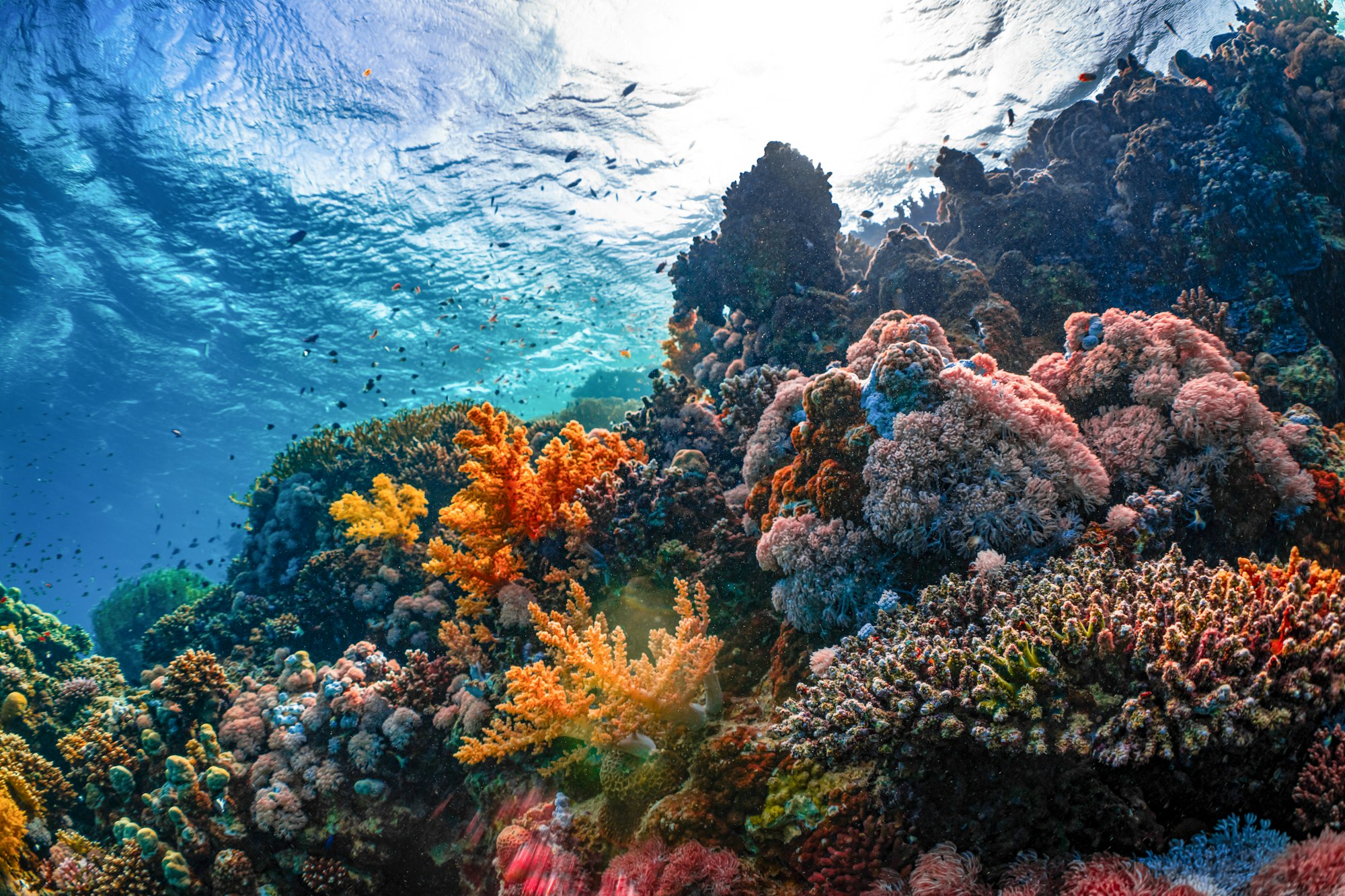
Manta Point (Emmadi Giri)
3.8958°N 73.4563°E · reef
Manta Point — locally Emmadi Giri — is South Malé Atoll's manta cleaning station off Guraidhoo, where reef mantas hover over a coral block to be cleaned by wrasse. A shallow, easy dive for all levels, best on the southwest monsoon. Mantas are seasonal and never guaranteed.
Overview
Manta Point — known locally as Emmadi Giri — sits on the sand just off the island of Guraidhoo in South Malé Atoll. It’s a giri, a Maldivian coral knoll, and at its heart is a large coral block rising from the sand: the cleaning station. Reef mantas glide in, hold station over the rock with their wings spread, and let cleaner wrasse pick the parasites from their skin while divers watch from the sand below.
The dive
The cleaning station is shallow — roughly 10 to 20 m over a sand floor around 15–25 m — and usually gentle enough to be forgiving. The mantas tend to appear when the current runs out of the atoll toward the reef, so the flow can pick up when they’re around. Beyond the mantas, the rock is a gathering and cleaning point for other big animals too, so there’s plenty to watch even between passes.
Marine life
Reef mantas are the reason to come. The same block draws eagle rays — sometimes in schools of a couple of dozen — along with nurse, white-tip and grey reef sharks, Napoleon wrasse and big hawksbill turtles. After dark it turns into a macro dive, with frogfish, octopus and nudibranchs.
Conditions & who should dive it
This is an easy dive suited to all levels — one of the more accessible manta encounters in the atoll, shallow enough that the shallowest cleaning can even be snorkelled. Current is mild at the station itself but strengthens on the outflow when mantas are most active. Visibility runs over 30 m in the dry season and 20–30 m during the southwest monsoon (the plankton that lowers visibility is exactly what brings the mantas).
When to go
The manta window here is the southwest monsoon, roughly May/June to October, with the peak in the plankton-rich mid-season. As always, mantas follow the plankton and are never guaranteed — some days the station is busy, others quiet.
Getting there
Guraidhoo is a local island with dive shops that reach the site in well under an hour — a budget, guesthouse-friendly option — and South Malé resorts and liveaboards dive it too.
Sea-surface temperature and wave height from Open-Meteo Marine (ERA5 reanalysis, monthly averages).
65 verified species observations (42 species) logged within ~11 km of this site between 1984 and 2023, from the Ocean Biodiversity Information System.
- Ascidiacea
- Gempylus serpens
- Phyllidia alyta
- Pteraeolidia ianthina
- Phyllidiella rosans
- Goniobranchus tritos
- Phyllidiella zeylanica
- Phyllidia exquisita
- Coriocella hibyae
- Phyllidia ocellata
- Melithaea
- Astrogorgia
Scientific survey records skew toward sampled taxa (molluscs, corals) and do not reflect what you are guaranteed to see on a dive.
Source: OBIS (obis.org), aggregated Darwin Core occurrence records.
Reef mantas are logged at South Malé channels and cleaning stations, most reliably during the southwest monsoon when plankton concentrates on the eastern reefs.
Conditions change with the tide and the season. If you have dived this site, share what it was actually like — date, visibility, current, and what you saw. Real, recent reports from divers are exactly what this guide is built to collect.
Send a conditions report ›