Blue Corner
8.1004°S 114.5205°E · wall
A current-swept wall dive at the corner of Menjangan Island where the reef drops sharply and pelagic life congregates in the blue water.
Overview
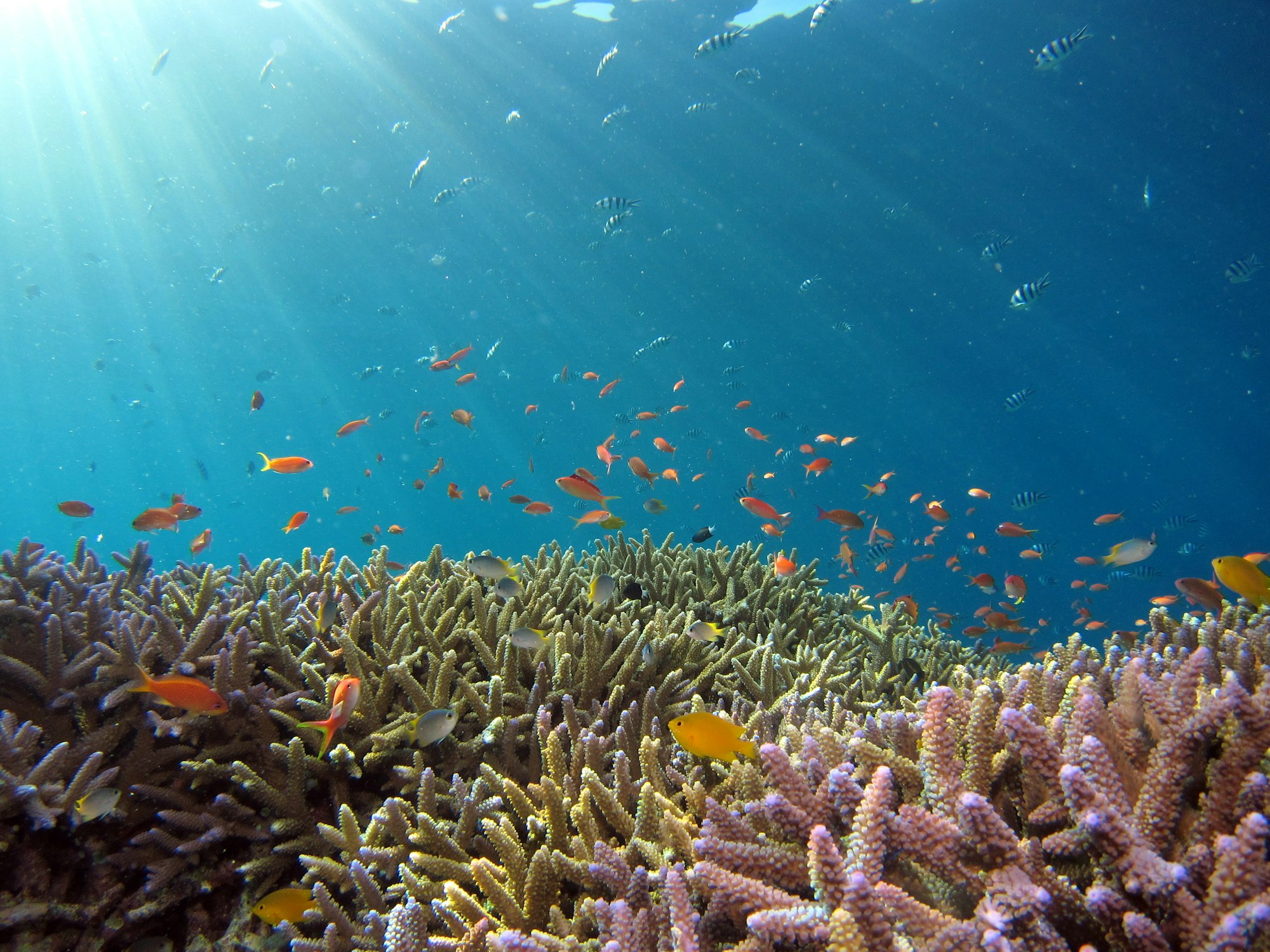
Blue Corner is situated at a prominent point on Menjangan Island where the reef wall turns sharply and currents accelerate around the corner, attracting schooling fish and pelagic species. The wall drops vertically from the surface to beyond 30 m, draped in gorgonian fans, black coral trees, and colourful soft corals. The corner geometry channels current to produce reliable fish aggregations — schools of trevally, fusiliers, and snapper are a constant presence. The site sits between the main eastern and western wall dive zones and offers a slightly more exposed character suited to intermediate divers comfortable with moderate current.
Site Information
- Location: Menjangan Island, West Bali National Park, northwest Bali
- Entry Type: Boat dive
- Site Type: Wall dive
- Difficulty Level: Intermediate
- Maximum Depth: 30 meters
- Typical Visibility: 15–30 m
- Current: Moderate to strong at the corner point
- Best Time: April to November
Marine Life
Schools of bigeye trevally and snapper dominate the corner point. Blacktip reef sharks are frequently seen at 20–30 m. Turtles feed on the wall corals, and large grouper inhabit the deeper overhangs. Moray eels are tucked into crevices throughout the wall, and the gorgonians host nudibranchs and pygmy seahorses for patient searchers.
Dive Profile
Descend to 15–20 m and position on the upcurrent side of the corner. Allow the current to carry you around the point where fish aggregations are densest. After rounding the corner, ascend gradually up the wall and drift to a sheltered area for the safety stop at 5 m. Total dive time 45–55 minutes.
Entry and Exit
Jukung boat from Labuhan Lalang. Entry via back roll on the upcurrent side. Currents at the corner can be significant — time your dive for moderate tidal flow. Deploy an SMB before ascending for boat pickup.
Tips and Recommendations
- Approach the corner at depth to stay below the strongest surface current
- Station yourself at 15–20 m to watch the show as fish circle the point
- Check gorgonians on the wall for pygmy seahorses while currents are manageable
- Carry a reef hook if your operator provides one for current-swept corners
- Combine with Pos 2 or Bat Cave for a full Menjangan diving day
Safety Considerations
Currents can be strong and may reverse unexpectedly as the tide changes. Do not round the corner if conditions are too strong — abort the dive and surface in a sheltered area. Always carry an SMB. Stay well clear of the wall to avoid being swept into it during current surges.
Photography
The corner’s fish aggregations provide spectacular wide-angle subjects — schools of trevally backlit against the blue water are the signature shot. Reef sharks on the wall add drama. Wide-angle with dual strobes works best; save macro for the calmer sections of the wall where current is reduced.
Sources: Dive Concepts - Crystal Bay Menjangan, Geko Dive Bali - Menjangan, Bali Fun Diving - Menjangan. Last updated 2026-07-17.
Sea-surface temperature and wave height from Open-Meteo Marine (ERA5 reanalysis, monthly averages).
347 verified species observations (130 species) logged within ~11 km of this site between 1982 and 2025, from the Ocean Biodiversity Information System.
- Trimma erdmanni
- Eviota bifasciata
- Trimma halonevum
- Caesio cuning · Red-bellied Fusilier
- Chaetodon octofasciatus · Eight-banded Butterfly-fish
- Eviota storthynx
- Corythoichthys haematopterus · Reef-top Pipefish
- Pseudanthias tuka · Purple Anthias
- Amphiprion ocellaris · False Clown Anemonefish
- Actitis hypoleucos · Common Sandpiper
- Chromis alpha · Yellow-speckled Chromis
- Pentapodus
Scientific survey records skew toward sampled taxa (molluscs, corals) and do not reflect what you are guaranteed to see on a dive.
Source: OBIS (obis.org), aggregated Darwin Core occurrence records.
Conditions change with the tide and the season. If you have dived this site, share what it was actually like — date, visibility, current, and what you saw. Real, recent reports from divers are exactly what this guide is built to collect.
Send a conditions report ›