Aikoku Maru
7.3728°N 151.9118°E · wreck
Aikoku Maru
A 10,438-ton armed merchant cruiser whose catastrophic ammunition explosion on February 17, 1944 obliterated the forward section and sent the ship to the bottom in two minutes — one of the most dramatic and sobering wrecks in Chuuk Lagoon.
Overview
The Aikoku Maru was a 10,438-ton (160.8 m / 527 ft) armed merchant cruiser completed August 31, 1941 by Mitsui Engineering & Shipbuilding at Tamano, Okayama. She was loading ammunition and preparing for departure to Rabaul when Operation Hailstone commenced on February 17, 1944. Aircraft from USS Intrepid struck first with bombs, one exploding in the officer’s wardroom. A second attack delivered the fatal blow: a torpedo hit the No. 1 hold, detonating the ammunition aboard. The massive explosion killed approximately 945 of the crew and passengers — mostly soldiers of the 1st Amphibious Brigade — and the TBM Avenger crew that delivered the torpedo was also destroyed in the blast. The ship sank in two minutes. The bow was sheared completely off by the explosion; forward of a certain point there is nothing but sand.
The stern section rests upright on the lagoon floor at approximately 62—64 meters. The stern gun remains on a large gun platform at 48 meters, and twin anti-aircraft guns are mounted on the upper deck corners. The funnel and bridge area are found at approximately 27 meters. The contrast between the obliterated forward section and the preserved stern makes the Aikoku Maru a powerful and haunting dive.
Site Information
- Location: Chuuk Lagoon, Chuuk State, Micronesia
- Entry Type: Boat dive
- Site Type: Wreck dive
- Difficulty Level: Advanced
- Maximum Depth: 63 meters
- Typical Visibility: 15-30 meters (50-100 feet)
- Current: Generally mild inside the lagoon
- Best Time: Year-round; December to April offers calmest conditions
Marine Life
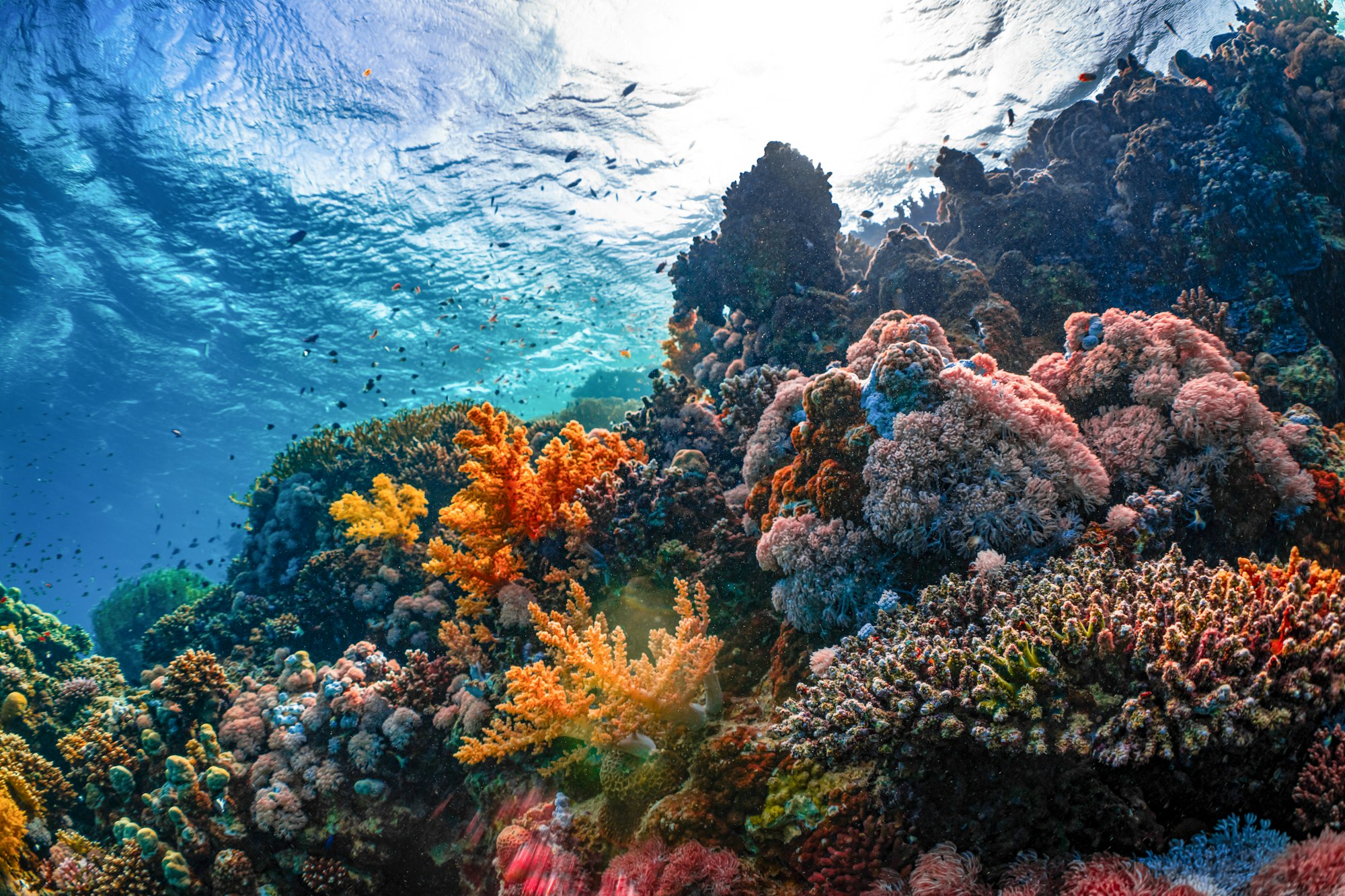
After more than eight decades on the lagoon floor, the Aikoku Maru has developed substantial coral colonization across its exposed surfaces. The superstructure and gun mounts support hard and soft coral growth, sea fans, and encrusting sponges. Schools of fusiliers and jacks are commonly seen around the wreck profile. Glassy sweepers occupy the darker interior spaces, and lionfish hunt along railings and overhangs. Reef sharks are occasionally sighted in the surrounding waters.
Dive Profile
This is a deep, demanding dive. The intact funnel at 27 meters provides the shallowest significant structure and a good orientation point. From there, divers can work aft along the superstructure toward the stern gun at 48 meters and the twin anti-aircraft gun mounts. The stern section at maximum depth rewards experienced divers with well-preserved military hardware. The obliterated forward section is a debris field on the lagoon floor. Bottom time at 63 meters is extremely limited — careful gas planning is essential, and most divers restrict their deepest excursion to a brief visit before working back to shallower structure.
Entry and Exit
Access is by dive boat from Weno-based operators, typically a 20-40 minute ride depending on departure point. A permanent mooring marks the site. Entry is by giant stride. Descend along the mooring line to the wreck. Surface at the mooring line or deploy an SMB if current has moved you off the wreck. Lagoon conditions are generally calm at the surface.
Tips and Recommendations
- This is a deep wreck requiring advanced certification and ideally decompression diving experience
- Carry a primary torch and backup for any interior exploration — the deeper sections receive limited ambient light
- Plan your deepest penetration first while gas supply is full, then work progressively shallower
- Nitrox or trimix is strongly recommended given the depth; discuss gas planning with your operator
- Multiple dives are needed to appreciate this large wreck — consider one dive focused on the stern armament and another on the mid-section superstructure
Safety Considerations
The Aikoku Maru is a war grave containing the remains of hundreds of crew members — treat the site with appropriate respect. Removing any artifacts is strictly illegal under Chuuk State law. The depth of 63 meters places this wreck firmly in technical diving territory; mandatory decompression stops are virtually unavoidable. Live ordnance including ammunition remains scattered throughout the wreck — do not touch or disturb any cargo or munitions. Overhead environments within the superstructure require wreck penetration training, redundant lights, and a continuous guideline or clear exit plan. Maintain proper trim and buoyancy at all times to avoid disturbing silt, which can reduce visibility to zero in enclosed spaces.
Photography
The stern gun at 48 meters and the twin anti-aircraft mounts offer dramatic military hardware subjects for wide-angle photography, though the depth limits available light and bottom time for composition. The funnel area at 27 meters provides more accessible wide-angle opportunities with better ambient light. The contrast between the intact stern and the destroyed forward section tells a powerful visual story. Strobes are essential at depth to restore color.
Sources: Michael McFadyen’s Scuba Diving - Aikoku Maru, Wikipedia - Aikoku Maru (1940), Dive3D - Aikoku Maru, DivePlanIt - Aikoku Maru. Last updated 2026-05-22.
Sea-surface temperature and wave height from Open-Meteo Marine (ERA5 reanalysis, monthly averages).
1870 verified species observations (164 species) logged within ~11 km of this site between 1949 and 2014, from the Ocean Biodiversity Information System.
- Ctenochaetus striatus · Small-bodied acanthurid
- Scaridae · Small-bodied parrotfish
- Chlorurus sordidus · Small-bodied parrotfish
- Chlorurus bleekeri · Small-bodied parrotfish
- Scarus psittacus · Small-bodied parrotfish
- Siganus doliatus · Rabbitfish
- Hipposcarus longiceps · Large-bodied parrotfish
- Monotaxis grandoculis · Large-bodied emperor
- Scarus globiceps · Small-bodied parrotfish
- Scarus rivulatus · Small-bodied parrotfish
- Chordata
- Siganus vulpinus · Rabbitfish
Scientific survey records skew toward sampled taxa (molluscs, corals) and do not reflect what you are guaranteed to see on a dive.
Source: OBIS (obis.org), aggregated Darwin Core occurrence records.
Conditions change with the tide and the season. If you have dived this site, share what it was actually like — date, visibility, current, and what you saw. Real, recent reports from divers are exactly what this guide is built to collect.
Send a conditions report ›