Heian Maru
7.3829°N 151.8558°E · wreck
Heian Maru
The largest diveable wreck in Chuuk Lagoon — a 163-meter submarine tender lying on her port side, with periscopes in the holds and torpedo tubes visible along the hull.
Overview
The Heian Maru was a 163-meter (536 ft), 11,615-ton passenger liner built in 1930 by Osaka Iron Works for Nippon Yusen Kaisha (NYK Line), originally operating the trans-Pacific route between Yokohama and Seattle. Requisitioned by the Imperial Japanese Navy on October 3, 1941, she was converted into an auxiliary submarine tender at Mitsubishi Heavy Industries in Kobe, fitted with four 15cm naval guns and anti-aircraft armament. When Operation Hailstone struck Truk Lagoon on February 17—18, 1944, the Heian Maru was struck by two pairs of bombs and then a torpedo from aircraft launched by USS Bunker Hill, which hit amidships on the port side. She rolled to port and sank to her resting place at 33—35 meters.
As the largest diveable wreck in Chuuk Lagoon, the Heian Maru is a massive dive requiring multiple visits to explore thoroughly. Her size is immediately apparent on descent — the hull stretches over one and a half football fields. The holds contain her most distinctive cargo: submarine periscopes, spare parts, and supplies intended for Japan’s submarine fleet. Torpedo tubes are visible along the exterior hull where they were stored as deck cargo. The wreck’s orientation on her side creates an unusual diving experience, with corridors becoming vertical shafts and decks becoming walls.
Site Information
- Location: Chuuk Lagoon, Chuuk State, Micronesia
- Entry Type: Boat dive
- Site Type: Wreck dive
- Difficulty Level: Advanced
- Maximum Depth: 35 meters
- Typical Visibility: 15-30 meters (50-100 feet)
- Current: Generally mild; occasional moderate current
- Best Time: Year-round; December to April for calmest conditions
Marine Life
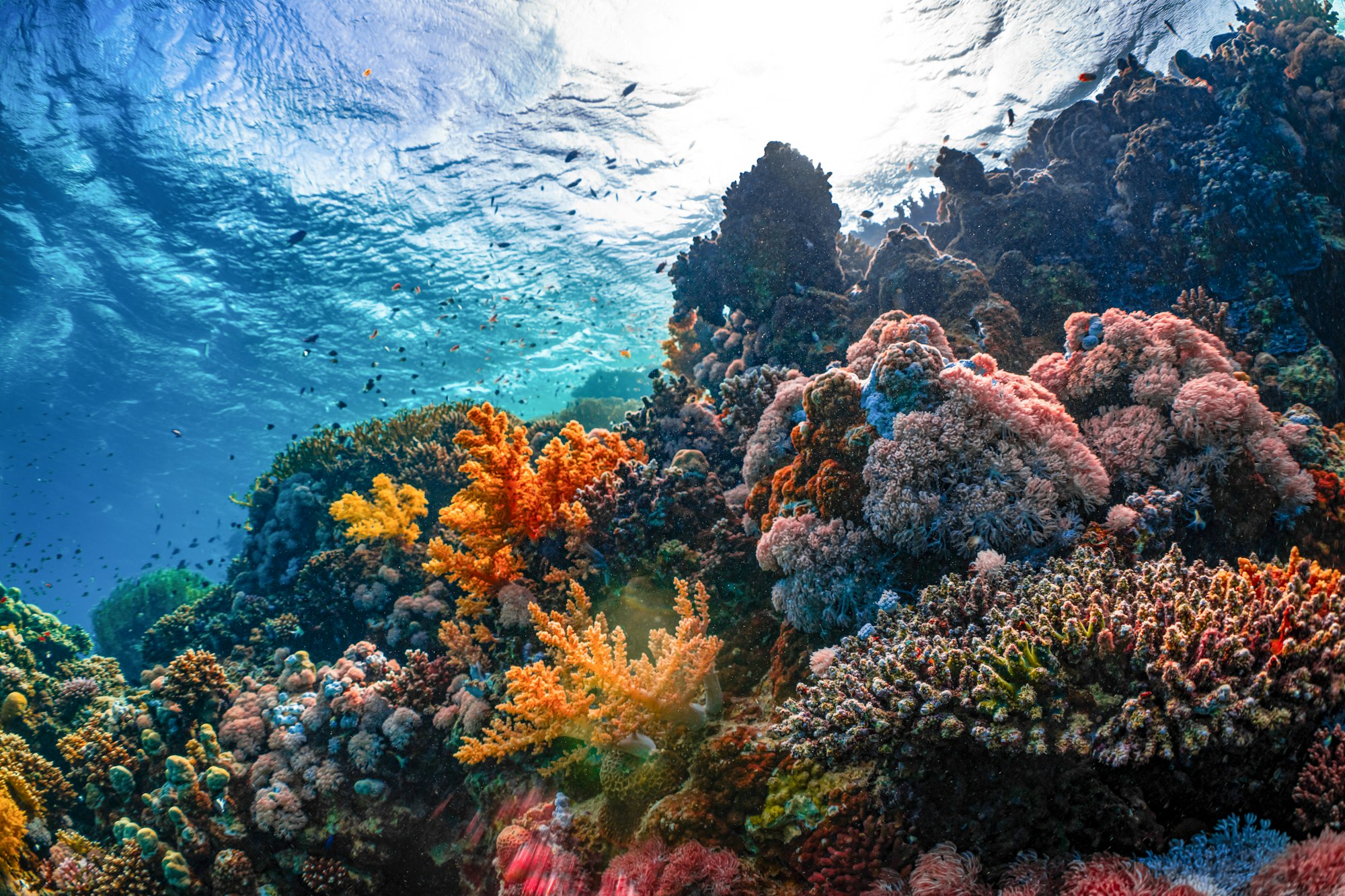
The enormous hull surface has become a sprawling artificial reef. Hard corals, soft corals, and sponges cover the exposed starboard side that faces upward toward the light. Gorgonian sea fans grow along the upper hull edges. The sheer size of the wreck attracts large pelagic visitors — grey reef sharks and whitetip reef sharks are seen in the surrounding lagoon waters.
Inside the holds, dense clouds of glassy sweepers and cardinalfish swirl in torch beams. Lionfish hunt along structural beams. Nudibranchs and flatworms inhabit the encrusted hull plates. Schools of fusiliers and surgeonfish aggregate around the wreck’s profile. The Heian Maru’s position on her side creates sheltered overhangs and cavities that provide habitat for reef fish and invertebrates. No site-specific marine life list has been confirmed by independent sources for this wreck beyond the reef fish and shark species typical of Chuuk Lagoon wrecks generally.
Dive Profile
The Heian Maru demands careful dive planning due to her size. Most divers focus on a single section per dive. A common first dive begins at the mooring line near amidships, descending to the exposed starboard hull at around 15—18 meters. Drop over the side to reach the main deck level at approximately 20 meters. The forward and mid holds contain the submarine periscopes — approximately 15-meter (50 ft) tubes standing in storage — along with torpedoes, shells, china, radio equipment, and medical kits. The periscopes are immediately recognizable and deeply impressive.
A second dive can focus on the stern section, where the engine room is accessible but requires advanced wreck penetration skills due to the disorienting side-lying orientation. The bridge area amidships offers accessible exploration. Torpedo tubes stored as deck cargo are visible along the exterior hull. The bow section at the far forward end requires a long swim but rewards with good structural integrity and less diver traffic.
The side-lying orientation means that what were once horizontal corridors now run vertically, and internal navigation is more challenging than on upright wrecks. A guide familiar with the layout is essential for any interior exploration.
Entry and Exit
Boat dive from Weno-based operators, approximately 20-30 minutes to the site. A permanent mooring is in place. Enter by giant stride and descend the mooring line to the wreck. The upper hull (starboard side) is at only 10 meters, giving a comfortable starting point before descending deeper. Surface at the mooring line. The lagoon location provides generally calm surface conditions.
Tips and Recommendations
- Plan a minimum of two dives: one for the forward holds with periscopes, one for the stern, engine room, and exterior features
- The periscopes in the holds are the signature feature — make them a priority on your first dive and bring adequate lighting
- The side-lying orientation makes internal navigation confusing; always dive with a guide on your first visit
- Carry a primary light and at least one backup for any hold or interior exploration
- Nitrox extends bottom time significantly on the 20-25 meter deck areas and is strongly recommended for this deep, large wreck
Safety Considerations
The Heian Maru is a war grave and protected site — artifact removal is illegal. The side-lying orientation creates the primary hazard: corridors that were designed as horizontal passages now function as vertical shafts, and rooms have walls where floors should be. Spatial disorientation is a real risk inside the wreck, particularly for divers accustomed to upright wrecks. Interior passages accumulate heavy silt that can obliterate visibility instantly. The 35-meter maximum depth combined with the size of the wreck means air consumption is a critical concern — it is easy to spend too long at depth exploring the holds. Wreck penetration certification, redundant lights, and a conservative gas plan are essential. The holds contain ordnance and military cargo that must not be touched or disturbed.
Photography
The submarine periscopes standing in the holds are among the most iconic photographic subjects in Chuuk — plan lighting carefully as the holds are dark at 30+ meters. Wide-angle shots along the massive hull create dramatic perspective compositions emphasizing the wreck’s scale. The torpedo tubes on the exterior hull are distinctive subjects. The coral-covered upper hull in shallow water provides colorful wide-angle work with natural light. The side-lying orientation offers unusual framing opportunities where structural features create unexpected patterns. Fisheye lenses are particularly effective for capturing the interior hold spaces.
Sources: Wikipedia - Heian Maru (1930), SS Thorfinn - Heian Maru, Dirty Dozen Expeditions - Heian Maru, Dive3D - Heian Maru, Scuba Diving Earth - Heian Maru. Last updated 2026-05-22.
Sea-surface temperature and wave height from Open-Meteo Marine (ERA5 reanalysis, monthly averages).
2247 verified species observations (179 species) logged within ~11 km of this site between 1949 and 2014, from the Ocean Biodiversity Information System.
- Ctenochaetus striatus · Small-bodied acanthurid
- Scaridae · Small-bodied parrotfish
- Chlorurus sordidus · Small-bodied parrotfish
- Hipposcarus longiceps · Large-bodied parrotfish
- Scarus psittacus · Small-bodied parrotfish
- Chlorurus bleekeri · Small-bodied parrotfish
- Siganus doliatus · Rabbitfish
- Monotaxis grandoculis · Large-bodied emperor
- Scarus rivulatus · Small-bodied parrotfish
- Scarus globiceps · Small-bodied parrotfish
- Scarus dimidiatus · Small-bodied parrotfish
- Chordata
Scientific survey records skew toward sampled taxa (molluscs, corals) and do not reflect what you are guaranteed to see on a dive.
Source: OBIS (obis.org), aggregated Darwin Core occurrence records.
Conditions change with the tide and the season. If you have dived this site, share what it was actually like — date, visibility, current, and what you saw. Real, recent reports from divers are exactly what this guide is built to collect.
Send a conditions report ›