Kensho Maru
7.3769°N 151.8458°E · wreck
Kensho Maru
A 116-meter cargo vessel that sees fewer visitors than Chuuk’s marquee wrecks — rewarding those who make the dive with intact workshops, tools, and well-preserved ship structure draped in coral.
Overview
The Kensho Maru was approximately a 116-meter (383 ft), 4,860-ton cargo vessel built in 1938, requisitioned by the Imperial Japanese Navy. She was towed to Truk Lagoon’s repair anchorage, and it appears she was undergoing repairs when Operation Hailstone commenced on February 18, 1944 (the second day of operations). She was struck by U.S. carrier aircraft — sources describe either a torpedo or a belly-tank fire-bomb as the cause — and sank upright onto the lagoon floor at approximately 36—40 meters.
The Kensho Maru is one of the less-visited wrecks in the lagoon, overshadowed by famous neighbors. The interior contains workshops, tool rooms, valves, gauges, and instruments — the character of a vessel in a repair role rather than a munitions transport. The superstructure is well-preserved and accessible with swim-throughs. Coral growth on the upper works is good, benefiting from less diver contact. Note: the “mines and munitions” description in earlier versions of this entry was not confirmed by independent sources during this QA pass; that claim has been removed. The maximum depth of approximately 40 meters at the sand line limits bottom time on air.
Site Information
- Location: Chuuk Lagoon, Chuuk State, Micronesia
- Entry Type: Boat dive
- Site Type: Wreck dive
- Difficulty Level: Intermediate
- Maximum Depth: 40 meters
- Typical Visibility: 15-30 meters (50-100 feet)
- Current: Generally mild; occasional light current
- Best Time: Year-round; December to April for calmest conditions
Marine Life
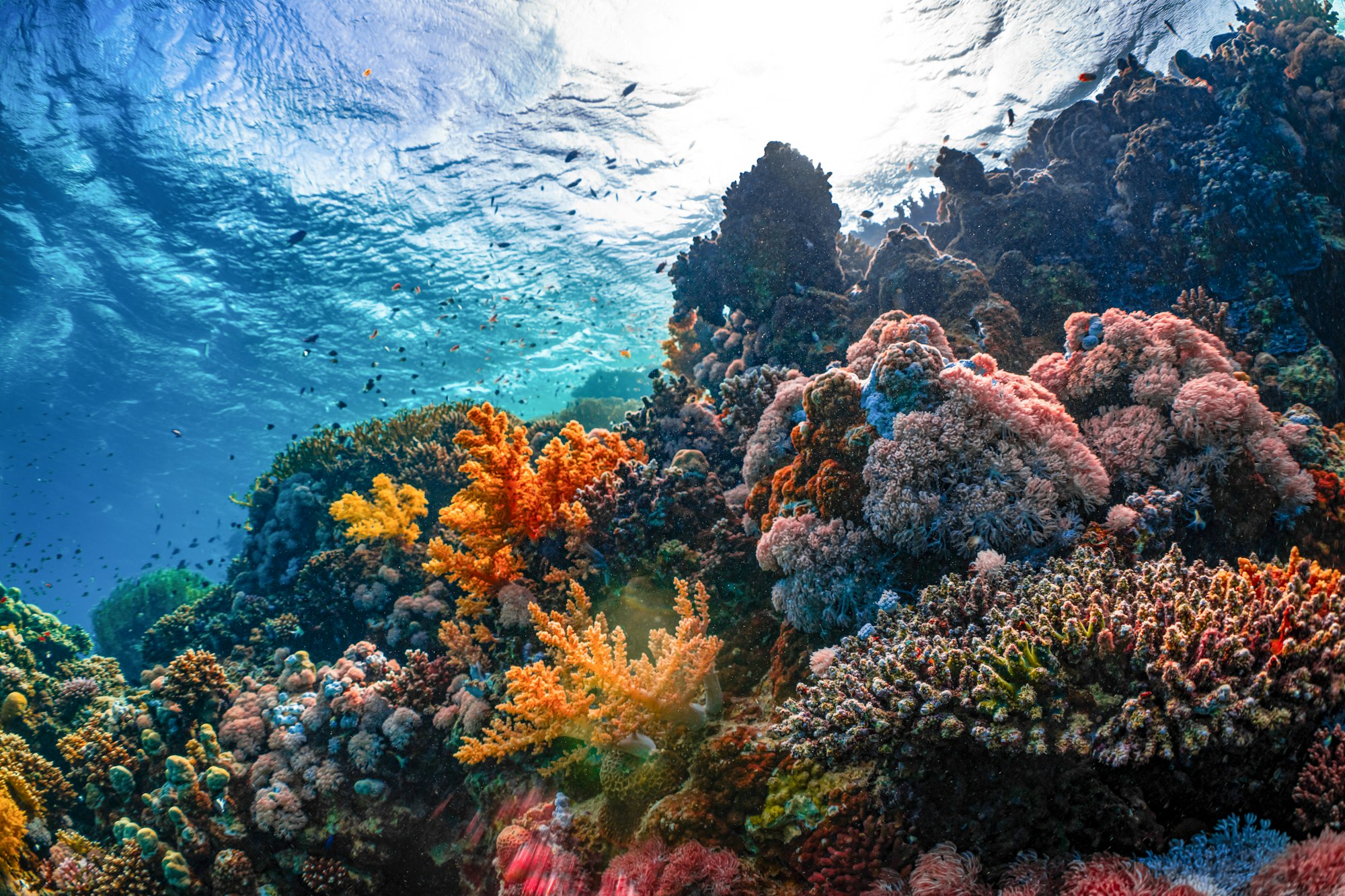
The Kensho Maru benefits from lighter diver traffic, and the coral growth reflects it. Hard corals and soft corals cover the superstructure, masts, and deck fixtures in healthy abundance. Sea fans and gorgonians grow along railings and cable runs. The upper masts carry dense coral colonies.
Resident fish populations are robust. Schools of fusiliers and surgeonfish circle the wreck. Batfish aggregate near the superstructure. Inside the holds and corridors, glassy sweepers and cardinalfish form dense clouds. Lionfish and scorpionfish are plentiful. No site-specific marine life reports were found for this wreck beyond the reef fish and shark species typical of Chuuk Lagoon generally.
Dive Profile
Descend the mooring line to the deck at approximately 18-22 meters. The bridge superstructure is accessible and well-preserved, with ship’s fittings and equipment still recognizable. Explore the bridge level before moving deeper.
The interior of the Kensho Maru has the character of a ship set up for repair work — workshops with tools, valves, gauges, and instruments are found in the enclosed spaces. There are also accessible swim-throughs. Bottom time at this depth is limited, so prioritize what you want to see.
Work back to shallower depths along the deck. The masts and upper superstructure at 10-15 meters offer excellent coral viewing and extend your dive during your safety stop. The wreck’s compact ~116-meter length means a single dive can cover a reasonable portion of the ship.
Entry and Exit
Boat dive from Weno-based operators, approximately 20-30 minutes to the site. A mooring buoy is in place. Enter by giant stride and descend the mooring line. The lagoon provides calm surface conditions. Ascend via the mooring line and complete a safety stop at 5 meters. Given the 40-meter depth, plan conservatively for potential decompression obligations.
Tips and Recommendations
- Dive this wreck for the experience of exploring without crowds — request it specifically from your operator if it is not on the standard itinerary
- Nitrox is strongly recommended to extend bottom time at the 18-22 meter deck level; bottom time at 40 meters on air is very short
- The compact size makes this a satisfying single-dive wreck — you can see the key features in one well-planned dive
- Pair with a shallower wreck like the Sankisan Maru for a comfortable two-dive day
- Carry a strong primary torch for the holds — the deeper depth means less ambient light than shallower wrecks
Safety Considerations
The Kensho Maru is a war grave and all artifacts are protected by law. While the “mines and munitions” claim has been removed as unverified, any wreck from Operation Hailstone may contain ordnance — do not touch or disturb any unidentified cargo. The approximately 40-meter maximum depth is the primary safety concern: bottom time on air is limited, and nitrogen narcosis is a factor for many divers at this depth. Plan gas supply carefully and carry adequate reserves. Interior penetration in the superstructure and holds requires wreck certification, redundant lights, and awareness of silt conditions.
Photography
The Kensho Maru rewards photographers willing to work at depth. The workshops and tools in the interior spaces make evocative subjects — wrenches, gauges, and valves in place tell the story of a vessel interrupted mid-repair. The coral-covered masts and superstructure at shallower depths provide colorful wide-angle compositions with natural light. The swim-throughs within the superstructure create opportunities for silhouette shots with divers framed in ambient-lit openings. The absence of crowds means clean shots without other divers in frame — a significant advantage over marquee wrecks. The deeper depth challenges exposure and color; bring strong video lights or wide-beam strobes to compensate for the reduced ambient light at 30-40 meters. Note: the “mines and shells” mentioned in earlier versions of this description were removed as unverified — photograph what you find, not what is assumed to be there.
Sources: Dive3D - Kensho Maru, Evolution Underwater - Sinking of the Kensho Maru, Diver Trek - Truk Lagoon Ghost Fleet. Last updated 2026-05-22. Correction 2026-06-16: Photography section updated to remove references to “mines and shells” that were inconsistent with Overview, which noted this claim was removed as unverified.
Sea-surface temperature and wave height from Open-Meteo Marine (ERA5 reanalysis, monthly averages).
2568 verified species observations (177 species) logged within ~11 km of this site between 1949 and 2014, from the Ocean Biodiversity Information System.
- Ctenochaetus striatus · Small-bodied acanthurid
- Scaridae · Small-bodied parrotfish
- Hipposcarus longiceps · Large-bodied parrotfish
- Chlorurus sordidus · Small-bodied parrotfish
- Scarus psittacus · Small-bodied parrotfish
- Chlorurus bleekeri · Small-bodied parrotfish
- Monotaxis grandoculis · Large-bodied emperor
- Chordata
- Siganus doliatus · Rabbitfish
- Scarus rivulatus · Small-bodied parrotfish
- Scarus dimidiatus · Small-bodied parrotfish
- Scarus globiceps · Small-bodied parrotfish
Scientific survey records skew toward sampled taxa (molluscs, corals) and do not reflect what you are guaranteed to see on a dive.
Source: OBIS (obis.org), aggregated Darwin Core occurrence records.
Conditions change with the tide and the season. If you have dived this site, share what it was actually like — date, visibility, current, and what you saw. Real, recent reports from divers are exactly what this guide is built to collect.
Send a conditions report ›